
Handling expired controlled substances isn’t just about cleaning out a cabinet-it’s a legal, safety, and ethical responsibility. If you’re a pharmacist, doctor, vet, or even a researcher working with narcotics like oxycodone, fentanyl, or diazepam, you can’t just toss them in the trash or flush them down the sink. Doing so risks diversion, environmental harm, and serious legal consequences. The DEA doesn’t allow guesswork. There are strict rules, and they’re enforced.
Why You Can’t Just Throw Them Away
Controlled substances are classified by schedule based on abuse potential. Schedule II drugs like morphine and Adderall have high addiction risk. Schedule III-V drugs like ketamine or low-dose codeine are less risky but still tightly regulated. Even if a pill is expired, it’s still a controlled substance. That means it can be stolen, sold, or misused. In 2022, 14.3% of veterinary drug diversion cases were linked to improper disposal, according to the American Veterinary Medical Association. And in healthcare settings, poorly documented waste accounts for nearly 1 in 5 compliance failures.The DEA’s main goal? Prevent these drugs from ever reaching the streets. That’s why they require you to render them non-retrievable. Crushing them into powder and dumping them in the sink? Illegal. Mixing them with coffee grounds or kitty litter? That works for regular painkillers, but not for controlled substances with recoverable amounts. The FDA says so, and the DEA enforces it.
What the Law Requires
The rules come from Title 21 of the Code of Federal Regulations, specifically Part 1317, which was finalized in 2014 after the Secure and Responsible Drug Disposal Act of 2010. This law gave the DEA the power to set clear disposal standards. Since then, the only approved method for destroying large quantities of controlled substances is incineration by a DEA-registered reverse distributor. That’s a company licensed to take back and destroy these drugs.There are two types of disposal: inventory disposal and wastage.
- Inventory disposal means getting rid of entire bottles, vials, or stock you no longer need. This requires a reverse distributor. You can’t do this yourself.
- Wastage is when you spill or waste a small amount during administration-like a few drops of an injection. In this case, two authorized people can witness and document the destruction on-site.
For Schedule I and II substances, you must use DEA Form 222 to transfer them to a reverse distributor. Since January 1, 2023, this form must be filed electronically through the DEA’s Electronic Registration System (ERS). Paper forms are no longer accepted. The system used to take over a week to process. Now, it’s under two days.
For Schedule III-V, you still need to document everything: the date, the quantity, the name of the person who destroyed it, and who witnessed it. But you don’t always need Form 222. Some states allow certain types of on-site destruction for these lower-schedule drugs, but only if you meet strict witness and recordkeeping rules.
Step-by-Step Disposal Process
If you’re responsible for disposing of expired controlled substances, here’s what you need to do:- Label everything clearly. Put a red sticker on every bottle, vial, or package that says “Expired - Do Not Use” or “To Be Disposed.” Keep these separate from active inventory. Store them in a locked, secure area-preferably inside a double-locked cabinet or a dedicated DEA-compliant storage unit.
- Track your inventory. Every time you receive or use a controlled substance, log it. When you identify something expired, add it to your disposal log. Include the drug name, strength, quantity, lot number, and expiration date. This log is your legal record.
- For inventory: Contact a reverse distributor. Companies like Stericycle, Daniels Health, and Drug and Laboratory Disposal, Inc. (DLD) handle this. They’ll send you a pre-labeled shipping box. You pack the drugs, sign the chain-of-custody form, and schedule a pickup. Fees range from $250 to $500 per pickup, depending on volume and location. Smaller practices often group shipments with nearby clinics to split costs.
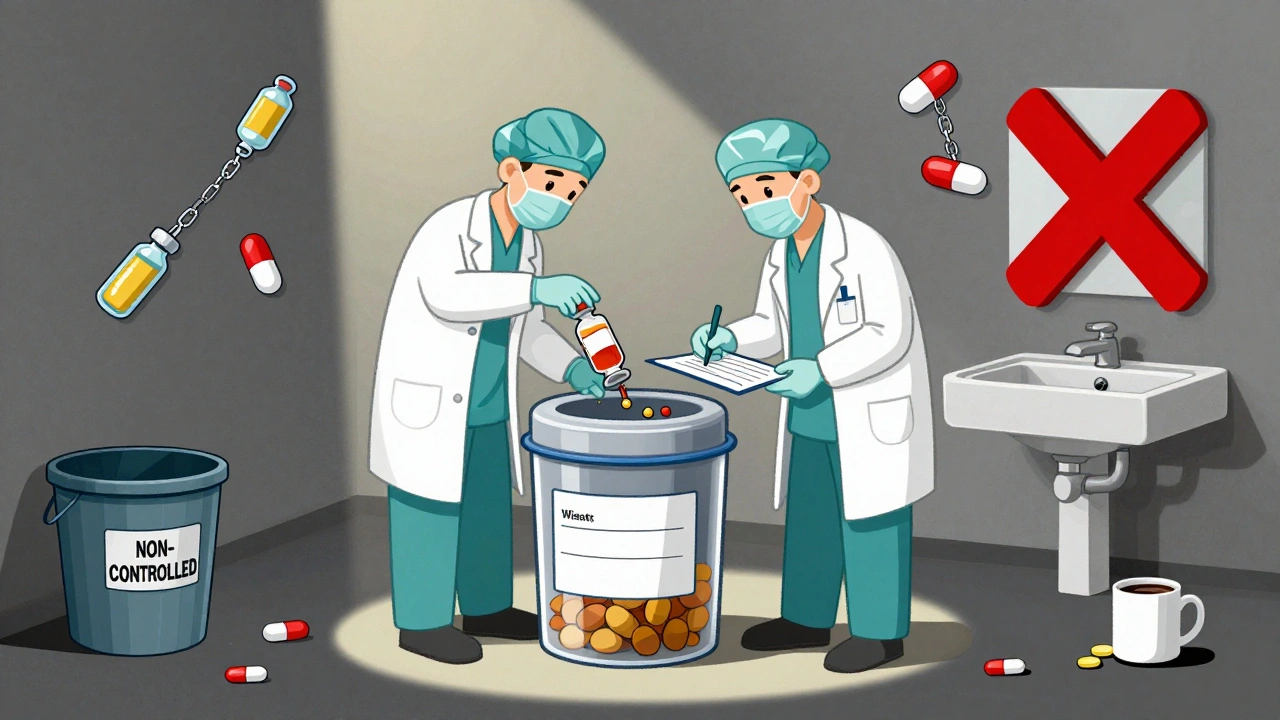
- For wastage: Two witnesses, one log. If you’re disposing of a small amount (like leftover liquid from an injection), two authorized people must be present. One must be the registrant or an authorized agent. They both sign a form confirming the drug was destroyed-usually by pouring it into a sharps container or mixing it with an absorbent agent in a sealed bag. The log must include names, dates, drug details, and method.
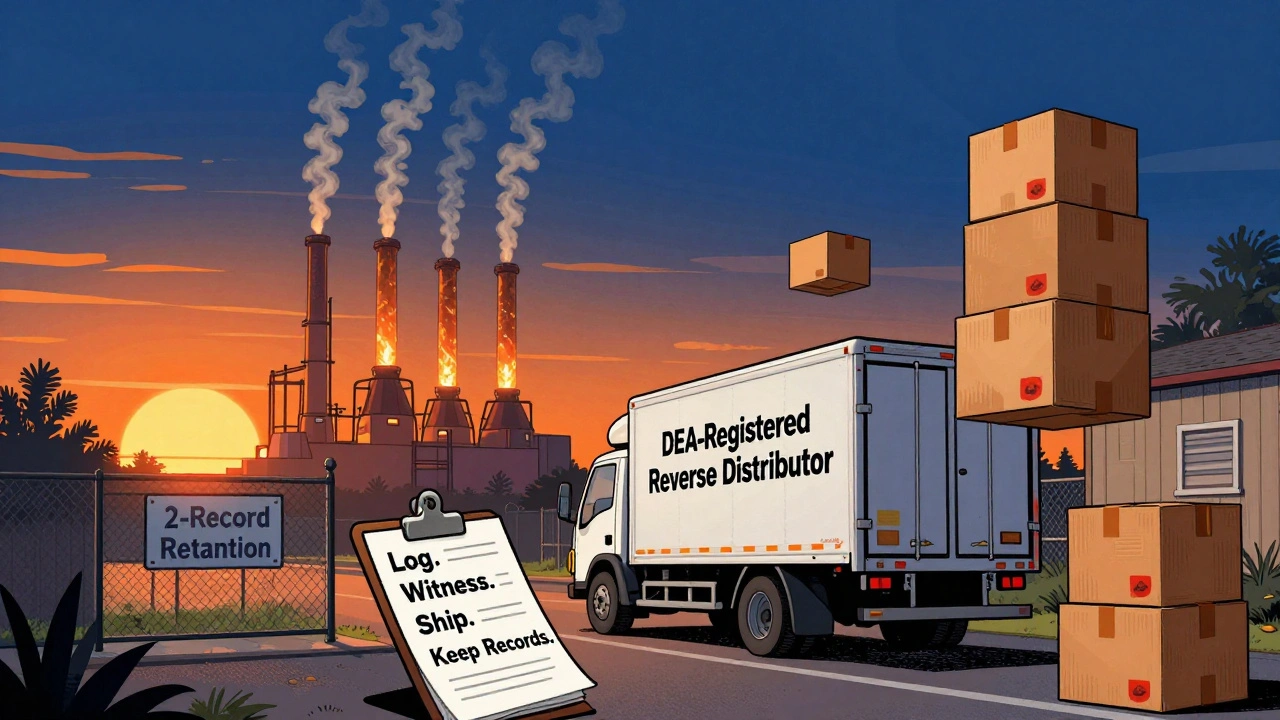
- Keep records for two years. The DEA requires all disposal records to be stored for at least 24 months. That includes Form 222 copies, chain-of-custody forms, wastage logs, and pickup receipts. Audit teams show up unannounced. If you can’t produce them, you’re looking at fines or loss of your DEA registration.
What Happens After You Ship It
Once the reverse distributor picks up your drugs, they’re taken to a licensed incineration facility. The DEA only recognizes incineration as a method that makes the substance truly non-retrievable. No other method-chemical neutralization, landfill burial, or even autoclaving-meets federal standards. The facility must issue a certificate of destruction, which you keep on file. That’s your proof you followed the law.Some large hospitals use on-site incinerators, but they require special permits and environmental controls. For most clinics, dental offices, and vet practices, outsourcing to a reverse distributor is the only practical option.
Common Mistakes and How to Avoid Them
Even experienced professionals mess this up. Here are the top errors-and how to fix them:- Mixing controlled substances with regular trash. This is a red flag for DEA inspectors. Always keep them separate. Use dedicated bins or containers labeled for controlled waste.
- Forgetting to update inventory logs. If your system shows you have 50 tablets but you only have 45, you need to explain the missing five. If you didn’t document disposal, you’re suspected of diversion.
- Waiting too long to schedule pickup. A University of Michigan survey found 63% of labs waited over two weeks for a reverse distributor. That’s risky. Expired drugs sitting around are a target for theft. Schedule pickups as soon as you identify waste.
- Not training staff. Only 67% of facilities met the DEA’s minimum training requirement in 2022. Everyone who handles these drugs needs a 2-hour initial training and a 1-hour refresher every year. Use free DEA materials or hire a compliance consultant.
- Using blue pads or sink disposal. These are explicitly banned for controlled substances. The DEA’s 2023 guidelines are crystal clear: “Flushing, pouring down drains, or using absorbent pads is not acceptable.”
What’s Changing in 2025
The DEA is rolling out the Electronic Inventory Management System (EIMS) by the end of 2025. This will require real-time reporting of all controlled substance movements-including disposal. Instead of waiting to file paperwork after the fact, you’ll log waste as it happens. This is a big shift. It’s meant to cut down on fraud and improve accountability.Meanwhile, reverse distributor fees are rising. They went up 6.8% last year. And compliance inspections are increasing too. In 2022, the DEA conducted 1,847 inspections and issued 327 warning letters. Fines totaled over $2.4 million. The message is clear: they’re watching.
What If You’re a Small Vet or Clinic?
If you’re a solo vet or a small dental office, you’re not alone. Many struggle with cost and logistics. The DEA’s online disposal locator tool (updated November 2022) can help you find a nearby reverse distributor. Some states offer group disposal programs for small practices. Ask your state pharmacy board. You can also partner with a nearby hospital or larger clinic to share a pickup. Don’t skip compliance because it’s inconvenient. The risk isn’t just legal-it’s public safety.Final Reminder: Documentation Is Your Shield
The DEA doesn’t care if you meant well. They care if you have a signed, dated, witnessed, and properly stored record that proves you followed the rules. One missing signature. One unlogged vial. One late pickup. That’s enough to trigger an investigation.Set up a simple system: a locked box for expired drugs, a logbook (digital or paper), two trained staff members, and a scheduled pickup every quarter. That’s it. No fancy software. No expensive equipment. Just consistency. That’s what keeps your practice legal, safe, and trusted.
Can I dispose of expired controlled substances in the regular trash?
No. Disposing of expired controlled substances in the regular trash is illegal under DEA regulations. These drugs must be rendered non-retrievable through incineration by a DEA-registered reverse distributor. Even small amounts require proper documentation and witness procedures. Throwing them away risks diversion, environmental contamination, and serious legal penalties.
What’s the difference between Schedule II and Schedule III-V disposal?
Schedule II substances (like oxycodone, fentanyl, Adderall) require DEA Form 222 and must be transferred to a reverse distributor for destruction. You cannot destroy them on-site. Schedule III-V substances (like ketamine, hydrocodone combinations) can sometimes be destroyed on-site by two authorized personnel, as long as you document the process and retain records for two years. But even then, you can’t flush, pour, or mix them with absorbents-you must use a secure, witnessed method like incineration in a sealed container.
Do I need to train my staff on disposal procedures?
Yes. The DEA requires all personnel who handle controlled substances to complete an initial 2-hour training and a 1-hour annual refresher. This includes pharmacists, nurses, vets, and even administrative staff who store or log these drugs. Training covers legal requirements, documentation, and safe handling. Failure to train staff is one of the most common reasons for DEA compliance violations.
Can I use kitty litter or coffee grounds to dispose of expired narcotics?
No. While the FDA recommends this method for non-controlled medications like acetaminophen or ibuprofen, it is explicitly prohibited for controlled substances with recoverable amounts. The DEA states that these methods do not render the drug non-retrievable. Using kitty litter or coffee grounds for narcotics could lead to fines, loss of your DEA registration, or criminal charges if the drugs are recovered and diverted.
How long do I need to keep disposal records?
You must keep all disposal records-including DEA Form 222, wastage logs, chain-of-custody forms, and destruction certificates-for at least two years. The DEA conducts random audits, and if you can’t produce these records, you may face penalties, warnings, or suspension of your ability to handle controlled substances. Digital backups are allowed, but they must be secure and easily retrievable.
Next Steps
If you’re unsure where to start:- Check your DEA registration status. If it’s expired, renew immediately.
- Review your current inventory. Label all expired or unused controlled substances.
- Contact a DEA-registered reverse distributor. Use the DEA’s online locator tool to find one near you.
- Train your team. Use free DEA materials or hire a compliance trainer.
- Set a quarterly disposal schedule. Don’t wait until you have a full cabinet.
Proper disposal isn’t optional. It’s part of your duty to protect patients, your practice, and the community. Follow the rules. Document everything. And never assume someone else will handle it.



Gene Linetsky
2 December, 2025 . 05:28 AM
They’re lying to you. The DEA doesn’t care about public safety-they care about control. Reverse distributors? Private contractors with ties to private prisons. Incineration? A profit scheme. You think they’re stopping diversion? Nah. They’re making sure YOU can’t access your own meds without paperwork. And don’t get me started on the ‘electronic inventory system’-that’s surveillance with a side of fines. They want you scared, dependent, and paying for every damn pill.
My cousin’s vet got audited for ‘missing’ two vials of ketamine. Turned out the cat died. They didn’t even let him flush it. Had to pay $400 to ship it to a company that burns it in Ohio. Meanwhile, the DEA’s own data says 98% of diverted drugs come from prescriptions-NOT disposal. So who’s really the threat here?
They don’t want you to know this, but the ‘non-retrievable’ standard? It’s a myth. I’ve seen the incineration reports. They still recover trace amounts. They just don’t test for it. It’s theater. All theater.
Vincent Soldja
4 December, 2025 . 02:34 AM
This post is accurate but overly verbose. The rules are simple: don't flush, don't trash, document everything. The rest is noise.
Makenzie Keely
4 December, 2025 . 04:01 AM
Oh my goodness, thank you SO MUCH for this comprehensive breakdown!! I’ve been a pharmacy tech for 12 years and I’ve seen so many clinics panic over expired meds-some even tried to bury them in the backyard (yes, really).
Just yesterday, a small animal clinic in Iowa called me in a panic because their vet thought kitty litter was ‘good enough’ for fentanyl. I sent them the DEA’s 2023 guidelines with the exact quote: ‘Flushing, pouring down drains, or using absorbent pads is not acceptable.’ They cried. Then they called Stericycle. And now they’re compliant.
Documentation isn’t bureaucracy-it’s your lifeline. I keep my logs in a password-protected Google Sheet with timestamps and witness initials. It’s saved me twice during audits. And yes, training matters! I made a 10-minute video for our staff with memes and a quiz. They actually remembered it.
Also-yes, fees are rising. But if you’re a solo vet, team up with three other clinics. Split the pickup. Share the cost. The DEA doesn’t care if you’re small-they care if you’re responsible. You’ve got this. And if you’re reading this? You’re already doing better than 70% of providers. Keep going!! 💪✨
Charles Moore
5 December, 2025 . 14:14 PM
Really appreciate the clarity here. I’m a vet in Ireland and we have slightly different rules, but the core principle is the same: if it’s controlled, treat it like a live grenade.
Here, we can destroy Schedule IV/V drugs on-site with witness logs, but even then, we use a sealed chemical neutralization kit-not coffee grounds, not kitty litter, not ‘whatever’s handy.’ The EU’s guidelines are strict, but they’re also practical. What I love about your post is how it centers accountability without fearmongering.
One thing I’d add: don’t wait for an audit to start. Set a calendar reminder. Every quarter. Same day. Even if you have nothing to dispose of, log it as ‘zero.’ That silence speaks volumes during inspections.
And if you’re a small practice? You’re not alone. Reach out to your national pharmacy board. They have grants for disposal programs. We got one last year-it covered 80% of our costs. You just have to ask.
Gavin Boyne
5 December, 2025 . 16:13 PM
Let’s be real-the DEA’s whole system is a tax on responsibility.
You follow every rule, log every pill, pay $500 to ship your expired oxycodone to a facility that burns it in a state you’ve never heard of, and what do you get? A pat on the back from a government that arrested a cancer patient for possessing a single pill without a prescription last month.
Meanwhile, the real problem? Doctors overprescribing. Pharmacies not checking scripts. People hoarding meds because they’re afraid to ask for refills.
But no, let’s focus on the vet who forgot to stamp the disposal log. That’s the crisis. That’s the enemy.
It’s not about safety. It’s about control. And the people who follow the rules? They’re just the ones who got scared enough to obey.
Still, I’ll admit-this post is the most accurate thing I’ve read on the topic. So… thanks? I guess.
Rashi Taliyan
6 December, 2025 . 23:19 PM
My heart is pounding just reading this. I am a nurse in India and I have seen so many people throw away pills like trash-sometimes even in rivers. I cried the first time I saw a child pick up a crushed fentanyl tablet from a gutter. How can we change this? How can we reach the villages? The cities? The pharmacies that don’t even know what Schedule II means?
I want to translate this into Hindi and Tamil. I want to make posters with pictures of pills and red X’s over trash cans. I want to go door to door. I want to scream into the wind. But I don’t have the resources. And now I’m scared-what if someone finds my expired morphine patch and thinks it’s candy?
Please, someone-help me. How do I start?
Rashmin Patel
7 December, 2025 . 03:24 AM
Yessssss!!! This is exactly what we need!! 🙌💖
I work in a rural clinic in Tamil Nadu and we have zero access to reverse distributors. We’ve been holding onto expired meds for over a year because we didn’t know what to do. I’ve been sleeping with the locked box under my bed. I keep checking the DEA website every day like it’s a dating app. ‘Has anything changed? Is there a new rule? Did they finally open a disposal center near Chennai?’
But now-I’m not alone. I found this. I printed it. I laminated it. I showed my entire team. We’re calling the state pharmacy board tomorrow. We’re emailing Stericycle. We’re forming a coalition with three other clinics. We’re not waiting anymore.
Thank you for writing this like you actually care. Like you know we’re out here trying. Like you know we’re scared. We’re not lazy. We’re just invisible. And now? We’re seen. 💪🩹🩺
sagar bhute
8 December, 2025 . 17:22 PM
This is a waste of time. All this paperwork is for suckers. I’ve been a pharmacist for 20 years and I’ve never once followed these rules. No one does. The DEA doesn’t have enough agents to inspect every clinic. You think they care about a few expired pills? They care about the big players-the distributors, the pharma execs, the doctors who push opioids. You’re just a pawn. Throw it in the trash. No one’s coming for you. And if they do? Lie. Say it was stolen. Everyone does.
Cindy Lopez
9 December, 2025 . 15:07 PM
The section on Schedule III-V disposal contains a factual error. The DEA does not permit on-site destruction for Schedule III-V drugs without specific state authorization, and even then, incineration is still required. The post incorrectly implies that witness documentation alone suffices.
James Kerr
10 December, 2025 . 15:43 PM
This is gold. Seriously. I’m a small-town dentist and I was about to toss a bottle of expired hydrocodone in the trash. Then I saw this. I called a reverse distributor today. They came out for $150. I felt like a hero. My assistant high-fived me. We’re doing it right. 😊👍
shalini vaishnav
11 December, 2025 . 23:06 PM
This is American bureaucratic nonsense. In India, we have no such systems. We use traditional methods-burning in open pits, burying in temple grounds. Why should we adopt your archaic, over-regulated, capitalist disposal model? Your laws are designed to enrich corporations, not protect people. We know our culture. We know our land. We don’t need your DEA to tell us how to handle our medicine.
vinoth kumar
13 December, 2025 . 07:25 AM
I’m a pharmacy intern in Bangalore and I’m so glad I found this. I’ve been trying to explain to my boss why we can’t just throw out expired tramadol. He thinks it’s ‘just old medicine.’ Now I can send him this link. We’re going to start a small awareness campaign in our community. Maybe we can even partner with a local NGO. Thanks for the clarity!
bobby chandra
14 December, 2025 . 23:04 PM
Let’s talk about the real villain here: the pharmaceutical industry.
They make the drugs. They push the prescriptions. They design the packaging so you can’t even open it without scissors. Then they charge you $200 for a bottle of pills that expire in 18 months. And when you’re left holding the bag-literally-they hand you a 20-page compliance manual and say, ‘Dispose of this responsibly.’
Meanwhile, they’re lobbying Congress to extend patent life, raise prices, and block generic alternatives. They profit whether you take the pill or burn it.
So yeah-follow the rules. Document everything. Pay the $500.
But don’t forget who’s really pulling the strings.
And if you’re a small clinic? You’re not just complying-you’re resisting. Keep fighting.
Archie singh
15 December, 2025 . 12:46 PM
This is performative compliance. You think your logbook saves you? You think your reverse distributor gives a damn? The DEA audits 1 in 1000 practices. The rest? They’re just scared. You’re paying $500 to feel safe. Meanwhile, the real drug crisis is in the supply chain-not your expired vial. You’re the patsy. Wake up.