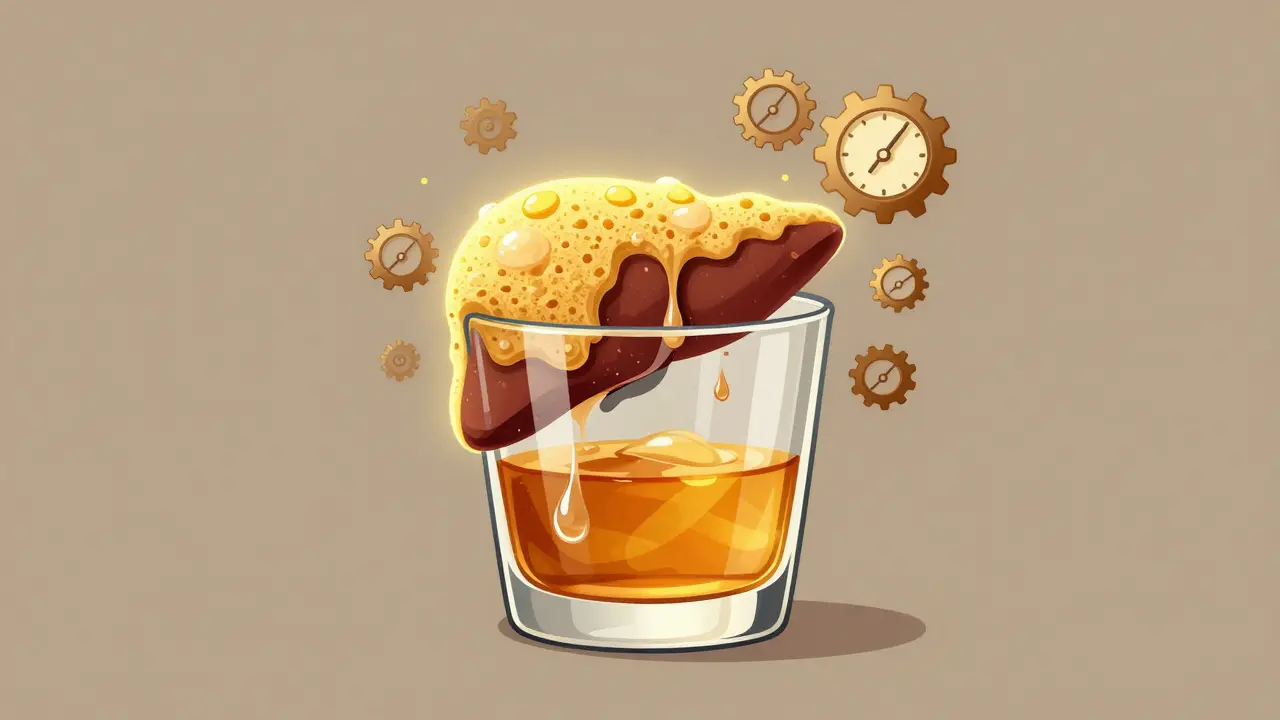
When you hear "liver damage from alcohol," you might picture someone who drinks every day, maybe even binge-drinks on weekends. But the truth is more subtle - and more dangerous. Liver damage doesn’t wait for addiction to set in. It starts quietly, often without symptoms, and progresses in stages you might never notice until it’s too late. This isn’t about moral judgment. It’s about biology. Your liver processes alcohol. But it has limits. And when you cross them, even once in a while, the damage begins.
Stage 1: Fatty Liver (Steatosis)
This is where it all starts. More than 90% of people who drink more than 3-4 standard drinks a day develop fatty liver. That’s not an exaggeration. It’s science. In just 3 to 5 days of heavy drinking, fat begins to build up in liver cells. The liver gets swollen, greasy, and overloaded. It’s called hepatic steatosis - or alcoholic fatty liver disease.
Here’s the kicker: you probably won’t feel a thing. No pain. No jaundice. No fatigue. Blood tests might show slightly elevated liver enzymes - especially AST and ALT, with AST usually higher than ALT. But most people never get tested. They don’t think they need to. That’s why 65% of patients in one UK survey only found out they had liver damage after they turned yellow.
Good news? This stage is 100% reversible. If you stop drinking for 4 to 6 weeks, your liver can clear out the fat. A 2017 study found 85% of people who quit alcohol during this phase saw their liver return to normal. No meds. No surgery. Just abstinence. The liver is an amazing organ - if you give it a chance.
Stage 2: Alcoholic Hepatitis (Alcohol-Associated Hepatitis)
Now imagine you kept drinking. Maybe you didn’t think it was a big deal. You were still working. Still socializing. Still feeling fine. But inside, inflammation is growing. This is alcoholic hepatitis - now called alcohol-associated hepatitis (AH) to reduce stigma. It’s not just fat anymore. It’s immune cells attacking liver tissue. Scar tissue begins to form.
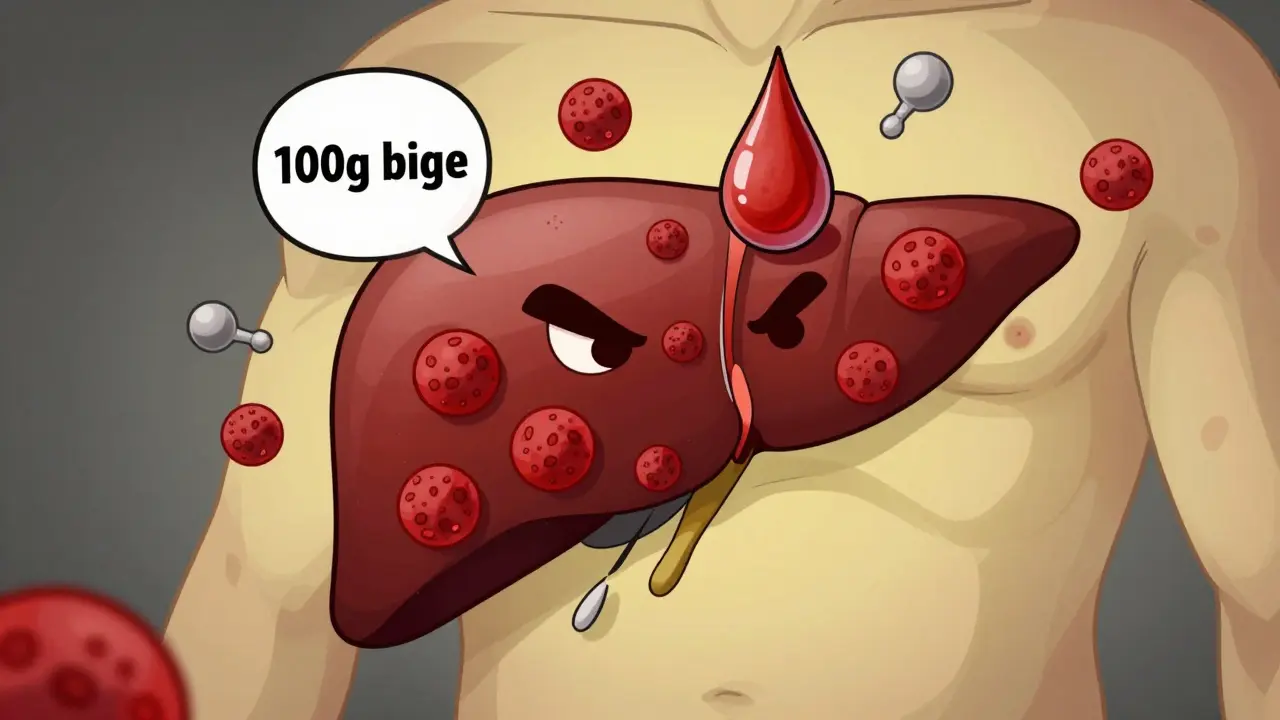
It usually takes years of heavy drinking - around 60-80 grams of alcohol daily (that’s 5-6 drinks). But some people develop it after a single binge. A 100-gram alcohol spike in one day - say, a night out drinking hard liquor - can trigger acute hepatitis in someone who’s been drinking regularly.
Symptoms start showing up now. Jaundice - yellow skin and eyes. Belly swelling from fluid buildup (ascites). Fever. Nausea. Loss of appetite. Fatigue that doesn’t go away. If you’re in this stage, your doctor will likely run a Maddrey Discriminant Function (mDF) score. If it’s above 32, you have severe AH. That means a 30-40% chance of dying within 30 days if you keep drinking.
But here’s the hope: even severe AH can improve. Steroids like prednisolone can cut death rates. The STOPAH trial showed a drop from 20% to 18% in 28-day mortality. And if you stop drinking? Survival jumps. The liver can repair some of the damage - if you act fast. But if you keep drinking? You’re almost certainly heading to the next stage.
Stage 3: Cirrhosis
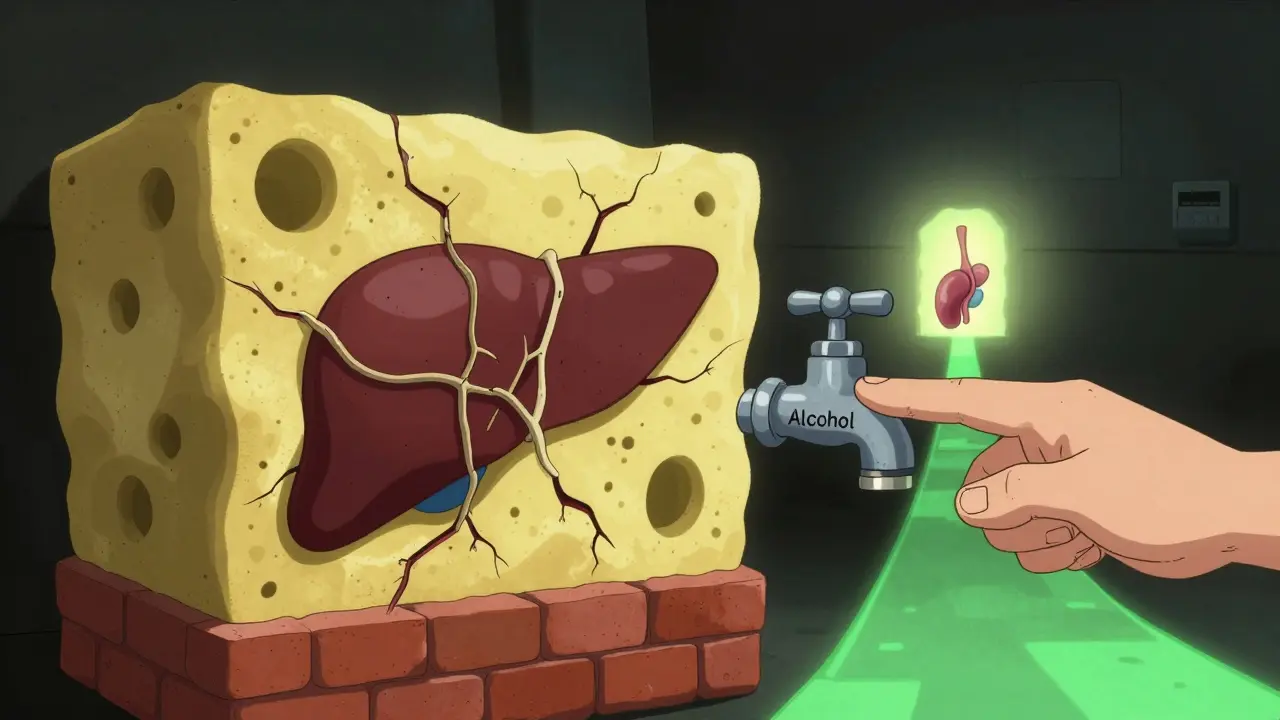
Cirrhosis is when the liver turns into scar tissue. Not just patches. Not just some. More than 75% of the healthy liver structure is replaced by fibrous scars. It’s like replacing a sponge with a brick. This stage is called Metavir F4. It’s the final stage before liver failure.
It develops in 10-20% of chronic heavy drinkers. But it’s not random. Women are 2-3 times more likely to get it at lower doses. Genetics matter too - certain gene variants like PNPLA3 make some people far more vulnerable. And if you have metabolic syndrome - high blood pressure, belly fat, diabetes - your risk skyrockets.
At this point, symptoms get serious. Fluid builds up in the belly. You might bleed from swollen veins in your esophagus (varices). Your brain gets foggy because toxins your liver can’t filter start building up (hepatic encephalopathy). Your kidneys start to fail. You’re at risk for liver cancer - 3-5% of cirrhotic patients develop it every year.
Is it reversible? Not really. But stopping alcohol can still save your life. In compensated cirrhosis - where the liver still works - abstinence increases 5-year survival from 30% to over 70%. One study showed people who quit after diagnosis lived 12+ years. Those who kept drinking? Median survival: just 1.8 years.
Liver transplant is the only cure. But most centers require 6 months of verified sobriety before listing. It’s not punishment. It’s proof you can stick with treatment. And the results? 70-75% survive five years after transplant. That’s better than many cancers.
What Makes Progression Faster?
Not everyone who drinks develops cirrhosis. Why? Because alcohol isn’t the only player.
- Gender: Women process alcohol slower. Their bodies have less water and fewer enzymes to break it down. So they get damage at lower doses.
- Genes: If you carry the PNPLA3 gene variant, your risk of fatty liver and fibrosis jumps dramatically.
- Other liver diseases: If you have hepatitis B or C - even if it’s mild - alcohol accelerates scarring. Same with NAFLD (fatty liver from obesity). Even moderate drinking speeds up fibrosis in these people.
- Age: People over 40 are more vulnerable. But the fastest-growing group? Young adults. Between 2010 and 2020, hospitalizations for ALD in 25-34-year-olds rose 65%, especially among women.
And here’s something rarely talked about: stigma. A 2022 survey found 45% of patients said doctors judged them instead of helping. That’s deadly. People hide their drinking. They delay care. They don’t get tested. The language matters. "Alcohol-associated" isn’t just politically correct - it’s more accurate. You don’t have to be "addicted" to damage your liver. You just have to drink too much, too often.
How Do You Know If You’re at Risk?
You don’t need a liver biopsy anymore. Tools like FibroScan (transient elastography) can detect fibrosis with 85-90% accuracy. Blood tests are improving too. A new biomarker panel called "ALive" is in phase 3 trials and can spot early fibrosis without a needle.
If you drink regularly - even just a few drinks a week - ask your doctor for:
- Liver enzyme tests (AST, ALT, GGT)
- AST/ALT ratio (if AST is more than double ALT, that’s a red flag)
- FibroScan or ultrasound if you’re over 40 or have other risk factors
And if you’ve ever been told your liver enzymes are high? Don’t brush it off. That’s your body screaming.
What Can You Do?
It’s not about quitting forever. It’s about giving your liver a break.
- Stage 1: Stop drinking for 6 weeks. You’ll likely see full recovery.
- Stage 2: Quit now. Get medical help. Steroids can save your life.
- Stage 3: Quit. Period. Your survival depends on it. Combine hepatology care with addiction counseling - studies show abstinence rates jump from 35% to 65% with dual support.
There’s new hope on the horizon. Fecal microbiota transplants (FMT) improved 90-day survival by 40% in early trials. Anti-inflammatory drugs like emricasan are being tested. But none of this matters if you keep drinking.
The most powerful treatment isn’t a pill. It’s not a transplant. It’s stopping.
One patient from Cleveland Clinic’s case study put it simply: "At 38, I was told I had fatty liver. I quit drinking. Six months later, my liver enzymes were normal. I didn’t even feel different - but my liver did."
Another, from a Mount Sinai study, said: "I had three hospital stays for hepatitis. I thought I was fine after each one. Then I got cirrhosis. By then, it was too late to fix it."
It’s not about guilt. It’s about timing. Your liver doesn’t care if you’re "a real drinker." It only cares if you give it rest.
Can you reverse alcoholic liver disease?
Yes - but only if you stop drinking early. Fatty liver (stage 1) can fully reverse in 4-6 weeks of abstinence. Alcoholic hepatitis (stage 2) can improve with treatment and quitting, though some scarring may remain. Cirrhosis (stage 3) is permanent, but stopping alcohol can stop further damage and dramatically improve survival. The key is timing: the earlier you quit, the better your chances.
How much alcohol causes liver damage?
There’s no safe threshold, but damage starts with regular consumption above 3-4 standard drinks per day. Women are at higher risk - as little as 2-3 drinks daily can lead to fatty liver. Heavy drinking (6+ drinks daily for men, 4+ for women) over 5-10 years significantly increases risk of hepatitis and cirrhosis. Even moderate drinking (1-2 drinks daily) can worsen existing liver conditions like NAFLD.
Do you have to be an alcoholic to get alcoholic liver disease?
No. The term "alcoholic" is outdated and misleading. You don’t need to be dependent on alcohol to damage your liver. Many people with advanced liver disease never met criteria for alcohol use disorder. The key factor is the amount and duration of alcohol consumed - not whether you consider yourself an "alcoholic." That’s why medical guidelines now use "alcohol-associated liver disease" to focus on the cause, not the person.
Can a liver transplant cure alcoholic liver disease?
Yes - but only if you stop drinking. Liver transplant is the only cure for end-stage cirrhosis. However, most transplant centers require at least 6 months of verified abstinence before listing. This isn’t punishment - it’s a predictor of long-term success. Studies show patients who quit alcohol before transplant have 70-75% survival at 5 years. Those who continue drinking after transplant rarely survive beyond a year.
What are the warning signs of advanced liver damage?
Yellow skin or eyes (jaundice), swelling in the belly (ascites), confusion or memory problems (hepatic encephalopathy), vomiting blood, or dark, tarry stools are major red flags. These mean your liver is failing. If you have any of these, seek emergency care. Even if you’ve never been diagnosed with liver disease, these symptoms can be your first sign.
Alcohol-related liver disease isn’t a punishment. It’s a biological consequence. And like any consequence, it has a window - a chance to change course. The clock starts ticking the moment you take your first drink. But it doesn’t stop until you stop.


Milad Jawabra
5 March, 2026 . 02:47 AM
Look, I’ve been there - 5 drinks a night, "just unwinding," until my AST was through the roof. No symptoms. Felt fine. Then my doc said, "You’re one binge away from hepatitis." I quit cold turkey. 6 weeks later, my liver enzymes were normal. No magic pill. Just stopped. Your liver doesn’t care if you’re "an alcoholic." It just wants a break. Give it one.
And yeah, I use emojis. 🍻➡️🩺. Don’t judge. I’m still alive.
marjorie arsenault
7 March, 2026 . 01:36 AM
I’m a nurse. I’ve seen this too many times. People think if they’re not "hungover every Monday," they’re fine. Nope. Fatty liver doesn’t scream. It whispers. And by the time it yells - jaundice, swelling, confusion - it’s too late for some.
Stop waiting to feel sick. Get tested. Even if you drink 2 glasses of wine a night. Even if you’re "not addicted." Your liver isn’t asking for permission. It’s just doing its job. Give it a rest.
Donna Zurick
7 March, 2026 . 01:50 AM
I got my first liver test at 35 because my mom had cirrhosis. Turned out I had fatty liver from 1-2 drinks a night. Quit. 3 months later, normal. No drama. Just stopped. You don’t need to be a hero. Just stop.
Tobias Mösl
7 March, 2026 . 12:37 PM
Let’s be real - this whole "alcohol-associated" thing is just woke nonsense. You drink too much? You’re an alcoholic. Stop pretending it’s not a moral failure. The liver doesn’t care about your trauma or your "stress." It just sees ethanol. And if you’re too weak to quit? That’s not biology - that’s character.
Also, FMT? Please. That’s a lab experiment. The real cure? Willpower. And if you don’t have it? Don’t waste everyone’s time.
tatiana verdesoto
8 March, 2026 . 13:19 PM
My cousin died at 41 from cirrhosis. He wasn’t a drunk. He just had wine with dinner. Every night. 2 glasses. Thought it was "heart-healthy."
He never had a single symptom until he collapsed. No warning. No pain. Just gone.
I don’t judge people who drink. I just want them to know - your liver doesn’t have a volume button. It’s either on or off. And once it’s off? You can’t turn it back on.
Darren Torpey
9 March, 2026 . 23:37 PM
Man, I used to think "liver damage" meant some guy passed out in a gutter with a bottle in his hand. Turns out it’s my neighbor - 42, triathlete, drinks a six-pack on Friday, calls it "rewards."
He got his FibroScan last year. Stage 2 fibrosis. He cried. Then he quit. Six months later, he’s hiking mountains. No meds. No rehab. Just stopped.
That’s the thing nobody talks about - your liver doesn’t need a savior. It needs a pause. Just… stop. For a while. Let it breathe.
And yeah - I’m still here. So are my enzymes. 🤘
Lebogang kekana
11 March, 2026 . 12:44 PM
I’m from South Africa. We don’t have the same stigma here. My uncle had cirrhosis. He didn’t drink every day. But he drank hard - 200g of vodka on weekends. No warning. Just one day, his belly swelled. Then his brain went fuzzy. He didn’t even know his own kids.
They said it was genetics. I say it was silence. Nobody talked about it. We just said "he likes his drink."
Stop being polite. Ask your friends. Get tested. If your liver’s tired - let it sleep.
Jessica Chaloux
13 March, 2026 . 07:17 AM
I’m 29. I drink 3-4 nights a week. I’ve had elevated enzymes for 2 years. I ignore it. I’m scared to find out how bad it is.
But I’m also tired of feeling tired. Tired of being bloated. Tired of thinking I’m fine when I’m not.
I don’t know if I can quit. But I think I need to.
…I’m going to the doctor tomorrow.
Thanks for this. I needed to hear it.
Justin Rodriguez
14 March, 2026 . 21:53 PM
Just want to add something the article didn’t mention: NAFLD + alcohol is a death combo. If you have fatty liver from weight or insulin resistance, even one drink a day can double your fibrosis risk.
One study showed people with NAFLD who drank 7 drinks/week had 4x higher progression to cirrhosis than those who didn’t.
So if you’re overweight and drink - you’re playing Russian roulette with your liver. No "moderation." No "I’m fine." Just stop. Get checked.
And yes - AST > ALT is a red flag. Don’t ignore it.
Milad Jawabra
15 March, 2026 . 01:27 AM
@Justin Rodriguez - YES. This. I had NAFLD before I even started drinking. One glass of wine and my enzymes went from 40 to 120 in 3 months. I thought I was fine. Turns out my liver was already on life support.
People need to stop thinking "liver disease = drunk guy." It’s a silent epidemic. And if you have any risk factor - weight, diabetes, family history - even 1 drink a day is a gamble.
Get tested. No shame. Just science.