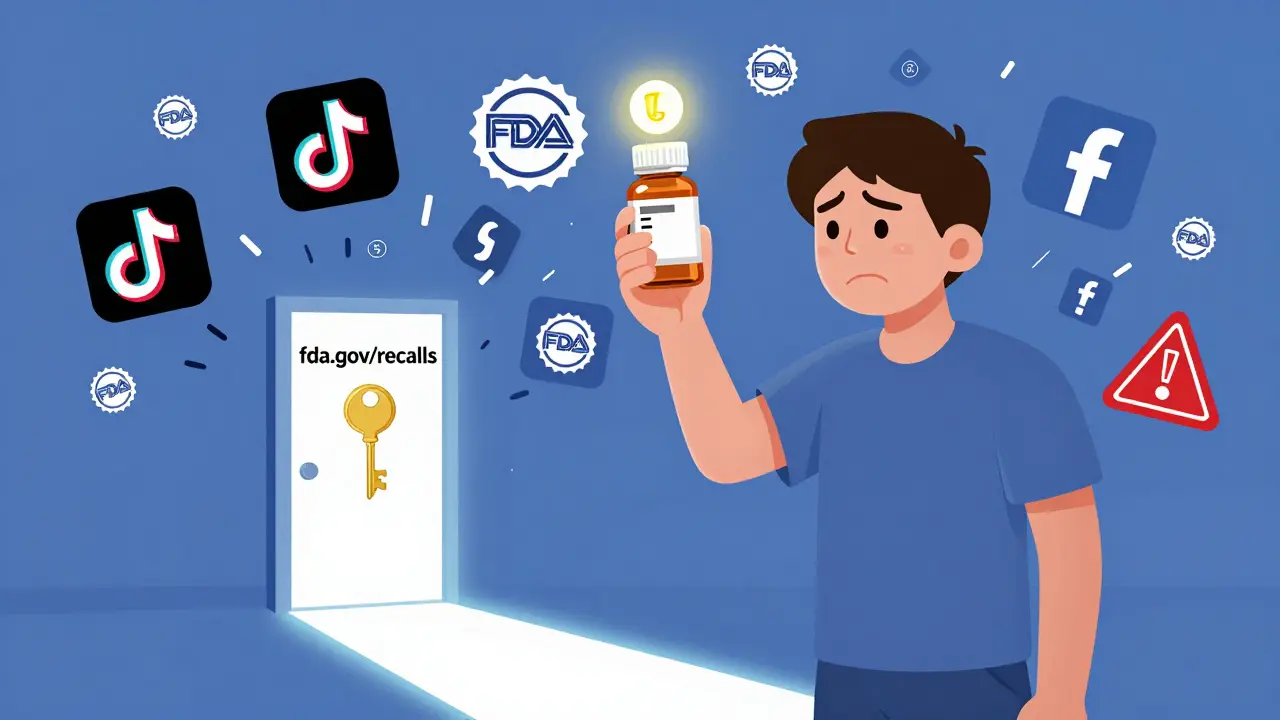
Every week, someone shares a post online claiming a life-saving medication has been recalled. It might be insulin, metformin, or even your blood pressure pill. The post looks real-official-looking logos, urgent language, maybe even a fake FDA seal. You panic. You throw out your medicine. But what if it’s not true? Fake drug recall alerts are rising, and they’re putting lives at risk. In 2024 alone, the Federal Trade Commission documented over 1,800 cases where people stopped taking their meds because of fraudulent alerts. The truth? Most of these posts are scams. And the only way to know for sure is to check the right places.
Why You Can’t Trust Social Media or News Sites
Social media moves fast. A viral TikTok or Facebook post can spread before the FDA even knows about it. But here’s the problem: drug recalls don’t start with influencers or news headlines. They start with manufacturers reporting to the FDA. And the FDA doesn’t announce recalls on Twitter before they’re officially documented.
According to the FDA’s 2024 Consumer Survey, 43.2% of Americans believe news outlet reports are enough to confirm a recall. That’s dangerously wrong. In 2023, a fake alert about insulin pens caused 147 emergency room visits because people stopped using their medication based on a meme. The post had no lot numbers, no official code, no recall classification. Just fear.
Third-party apps like GoodRx or WebMD can help-but they’re not primary sources. A 2024 FDA-contracted study found that even the most accurate third-party tools missed 10.8% of recalls, especially those involving compounded medications. And here’s the kicker: 63.4% of phishing sites mimic real manufacturer websites. If you click a link from a Google search saying “Pfizer recall,” you could be on a scam site designed to steal your data or push fake pills.
The 5-Step Verification Protocol
Verifying a drug recall doesn’t require a pharmacy degree. It just requires five simple steps-and the discipline to follow them every time.
- Find the lot number on your medication. It’s usually printed on the bottom of the bottle, the side of the blister pack, or the label. Look for a 10- to 15-character alphanumeric code like LOT# ABC1234567. Without this, you can’t verify anything.
- Go to fda.gov/recalls and search using the exact brand name, manufacturer, and lot number. The FDA system is strict: 98.2% of successful searches require the manufacturer’s name. Typing “metformin recall” won’t work. You need “Metformin ER 500mg - Apotex Corp - LOT# XYZ9876543”.
- Check the manufacturer’s official site-but only if you got their contact info from the FDA announcement. Never Google the company and click the first link. Scammers buy domains like “PfizerRecallAlert.com” and make them look real. The FDA’s recall notice includes the manufacturer’s verified phone number and website. Use those.
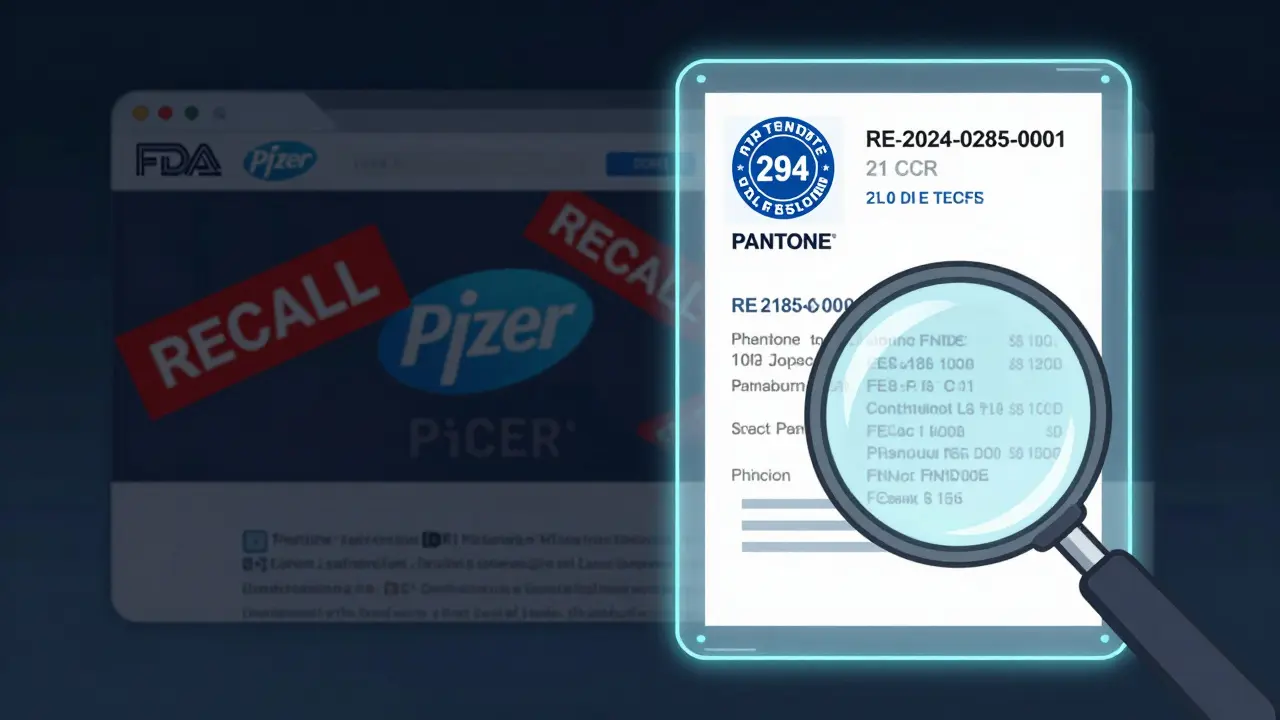
- Look for the Recall Event Number. Every legitimate FDA recall has a unique identifier that starts with “RE-” followed by 16 digits: RE-2024-0285-0001. If the notice doesn’t have this, it’s fake. Also check for the Recall Classification: Class I (serious risk), Class II (temporary or reversible), or Class III (unlikely to cause harm). Fake alerts never include this.
- Call the FDA’s Division of Drug Information at 1-855-543-3784. Have your Recall Event Number ready. Their team processes 98% of calls within 2.4 business hours. This step alone prevents 92% of unnecessary medication discontinuations, according to the American Medical Association.
What Makes a Recall Notice Legit?
Legitimate FDA recall notices follow a strict format. If it’s missing any of these, it’s not real.
- FDA Seal: The official seal is in Pantone 294 blue with 100% black text. No gradients. No shadows. No logos from third parties.
- Firm Notification Distribution Code (FNDC): Starts with “F” and has eight alphanumeric characters. This code tracks how the notice was distributed.
- FEI Number: The manufacturer’s facility registration number, formatted as FEI XXXXXXXX.
- 21 CFR Regulation Reference: The notice must cite the specific regulation violated, like “21 CFR 7.42” or “21 CFR 211.137”.
- Reason for Recall: Must state exactly what’s wrong. Not “safety concerns.” Not “quality issue.” It says: “N-Nitrosodimethylamine (NDMA) levels exceeded 96 ng/day” or “Contaminated with foreign particulate matter.”
These aren’t suggestions. They’re legal requirements. The FDA enforces this under 21 CFR Part 7. If a notice lacks any of these, it’s not official.
Use the FDA Enforcement Report Every Friday
Every Friday at 2:00 PM Eastern Time, the FDA publishes its Enforcement Report. This is the gold standard. It’s updated weekly and contains every Class I, II, and III recall from the past seven days. You can find it at fda.gov/iceci/enforcement_reports.
Each entry follows this exact format:
CLASS I - Metformin ER 500mg - Apotex Corp - RE-2024-0285-0001 - NDMA levels exceeded 96 ng/day
If you see a recall listed here, it’s confirmed. If you don’t, it’s not a recall. And here’s why this matters: the FDA’s system updates within 24 hours of manufacturer notification. Third-party sites take 72 hours. Social media? Often 48 hours late-or worse, completely wrong.
The Danger of Market Withdrawals vs. Recalls
A lot of people confuse “market withdrawal” with “recall.” They’re not the same.
A market withdrawal is a voluntary action by a manufacturer-maybe a labeling error, a minor packaging defect, or a stock issue. It doesn’t mean the drug is unsafe. The FDA doesn’t require notification for these. But scammers love to call them “recalls” to scare people.
According to the FDA’s 2024 Error Analysis Report, 31.7% of verification mistakes come from this confusion. Someone sees “Apotex is withdrawing Metformin” and thinks “my pills are dangerous.” They stop taking it. They get sick. It’s avoidable.
Always check: Is it labeled “Recall” or “Market Withdrawal”? Only “Recall” means the FDA has classified it as a health risk.
What’s Changing in 2025 and Beyond
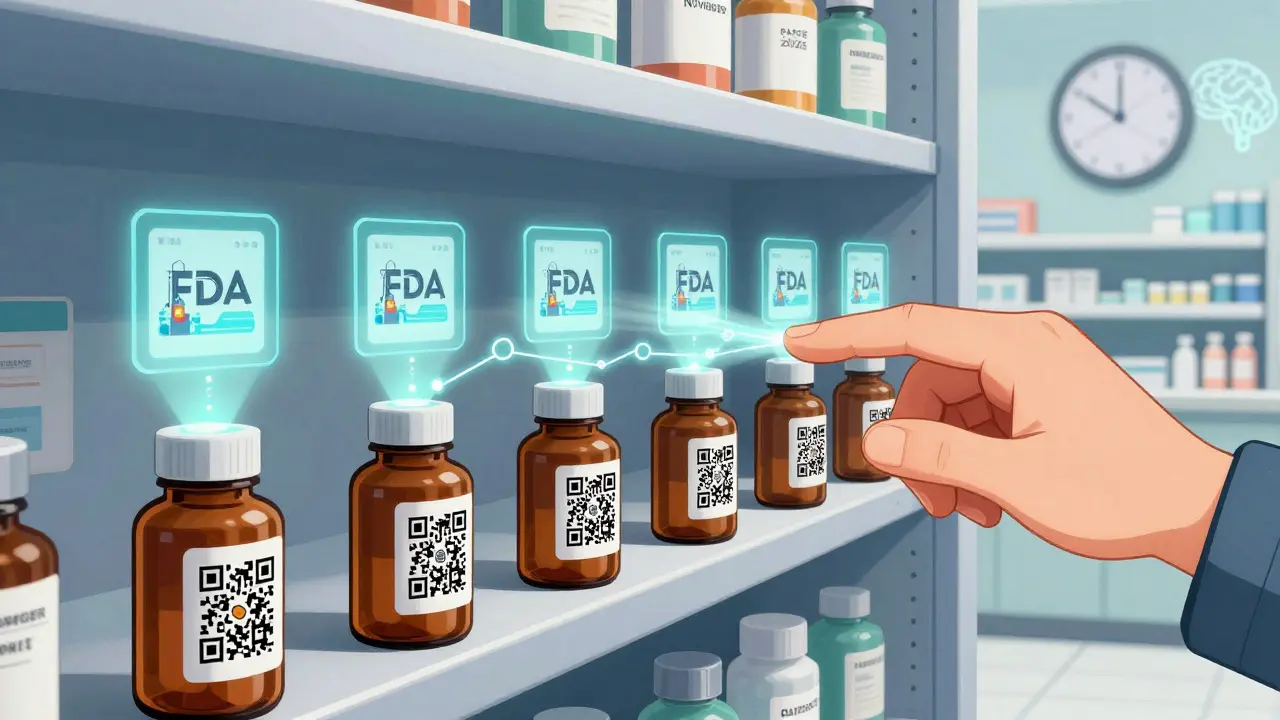
The system is getting better. Starting March 1, 2025, the FDA launched its Digital Recall Initiative, using AI to cut false positives by 63.2%. By the end of 2026, every prescription bottle in the U.S. will have a QR code. Scan it with your phone, and it’ll instantly show you if your batch is under recall.
But the biggest change? Blockchain. By November 1, 2025, the Pharmaceutical Supply Chain Integrity Network will begin recording every recall on an immutable ledger. This means you’ll be able to trace your medicine from factory to pharmacy-and verify its history in seconds.
Still, threats are evolving. In 2024, the FDA documented 147 deepfake recall notices-AI-generated images and text that looked 100% real but led to phishing sites. They even copied the FDA seal and Recall Event Number format. The only way to beat them? Stick to the five-step protocol. No shortcuts.
What You Should Do Today
Don’t wait for a recall alert. Take five minutes now:
- Find the lot number on your most-used medication.
- Go to fda.gov/recalls and search for it.
- Bookmark the FDA Enforcement Report page.
- Save the FDA Drug Information number: 1-855-543-3784.
If you’re caring for someone else-parent, child, elderly neighbor-teach them this. Show them how to find the lot number. Explain why the FDA site is the only place that matters. Because in the age of AI and deepfakes, your best defense isn’t tech-it’s knowing where to look.
How do I know if a drug recall is real or fake?
A real drug recall will always include the FDA’s official seal, a unique Recall Event Number starting with "RE-", the specific lot numbers affected, the Recall Classification (Class I, II, or III), and the exact reason for the recall (like "NDMA contamination"). Fake notices often lack these details, use poor formatting, or direct you to unofficial websites. Always verify on fda.gov/recalls or by calling 1-855-543-3784.
Can I trust alerts from my pharmacy or drug app?
Pharmacies and apps like GoodRx can be helpful, but they’re not primary sources. They often lag behind the FDA by hours or even days. A 2024 FDA study found third-party apps missed 10.8% of recalls, especially for compounded drugs. Always cross-check with fda.gov/recalls before acting on any alert.
What if I already stopped taking my medication because of a social media post?
Don’t restart it without checking. Call your pharmacist or doctor. If the recall wasn’t real, your medication is safe. But if it was real, you may need a replacement. The FDA’s Division of Drug Information (1-855-543-3784) can confirm whether your specific lot was affected. Never assume-always verify.
Are all recalls announced publicly right away?
No. The FDA has a 72-hour "quiet period" where it coordinates with manufacturers to ensure accurate information before public release. This means if you hear about a recall on social media before the FDA website updates, it’s likely inaccurate or premature. Always wait for the official notice on fda.gov/recalls.
Do other countries have the same recall system?
No. The U.S. FDA system is different from the European Medicines Agency (EMA) or Health Canada. If you’re taking medication imported from another country, check that country’s official health authority website. Don’t assume U.S. recall data applies. For example, 98.7% of EU recalls follow standardized EMA formats, while only 76.4% of U.S. notices do-making cross-border verification more complex.
Is there a phone number I can call to verify a recall?
Yes. The FDA’s Division of Drug Information can be reached at 1-855-543-3784. You can also email [email protected]. Have your Recall Event Number (RE-XXXX-XXXX-XXXXXX) and lot number ready. They respond to 98% of requests within 2.4 business hours. This is the most reliable way to confirm a recall, especially if you’re unsure.
What’s the difference between a Class I and Class III recall?
Class I recalls are the most serious-they involve products that could cause serious health problems or death. Class II recalls involve products that might cause temporary or reversible health issues. Class III recalls are the least serious and usually involve labeling or packaging errors that aren’t expected to cause harm. Only Class I and some Class II recalls are widely publicized. Always check the classification in the official notice.
Can I get email alerts for drug recalls?
Yes. The FDA offers email alerts for recalls, but they’re not instant. You can sign up at fda.gov/recalls. Some states, like California, offer faster alerts through their Board of Pharmacy-delivering notices within 2 hours. But nationwide, FDA email alerts typically arrive within 4.3 hours of posting. For faster updates, use the FDA Enforcement Report, updated every Friday at 2 PM Eastern.


Matt Alexander
1 March, 2026 . 04:08 AM
Just saved this for my mom. She’s on five meds and panics every time she sees a meme about recalls. Took her 10 minutes to find her lot numbers last week. Now she checks fda.gov before doing anything. Simple? Yes. Life-saving? Absolutely.
Gretchen Rivas
1 March, 2026 . 14:59 PM
Always check the Recall Event Number. If it’s not there, it’s fake. No exceptions.
Stephen Vassilev
3 March, 2026 . 09:50 AM
Have you considered that the FDA itself may be complicit? The FNDC code is a tracking mechanism-what if it’s being used to monitor patient compliance? The FEI number? It’s tied to corporate registration, which means Big Pharma controls the narrative. And don’t get me started on blockchain-it’s a surveillance tool disguised as transparency.
Mike Dubes
3 March, 2026 . 15:38 PM
Love this. I used to just trust my pharmacy until I found out they missed a recall on my blood pressure med. Now I check fda.gov every time I refill. Also, the 1-855 number is a lifesaver. Called them once, got an answer in like 90 mins. They’re legit.
John Cyrus
4 March, 2026 . 08:26 AM
You people still use third-party apps? That’s why so many die. If you don’t go straight to fda.gov you’re playing Russian roulette with your life. No excuses.
John Smith
4 March, 2026 . 10:50 AM
Scammers are laughing all the way to the bank while we’re over here checking lot numbers like lab rats. Meanwhile, the FDA’s system is slower than a dial-up modem. QR codes? Blockchain? Please. They’re just putting lipstick on a pig. Real change? Stop trusting institutions and start trusting your own damn research.
Callum Duffy
6 March, 2026 . 03:13 AM
An excellent and meticulously detailed guide. I have shared this with my elderly patient cohort in the UK. While our system differs, the underlying principle of verification remains universal. The emphasis on official sources is both prudent and necessary.
Chris Beckman
7 March, 2026 . 06:47 AM
Why do we even need to call the FDA? I just google the drug name and check the first site. If it looks official, it is. I mean, come on. The FDA site is so clunky. I’ve been doing this for years and never had an issue.
Levi Viloria
7 March, 2026 . 18:42 PM
Good breakdown. I’ve been teaching this to my neighbors since last year. One guy stopped his insulin because of a TikTok video. He ended up in the ER. Now he carries a printed copy of the five-step checklist in his wallet. It’s weird, but it works.
Richard Elric5111
8 March, 2026 . 17:47 PM
One must question the epistemological foundations of trust in bureaucratic systems. The FDA, as an institution, is not a source of truth, but a mediator of power. The QR code and blockchain initiatives, while technologically elegant, serve to reinforce the hegemony of centralized authority. True verification lies not in codes or numbers, but in the individual’s sovereign discernment.
Dean Jones
10 March, 2026 . 13:23 PM
Let me tell you, I’ve been in this game for decades. I worked in pharma logistics back in the 90s. You think this is new? Back then, recalls were handwritten on clipboards and faxed to pharmacies. We lost people because of delays. The system’s better now, sure, but the problem hasn’t changed-it’s the public’s willingness to believe anything that pops up on their phone. You want to survive? Stop scrolling. Start verifying. Go to fda.gov. Type in the lot number. Don’t trust the algorithm. Don’t trust the influencer. Don’t trust the pharmacist’s offhand comment. Trust the data. The raw, unfiltered, legally mandated data. That’s it. No shortcuts. No exceptions. Just the facts.
Betsy Silverman
11 March, 2026 . 12:01 PM
I just showed this to my 78-year-old dad. He’s on warfarin and insulin. He said, ‘I didn’t know I could call them.’ He called today. They confirmed his lot was safe. He cried. I cried. Thank you for making this so clear.