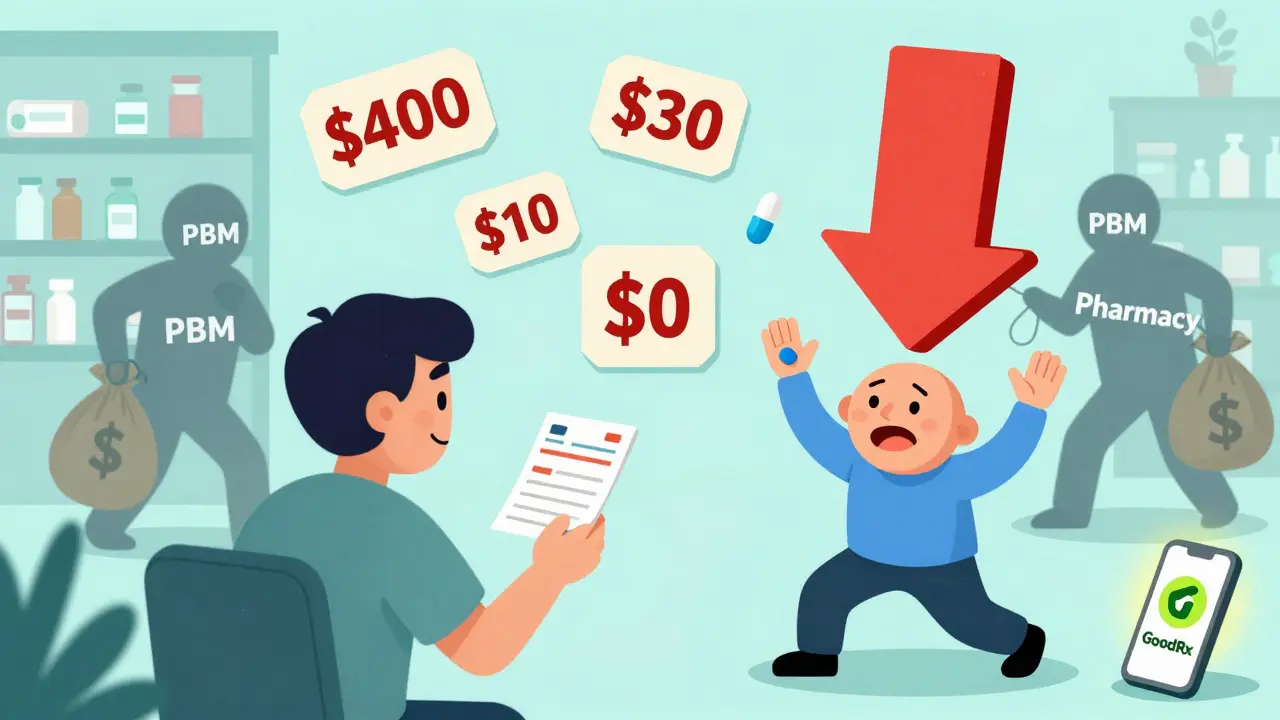
When you walk into a pharmacy to pick up your blood pressure medication, you might assume the generic version is cheaper because it’s "generic." But here’s the truth: generic drug prices don’t always mean lower costs for you. In fact, the biggest savings happen behind the scenes - in a messy, complicated system called a price war. And unless you know how to navigate it, you could be paying way more than you should.
What Exactly Is a Generic Drug Price War?
A generic drug price war isn’t like a Black Friday sale. It’s when multiple companies start making the exact same drug after the original brand’s patent expires. These companies don’t need to redo expensive clinical trials. They just prove their version works the same. Then they start undercutting each other. The more competitors, the lower the price. It’s basic economics - supply goes up, price goes down. But here’s where it gets real: the savings don’t always reach you. The FDA found that when six or more companies make the same generic drug, prices drop more than 95% compared to the brand name. That sounds amazing. But if your pharmacy is part of a system that takes a cut - and most are - you might not see that drop at the register.How Much Do Prices Actually Drop?
The numbers don’t lie. Let’s break it down:- With just one generic maker? Price is about 15-30% lower than the brand.
- With two generic makers? Down 44-54%.
- With four? Drops to 73-79% off.
- With six or more? Over 95% cheaper than the brand.
Why You’re Still Paying Too Much (Even With Generics)
You might think, "I have insurance, so I’m covered." But insurance doesn’t always help. In fact, it can hurt. Many plans have "gag clauses" - yes, they’re real - that stopped pharmacists from telling you the cash price was cheaper than your copay. That changed in 2018, but many people still don’t know. A Consumer Reports survey found 42% of people didn’t realize they could pay less out of pocket without insurance. Here’s a real example: EpiPen. Even though generics exist, some patients pay $300 because their insurance plan forces them to use the brand. Why? Because the PBM has a deal with the brand company. Meanwhile, the generic version costs $10 at Walmart. But if your plan doesn’t cover it, you’re stuck. Pharmacies also make more money on generics than brands. Gross margins on generics? Around 42.7%. On brand drugs? Just 3.5%. So why don’t they push generics harder? Because they’re paid more by PBMs to push certain drugs - even if they cost more.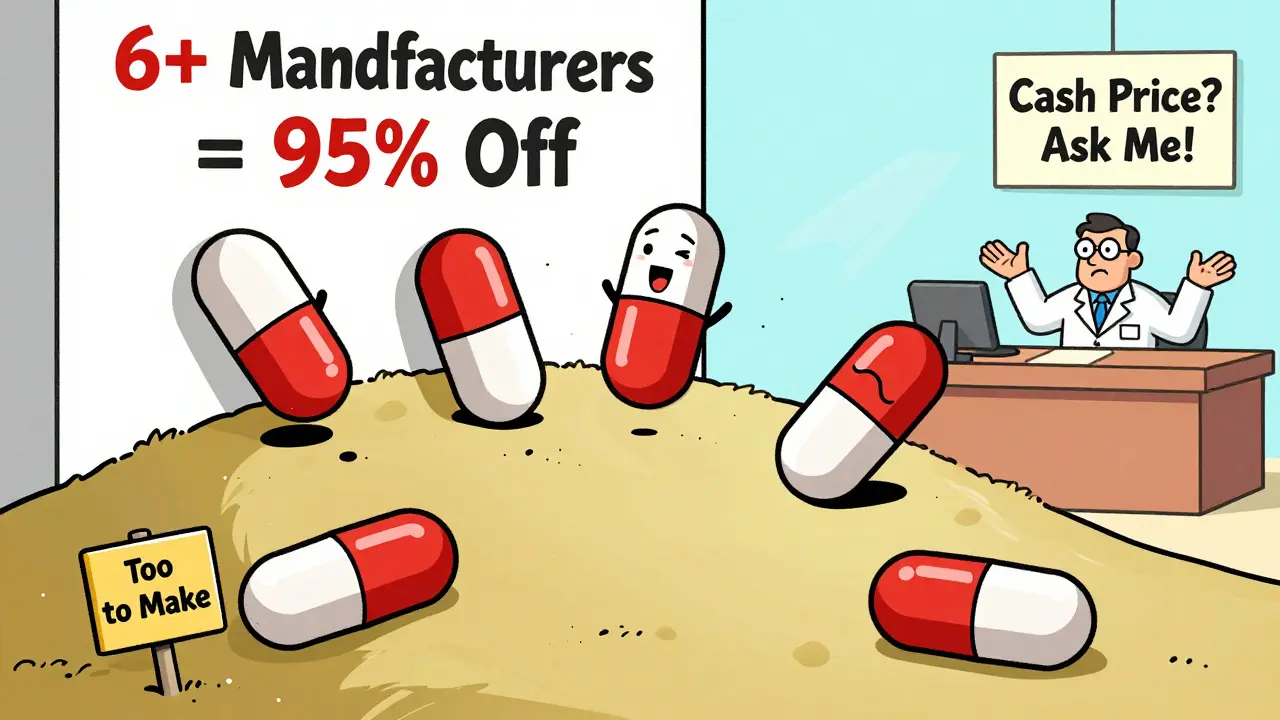
Where the System Breaks Down
Price wars only work if companies can stay in business. But when prices drop too low - say, below $2 per pill - some manufacturers quit. They can’t make money. That’s when shortages happen. The AEA Web analysis found that 30% of generic shortages occur in markets with four or more competitors. Why? Because the price war became too fierce. One company drops out. Then another. Suddenly, you’ve got one supplier left. And guess what? Prices jump back up. That’s why drugs like apixaban (a blood thinner) or insulin glargine (for diabetes) still cost a lot even though generics exist. Few companies make them. And when they do, they raise prices because they know you have no choice.How to Actually Save Money
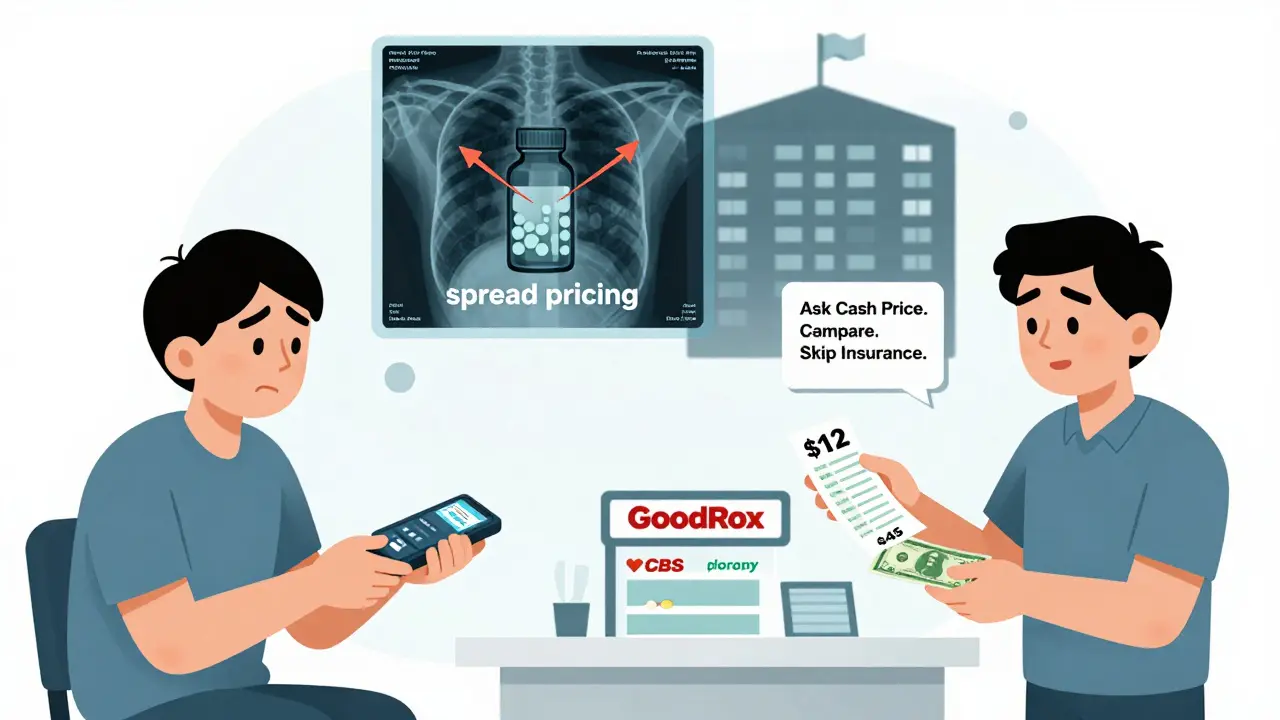
You can’t fix the system. But you can beat it. Here’s how:- Always ask for the cash price. Seriously. Even if you have insurance. In 28% of cases, the cash price is lower than your copay. That’s not a typo. A $10 drug might cost you $25 with insurance because of how your PBM works.
- Use GoodRx or similar apps. They show prices at nearby pharmacies. Sometimes, the difference between CVS and Walgreens is over 300%. That’s not a mistake - it’s how the system is rigged.
- Check therapeutic equivalence. Look for "AB" on the label. That means the generic is as good as the brand. No need to pay extra for a "premium" generic.
- Buy chronic meds in bulk. If you take a drug every day, buying a 90-day supply often cuts the price per pill. Walmart, Costco, and Target offer $4 or $10 lists for common generics.
- Know your formulary. Ask your insurer: "Which generic versions are covered?" Some plans only cover one brand of generic - even if others are cheaper.
Real Stories, Real Savings
On Reddit, users share how they cut their bills:- One person pays $0 for lisinopril (blood pressure) at Walmart - because they skipped insurance and paid cash.
- Another pays $12 a month for metformin instead of $45 - after switching from CVS to a local pharmacy using GoodRx.
- A man in Ohio used to pay $200 for his cholesterol drug. After checking prices, he found the same pill at a pharmacy 10 miles away for $8.
The Bigger Picture
The U.S. spends $71 billion a year on generic drugs. That’s 90% of all prescriptions. But we pay more than other countries. In Canada or the UK, governments negotiate prices directly. Here, it’s a free-for-all - with middlemen taking cuts. The good news? Change is coming. The 2023 Pharmacy Benefit Manager Transparency Act aims to ban spread pricing. The FDA approved over 1,000 generics in 2023 - up from 748 the year before. More competition means more savings. But until then, you’re the only one who can protect yourself. Don’t assume. Don’t trust. Ask. Compare. Pay cash. It takes 10 minutes, but it could save you hundreds - or thousands - a year.What’s Next?
If you’re on a chronic medication, start now. Grab your prescription. Open GoodRx. Call three pharmacies. You might be shocked. And you’ll be glad you did.Are generic drugs as safe as brand-name drugs?
Yes. The FDA requires generics to have the same active ingredients, strength, dosage form, and route of administration as the brand. They must also prove they work the same way in the body. The only differences are in inactive ingredients - like fillers or dyes - which don’t affect how the drug works.
Why is the same generic drug cheaper at one pharmacy than another?
Because pharmacies don’t all pay the same wholesale price, and PBMs negotiate different deals with each one. Some pharmacies get better rates from distributors. Others get paid more by insurance plans to push certain drugs. That’s why prices can vary by over 300% - even for the exact same pill.
Can I use GoodRx even if I have insurance?
Yes, and you should. GoodRx shows the cash price - which is often lower than your insurance copay. When you use GoodRx, you’re not using your insurance. That means your copay doesn’t count toward your deductible. But if the cash price is cheaper, you save money anyway. It’s not about insurance - it’s about price.
Why do some generics cost almost as much as the brand?
When only one or two companies make a generic, there’s no real competition. That’s called a "limited competition market." In those cases, manufacturers can keep prices high - sometimes within 15% of the brand. This often happens with complex drugs or those that are hard to manufacture.
Is it true that PBMs are making money off my generic drug savings?
Yes. PBMs negotiate discounts from drug makers, then charge pharmacies a higher price. The difference - called "spread pricing" - goes into their pocket. In some cases, they charge you $40 for a drug that cost the pharmacy $15. You pay the $40, and they keep $25. That’s why your copay doesn’t always reflect the real cost.

Tommy Chapman
22 February, 2026 . 11:03 AM
Let me get this straight - you’re telling me we’re paying $30 for a $10 pill because some corporate middleman decided to pocket the difference? Bro. This isn’t capitalism. This is robbery with a pharmacy receipt.
I’ve been paying cash for my blood pressure meds for years. Walmart’s $4 list saved me $1,200 last year. Insurance? Nah. That’s just a tax on being dumb enough to trust them.
And don’t even get me started on PBMs. They’re not intermediaries - they’re parasites. I swear, if I could throw a brick through their corporate HQ, I’d do it in a heartbeat.
Hariom Sharma
24 February, 2026 . 02:33 AM
Bro this is so true! In India we don’t even have this mess - generics are dirt cheap and everyone uses them. I came to the US last year and almost cried when I saw how much a simple metformin pill costs.
GoodRx changed my life. I now buy my diabetes meds from a tiny pharmacy in Texas for $7. My cousin back home pays less than $2 for the same thing. We need to fix this system - not just for Americans, but for global health equity.
Nina Catherine
26 February, 2026 . 00:28 AM
omg i just realized i’ve been overpaying for my antidepressants for TWO YEARS 😭
i used goodrx for the first time last week and it dropped from $48 to $9 at the corner drugstore. i’m crying. i didn’t even know this was a thing. why isn’t this on tv? why does no one talk about this?
also i typo’d ‘pharmacy’ as ‘phramacy’ and now i’m embarrassed. but hey, at least i saved $400. 🙌
Taylor Mead
26 February, 2026 . 13:50 PM
Interesting breakdown. I’ve been using GoodRx for a while now, and yeah, the price differences are wild. One time I checked the same prescription at CVS vs. a local independent pharmacy - $37 vs. $11. That’s not a typo. That’s a system failure.
I don’t blame pharmacists. They’re stuck in the middle too. The real villains are the opaque contracts between PBMs and insurers. We need transparency laws enforced, not just passed.
Amrit N
28 February, 2026 . 04:41 AM
so i tried this cash thing last month for my thyroid med
used goodrx
paid $6.50 at a walmart in ohio
my insurance copay was $32
idk why i never thought of this before lmao
also i think my cat is now more financially literate than me
Courtney Hain
28 February, 2026 . 13:16 PM
Okay, but have you considered that this entire system is a controlled demolition? The FDA, the PBMs, the pharmacy chains - they’re all part of a coordinated effort to keep you docile, overmedicated, and dependent.
Did you know the same active ingredient in metformin is sold in China for 37 cents? Why is it $10 here? Because they want you to think you need insurance to survive.
And don’t get me started on the glyphosate in the fillers. They’re not just overcharging you - they’re slowly poisoning you under the guise of ‘efficacy.’
There’s a reason your pharmacist won’t tell you the cash price. They’re being paid to stay silent. I’ve seen the documents. They’re encrypted. But I’ve got the key. Want me to leak them? I’ll start a GoFundMe to fund the exposé.
Greg Scott
1 March, 2026 . 21:17 PM
Just wanted to say thanks for laying this out so clearly. I’ve been on statins for 8 years and never realized I was overpaying. I switched to cash last month - saved $200. Simple, but nobody talks about it.
Also, the part about bulk buying? Game changer. I now get 90-day supplies. My pharmacist even gives me a nod now. Feels good to outsmart the system.
Caleb Sciannella
2 March, 2026 . 11:58 AM
While the practical advice offered herein is both pragmatic and empirically supported, one must not overlook the structural macroeconomic forces at play. The fragmentation of pharmaceutical distribution in the United States - coupled with the absence of centralized price negotiation - creates systemic inefficiencies that disproportionately burden low- and middle-income populations.
Moreover, the phenomenon of therapeutic substitution, while legally permissible, is often obfuscated by marketing strategies that prioritize profit over patient outcomes. The fact that 42.7% gross margins exist on generic drugs - while brand-name drugs yield only 3.5% - underscores a perverse incentive structure that rewards obfuscation over accessibility.
Policy reform must be paired with individual action. The tools you’ve outlined - GoodRx, cash pricing, formulary awareness - are essential stopgaps. But they are not solutions. They are survival tactics in a broken ecosystem.
Maddi Barnes
3 March, 2026 . 00:04 AM
Oh my god, I just realized I’ve been a sucker for 7 years 😂
I used to think insurance was my friend. Nope. It’s the guy who steals your wallet… then charges you $10 for the privilege of having it returned.
Also - and this is wild - my pharmacist once told me (in whispers) that they get paid MORE if I use insurance. So they literally want me to pay more. I almost threw my pill bottle at them.
Now I use GoodRx. I pay $3.50 for my birth control. My insurance copay was $28. I’m not mad. I’m just… disappointed in humanity. 🙃
Jeremy Williams
4 March, 2026 . 01:33 AM
My wife and I have been using this method for over a year now. We pay cash for all chronic medications. We’ve saved over $4,000 annually. We don’t use insurance for prescriptions at all anymore. It’s not about being anti-insurance - it’s about being pro-savings.
For anyone reading this: don’t wait. Open GoodRx. Call three pharmacies. Take 10 minutes. It’s the most powerful 10 minutes you’ll spend on your health this year.