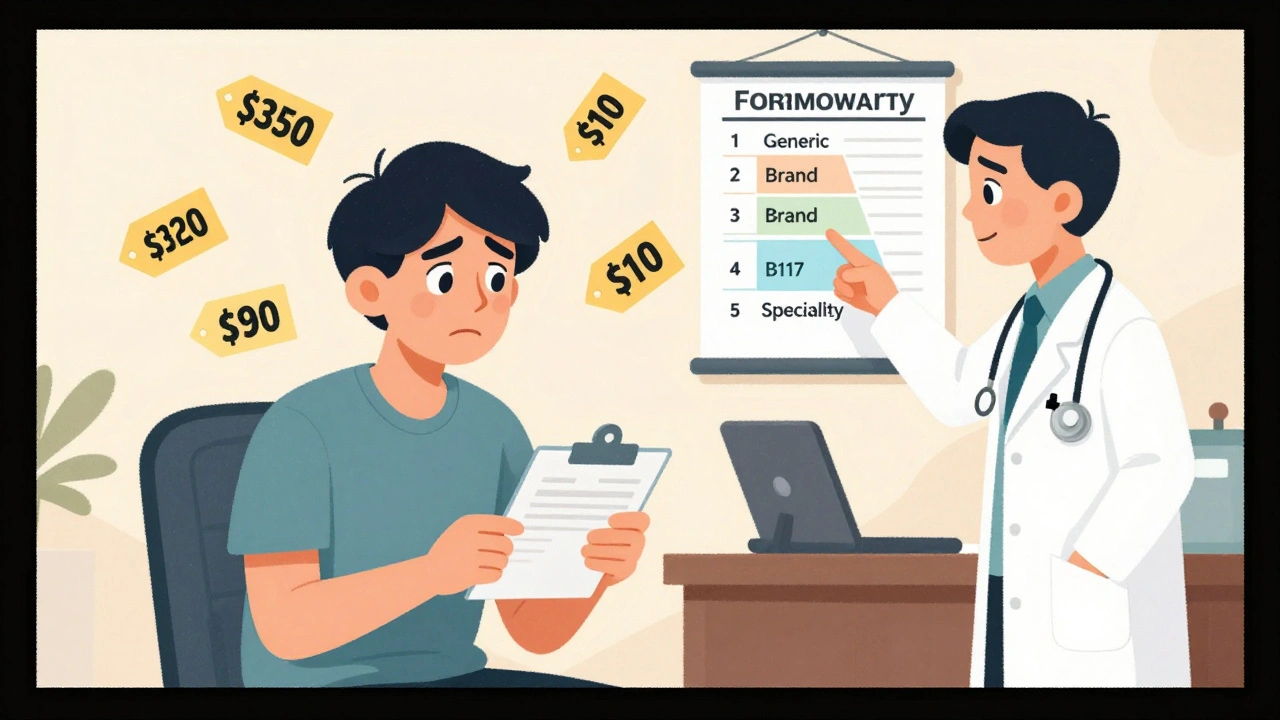
Imagine this: you leave your doctor’s office with a new prescription, excited to start feeling better. But when you get to the pharmacy, the pharmacist tells you the copay is $350. You didn’t expect that. You didn’t even know it could be that high. So you walk out without it. You’re not alone. About 22% of people skip filling prescriptions because of cost, according to 2023 GoodRx data. That’s more than one in five people. And it’s not because they don’t want to get better-it’s because they didn’t know what they’d be paying until it was too late.
Why Talking About Cost Before the Prescription Matters
Doctors don’t always know how much your medicine will cost you. Not because they’re careless, but because insurance plans are complicated. Each plan has its own list of covered drugs-called a formulary. That list is broken into tiers. Tier 1 might be a $10 generic. Tier 3 could be a $90 brand-name drug. And specialty drugs? Those can cost hundreds, even thousands, with no cap in many commercial plans.
Medicare Part D changed that in 2025. Starting this year, if you’re on Medicare, your total out-of-pocket drug costs are capped at $2,000 per year. That’s a huge shift. Before, you could hit $8,000 in spending before catastrophic coverage kicked in. Now, once you hit $2,000, your plan pays almost everything. Insulin is capped at $35 per month. And you can now pay for prescriptions in monthly installments through the new Medicare Prescription Payment Plan.
But if you have commercial insurance-through your job or the marketplace-you don’t have that same protection. Many plans still have no annual cap on drug spending. That’s why talking about cost before your doctor writes the script isn’t just smart-it’s essential.
What to Ask Before Your Doctor Writes the Prescription
You don’t need to be an expert. Just ask these five simple questions during your visit:
- Is there a generic version? Generics work the same as brand names but cost far less. For many common meds, generics are 80-85% cheaper.
- Is this drug on my insurance’s formulary? If it’s not covered, you’ll pay full price. Even if it’s covered, the tier matters. Ask which tier it’s on.
- What will my out-of-pocket cost be? Don’t settle for “I don’t know.” Ask for a number. Even an estimate helps.
- Are there alternatives that cost less? Sometimes another drug in the same class works just as well-for a fraction of the price.
- Can I get a 90-day supply or use mail-order? Many plans offer lower copays for longer supplies. Mail-order can cut your monthly cost by half.
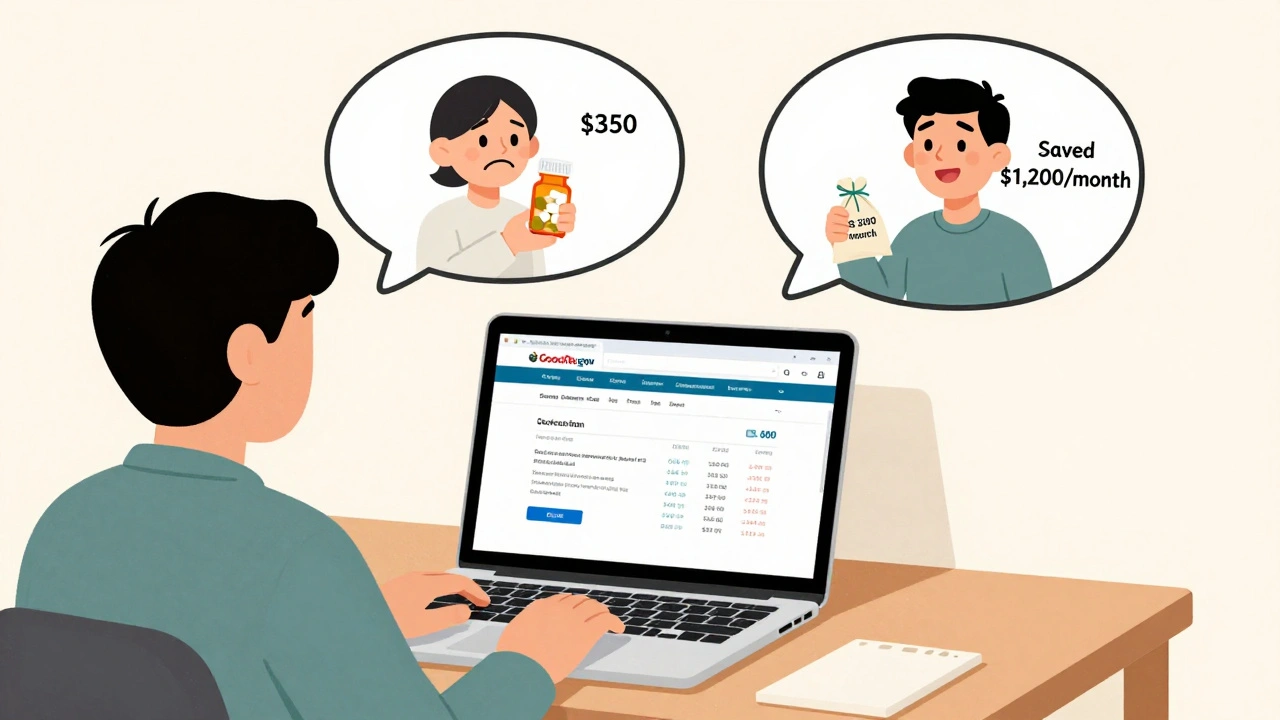
One patient, ‘MedicareMom2023’ on Reddit, saved $1,200 a month just by checking her plan’s formulary online before her appointment. She showed her doctor a cheaper alternative that was covered-and got it prescribed right then.
Tools to Check Costs Before You Leave the Office
You don’t have to guess. There are free tools that give you real-time cost estimates:
- Medicare.gov Plan Finder - Updated every October for the next year’s coverage. Enter your drugs, zip code, and pharmacy. It shows you exact prices across all Part D plans.
- GoodRx - Compares cash prices and coupons at local pharmacies. One user saved $287 on blood pressure meds by showing the pharmacist a GoodRx coupon-even with insurance.
- CVS Caremark’s Check Drug Cost & Coverage - Lets you search by drug name and see your copay, coverage status, and generic options.
- SingleCare and RxSaver - Similar to GoodRx, with discounts that often beat insurance prices.
These tools aren’t magic. But they’re better than walking into the pharmacy blind.
Timing Matters: When to Ask Matters Even More
Asking after your doctor writes the script is too late. The best time is before the prescription is written. That’s when your doctor still has options. Once it’s printed, switching becomes harder.
Also, timing within the year matters. If you’re on a high-deductible plan, your out-of-pocket costs are highest in January through March. You haven’t met your deductible yet. A $50 copay in December might be $300 in February. Ask your doctor: “Is this something I can wait until after I meet my deductible?”
And if you’re on Medicare, the Annual Enrollment Period (October 15 to December 7) is your chance to switch plans for cheaper drug coverage next year. Use the Medicare Plan Finder to compare costs for your exact medications.

What If Your Drug Isn’t Covered?
It happens. About 43% of cost-related prescription issues come from drugs not being on the formulary, according to the Patient Advocate Foundation.
Your doctor can file a prior authorization request. That means they write a letter to your insurer explaining why this drug is necessary. About 68% of these requests are approved. Don’t give up. Ask your doctor’s office to help. Many have staff dedicated to this.
If prior auth fails, ask: “Can you prescribe a similar drug that’s covered?” Sometimes switching to another drug in the same class-like a different statin or antidepressant-works just as well.
How Pharmacists Can Help
Pharmacists are your last line of defense. They see the price before you do. If you’re paying more than 2% of your monthly income for a prescription, the American Pharmacists Association says they should flag it.
Don’t be shy. When you hand over your prescription, say: “I’m worried about the cost. Is there a cheaper option?” They can often suggest a different formulation, a 90-day supply, or even a manufacturer coupon you didn’t know about.
Some pharmacies offer discount programs. Walmart and Kroger have $4 lists for common generics. CVS and Walgreens sometimes match GoodRx prices.
What’s Changing in 2025 (and Why It Matters)
Big changes are coming for Medicare beneficiaries. Starting in 2025:
- Out-of-pocket drug costs are capped at $2,000 per year.
- Insulin costs no more than $35 per month.
- Free vaccines are included.
- You can pay for prescriptions in monthly installments through the new Prescription Payment Plan.
These changes are the result of the Inflation Reduction Act of 2022. They’re already helping people. But they only apply to Medicare. If you have private insurance, you’re still on your own-unless your employer or plan has voluntarily adopted similar caps.
For commercial plans, the trend is toward more complexity. The average plan now covers over 3,250 drugs across 5 or 6 tiers. That’s up from 2,800 drugs in 2020. More choices don’t mean lower prices. They mean more confusion.
Real Stories, Real Savings
One man on r/healthinsurance shared how he avoided a $1,500 monthly bill for a specialty drug. He called his insurer before his appointment, got the formulary list, and found a similar drug that was covered. His doctor agreed to switch. He saved $18,000 a year.
Another woman, on Trustpilot, said she used GoodRx to find a $40 cash price for her cholesterol med. Her insurance copay was $120. She paid cash and saved $80 a month.
These aren’t rare wins. They’re repeatable. All it takes is asking one question before the prescription is written.
What to Do If You Already Filled the Prescription and It’s Too Expensive
It’s not too late. Call your insurance company. Ask for a retroactive exception. Some plans will adjust your cost if you explain you weren’t aware of the price.
Check if the drug manufacturer offers a patient assistance program. Most big pharma companies have them. You can apply online. Many provide free or discounted meds for low-income patients.
And don’t skip doses to make it last longer. That’s dangerous. Studies show people who skip doses because of cost are 37% more likely to end up in the hospital. That’s far more expensive than the drug itself.
If you’re struggling, contact the Patient Advocate Foundation. They help people navigate coverage issues for free. They’ve helped resolve 68% of formulary-related problems through prior authorization.
Should I always ask my doctor about the cost of my prescription?
Yes. Even if your doctor doesn’t bring it up, you should. Studies show only 15% of patients regularly discuss costs with providers, but 30% skip doses because of cost. Asking doesn’t make you difficult-it makes you informed. Doctors appreciate patients who help avoid expensive mistakes.
Can I use GoodRx instead of my insurance?
Yes, and sometimes you should. GoodRx often shows lower prices than your insurance copay, especially for generics. At the pharmacy, you can ask to use the GoodRx coupon instead of your insurance. Just make sure you’re not paying more than you would with insurance. Compare both prices before paying.
What if I’m on Medicare and my drug isn’t covered?
You can ask your doctor to file a prior authorization request. If that fails, you can switch plans during the Annual Enrollment Period (October 15-December 7). Use the Medicare Plan Finder to compare how your drugs cost across different Part D plans. You might find a plan that covers your meds for less.
Are there free programs to help pay for prescriptions?
Yes. Most drug manufacturers offer patient assistance programs if you meet income requirements. You can apply directly through their websites. Nonprofits like NeedyMeds and the Patient Advocate Foundation also help connect people to free or low-cost meds. These programs are not hard to qualify for-many people don’t even know they exist.
Why do some drugs cost so much even with insurance?
Many insurance plans use tiered formularies. Specialty drugs-like those for cancer, MS, or rheumatoid arthritis-are often in the highest tier. You might pay 25-33% of the total cost as coinsurance, with no annual cap in commercial plans. That’s why a $10,000 drug could cost you $2,500 even with insurance. Medicare’s new $2,000 cap in 2025 fixes this for seniors, but private plans don’t have to follow suit.
Next Steps: What to Do Today
If you’re taking any prescription right now, do this:
- Go to your insurer’s website and look up your formulary.
- Search for each drug you take. Note the tier and copay.
- Check GoodRx for the cash price.
- If the cash price is lower, ask your pharmacist if you can pay cash instead of using insurance.
- Write down any questions you have for your next doctor visit.
If you’re about to get a new prescription, ask the five questions before your doctor clicks “send.” Don’t wait until you’re at the pharmacy. The difference between paying $10 and $300 is one conversation.

Declan Flynn Fitness
3 December, 2025 . 02:34 AM
Big up to the OP for laying this out so clearly. I work in primary care and I can't tell you how many times I've seen patients walk out because they didn't know the cost until the pharmacy counter. Just asking 'is there a generic?' or 'what's the copay?' saves so much stress. Seriously, if you're on meds long-term, this one conversation can save you thousands.
Lucinda Bresnehan
3 December, 2025 . 14:06 PM
Thank you for this. My mom just got hit with a $400 bill for her thyroid med last week-she cried. We found a GoodRx coupon for $22. I wish someone had told us this sooner. I’m printing this out and taking it to her next appointment.
Louise Girvan
3 December, 2025 . 22:06 PM
This is all propaganda. Big Pharma and Medicare are manipulating you. They want you to think you're saving money-but they're just hiding the real costs in your premiums. You think $2k cap is good? Wait till you see your 2026 premium hike. They're setting you up for a trap.
Michelle Smyth
5 December, 2025 . 09:21 AM
How quaint. You assume the average patient has the cognitive bandwidth to navigate tiered formularies, compare cash prices across six platforms, and then diplomatically negotiate pharmaceutical alternatives during a 12-minute consult. This isn't healthcare-it's a performance art piece for the upper-middle-class bourgeoisie who have time to optimize their copays like they're optimizing their 401(k)s. The system is broken. Asking nicely won't fix it.
soorya Raju
7 December, 2025 . 00:29 AM
lol u think this is new? my cousin in delhi pays 5$ for same med i pay 120$ for. usa healthcare is a joke. they sell you hope then charge you 3x for the dream. i use pharma coupons from india websites. no one told u? lol
Dennis Jesuyon Balogun
7 December, 2025 . 06:00 AM
Let’s be real: this isn’t about individual agency. It’s about structural violence. The commodification of health turns human survival into a transactional puzzle. When insulin is capped at $35, it’s not charity-it’s damage control after decades of predatory pricing. The fact that we need to beg for affordability proves the system is morally bankrupt. We don’t need tips-we need systemic overhaul. But yes, ask the questions. Fight the fight. Even if it’s just to survive until the revolution.
Grant Hurley
8 December, 2025 . 06:20 AM
omg this is literally the most helpful thing i’ve read all year. i’ve been skipping my blood pressure pills bc i thought $80 was normal. just checked goodrx-$15. i’m gonna go get it today. thank you thank you thank you 🙏
Bee Floyd
9 December, 2025 . 22:37 PM
I used to work at a pharmacy. People would come in shaking, holding a script, terrified of the price. I’d quietly say, ‘Hey, I’ve got a coupon here that cuts this in half.’ No one ever thanked me. But I kept doing it. You don’t need to be an expert-you just need to ask. And if you’re the one holding the script? Don’t be shy. We’re here to help, not to judge.
Patrick Smyth
10 December, 2025 . 09:26 AM
I just lost my wife to cancer last year. She couldn’t afford her chemo drug. We begged. We cried. We applied for every program. They said ‘no’ 14 times. This article? It’s too late for us. But maybe-just maybe-it’ll save someone else. Please. Read it. Share it. Don’t wait until it’s your turn to suffer.
Sean McCarthy
11 December, 2025 . 15:24 PM
This is a scam. The $2,000 cap only applies to Medicare. You think they'll extend it to private insurance? Never. The insurance companies will just raise premiums to cover it. This is a distraction tactic. They want you to think you're being helped while they quietly raise your rates. Look at the numbers. They always do.
Jeremy Butler
11 December, 2025 . 21:25 PM
One must interrogate the epistemological foundations of pharmaceutical cost transparency. The very notion that a patient can 'ask' for cost information presupposes an ontological parity between the physician and the insured-yet the asymmetry of power, knowledge, and institutional authority renders such agency illusory. The formulary is not a tool of liberation; it is a bureaucratic apparatus of control, disguised as consumer empowerment. One must not confuse procedural advice with structural justice.
Declan Flynn Fitness
12 December, 2025 . 08:17 AM
Love that you’re pushing back on the systemic stuff, Dennis. But honestly? The OP’s advice isn’t about fixing the system-it’s about surviving it until it gets fixed. My grandma used GoodRx to get her arthritis med for $5 instead of $110. She didn’t care about the politics. She just wanted to walk without pain. Sometimes, the small wins matter more than the grand revolutions.