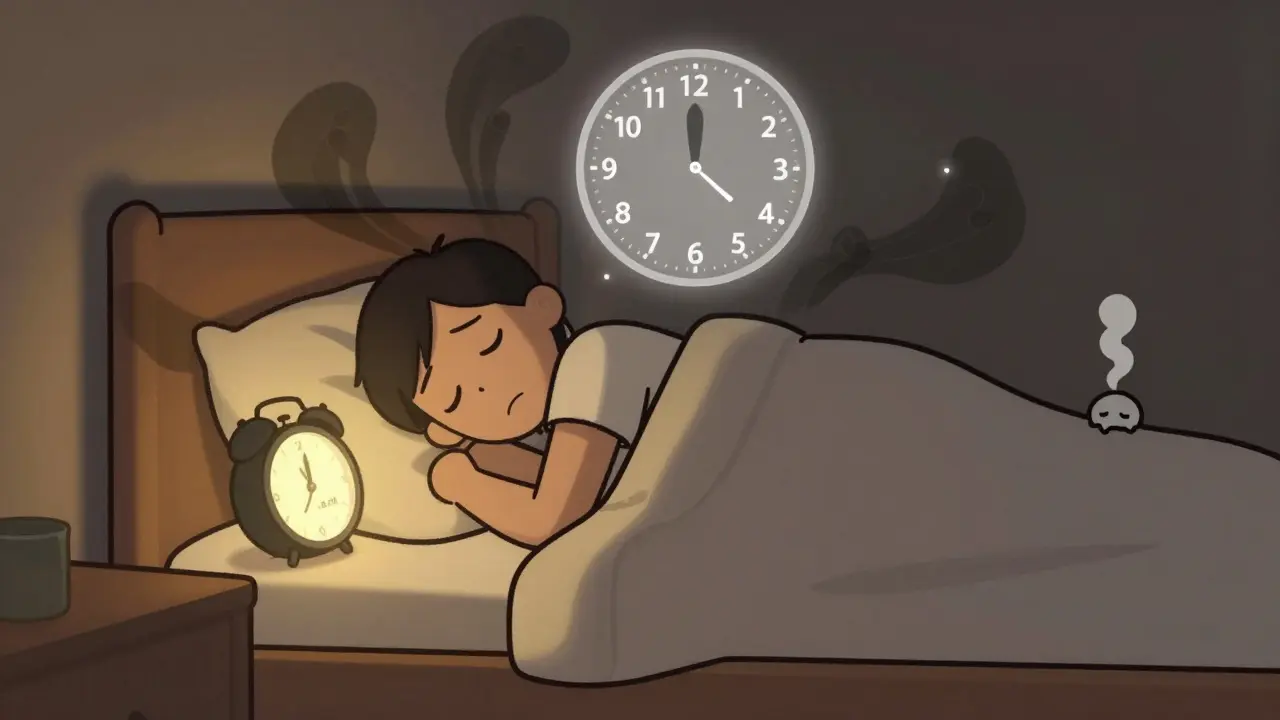
If you’ve spent years lying awake at night, counting sheep, checking the clock, or wondering why your bed feels more like a wake-up call than a place of rest, you’re not broken. You’re caught in a cycle that’s easy to fall into-and even easier to fix. Sleep Restriction Therapy (SRT) isn’t about sleeping more. It’s about sleeping better. And it works by doing the opposite of what most people with insomnia think they should do: spend less time in bed.
Why Less Time in Bed Helps You Sleep More
Most people with chronic insomnia spend way too much time in bed. Maybe you’re in bed for eight hours, but only sleeping five. That means you’re lying awake for three hours every night. Over time, your brain starts associating your bed with frustration, anxiety, and wakefulness-not rest. That’s the core problem SRT targets. Sleep Restriction Therapy was developed by Dr. Arthur Spielman in the 1980s and is now a cornerstone of Cognitive Behavioral Therapy for Insomnia (CBT-I). It’s not a quick fix. It’s a reset. By reducing the amount of time you spend in bed to match your actual sleep time, you build up what’s called sleep pressure. Think of it like hunger. If you don’t eat for 24 hours, you’re starving. If you don’t sleep for 24 hours, your body screams for rest. SRT forces your body into that state-safely and systematically. Studies show SRT cuts the time it takes to fall asleep by up to 50%, reduces nighttime awakenings, and boosts sleep efficiency-the percentage of time in bed actually spent sleeping. The American Academy of Sleep Medicine calls it a guideline treatment, meaning it’s backed by solid evidence and recommended as a first-line option over sleeping pills.How SRT Works: The Step-by-Step Process
SRT isn’t guesswork. It’s a precise, science-backed protocol. Here’s how it works in practice:- Track your sleep for 7 days. Use a sleep diary. Write down when you get into bed, when you fall asleep, when you wake up, and any time you’re awake during the night. Don’t rely on your phone or a smartwatch-write it down. Accuracy matters.
- Calculate your average total sleep time. Add up all the hours you slept over the week and divide by seven. If you slept 5, 5.5, 4.5, 6, 5, 5.5, and 6 hours, your average is about 5.4 hours.
- Set your initial time-in-bed limit. Your time in bed becomes your average sleep time-rounded down to the nearest half-hour. In this case, you’d start with 5 hours in bed.
- Choose a fixed wake-up time. This is non-negotiable. Set your alarm for the same time every day, even on weekends. Your body needs consistency to rebuild its rhythm.
- Calculate your bedtime. If you wake up at 6 a.m. and your time-in-bed limit is 5 hours, you go to bed at 1 a.m. No earlier. No later.
When and How to Increase Your Time in Bed
You don’t stay at 5 hours forever. The goal is to gradually expand your time in bed as your sleep improves. But only when you’re ready. The rule is simple: if your sleep efficiency (total sleep time divided by time in bed) hits 85-90% for three nights in a row, you can add 15 to 30 minutes to your time in bed. So if you’re sleeping 4.5 hours in 5 hours of bed time, that’s 90% efficiency. You’re ready to move to 5.5 hours. You keep doing this-adding time slowly-until you reach 7-8 hours in bed and still maintain 85%+ sleep efficiency. That’s when you’ve successfully reset your system. Most people get there in 6 to 8 weeks. Some take longer. But the key is patience and precision.Why SRT Beats Sleeping Pills
Sleeping pills might help you nod off tonight. But tomorrow? You’ll need them again. And the next night. And the next. And then you’re stuck with side effects, dependency, and rebound insomnia when you stop. SRT doesn’t just help you sleep-it rewires how your brain responds to bedtime. A 2023 meta-analysis found SRT improved sleep efficiency by 47% more than sleep hygiene alone. In 10 out of 10 studies, participants reduced the time they spent lying awake in bed. Meanwhile, benzodiazepines showed only 60-70% effectiveness, with high relapse rates after stopping. Even better: the results last. A 2023 study from Sleepstation.org.uk found that 78% of people who completed SRT still had better sleep six months later. Compare that to just 32% for people who used medication. SRT doesn’t mask the problem. It fixes the root cause.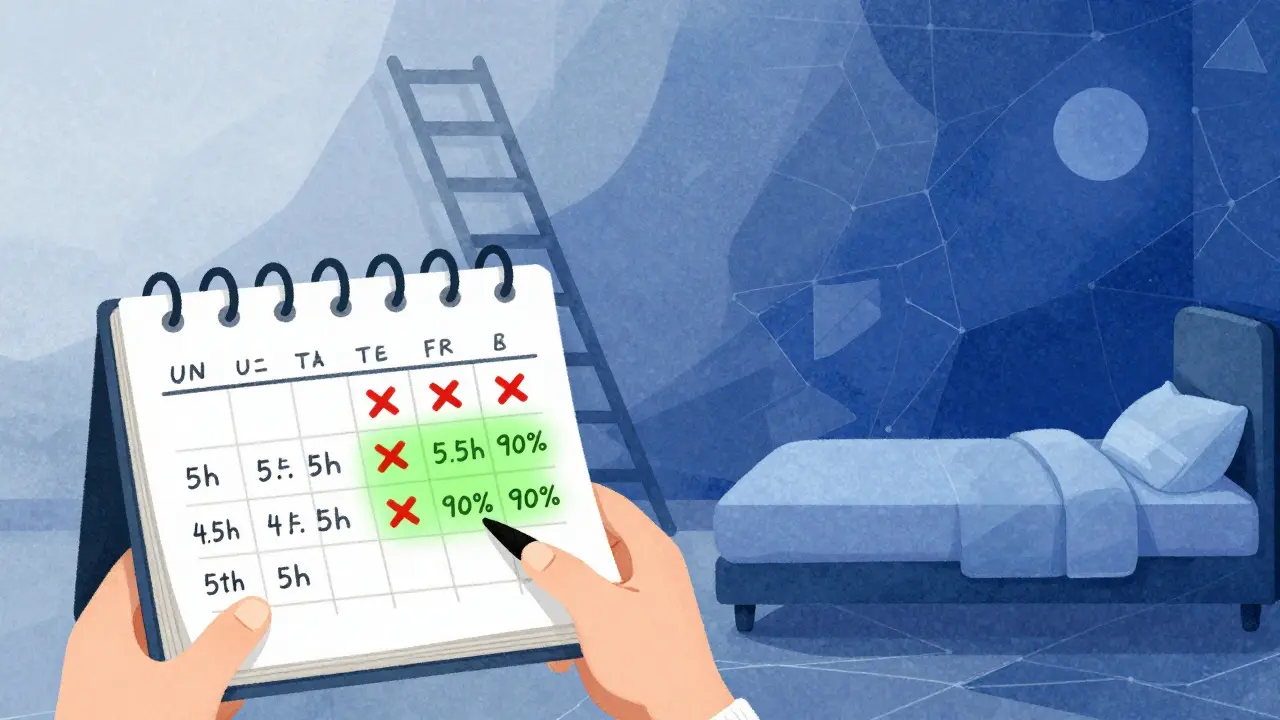
What Doesn’t Work With SRT
SRT isn’t magic. It won’t help if you’re cheating. The biggest mistake? Extending your time in bed on weekends. If you sleep in until 8 a.m. on Saturday, you’re undoing all the progress you made during the week. Your body’s internal clock gets confused. Sleep efficiency drops. Progress stalls. Napping is another trap. Even a 20-minute nap during the day can kill your sleep pressure. You won’t feel tired enough at night to fall asleep quickly. That’s why SRT requires no naps-full stop. It also doesn’t work well if you have severe depression, untreated anxiety, or shift work. Those conditions need additional support-like cognitive therapy or light therapy-alongside SRT. It’s not a standalone fix for everyone, but it’s a powerful tool when used correctly.Real People, Real Results
On Reddit’s r/Insomnia, a user named SleepSeeker89 wrote: “After three weeks of strict SRT, my sleep efficiency jumped from 68% to 89%. I fall asleep in 15 minutes instead of lying awake for hours.” Another user, TiredButSleeping, shared: “I used to spend 9 hours in bed for 6 hours of sleep. Now I get 7.5 hours of sleep in 8 hours-with almost no awakenings.” These aren’t outliers. In a survey of 1,243 people using digital CBT-I programs, 76% reported significant improvement in sleep quality. But 68% also said the first two weeks were the hardest. Daytime fatigue was real. But it faded. The people who succeed? They stick to their wake-up time. They track their sleep. They don’t nap. And they don’t give up when it feels impossible.How to Get Started-Without a Therapist
You don’t need to see a specialist to start SRT. But you do need structure. Start with a free sleep diary template (many are available online). Track for 7 days. Calculate your average. Set your wake-up time. Pick your bedtime. Stick to it. There are also digital tools that guide you through the process. CBT-i Coach, developed by the U.S. Department of Veterans Affairs, is free and evidence-based. Sleepio and Somryst are FDA-cleared apps that deliver full CBT-I programs-including SRT-remotely. Somryst showed 64% efficacy in a 2023 trial. If you can afford it, work with a CBT-I-certified therapist. There are about 1,200 in the U.S. alone, according to the Society of Behavioral Sleep Medicine. In Australia, access is growing, especially in major cities like Perth.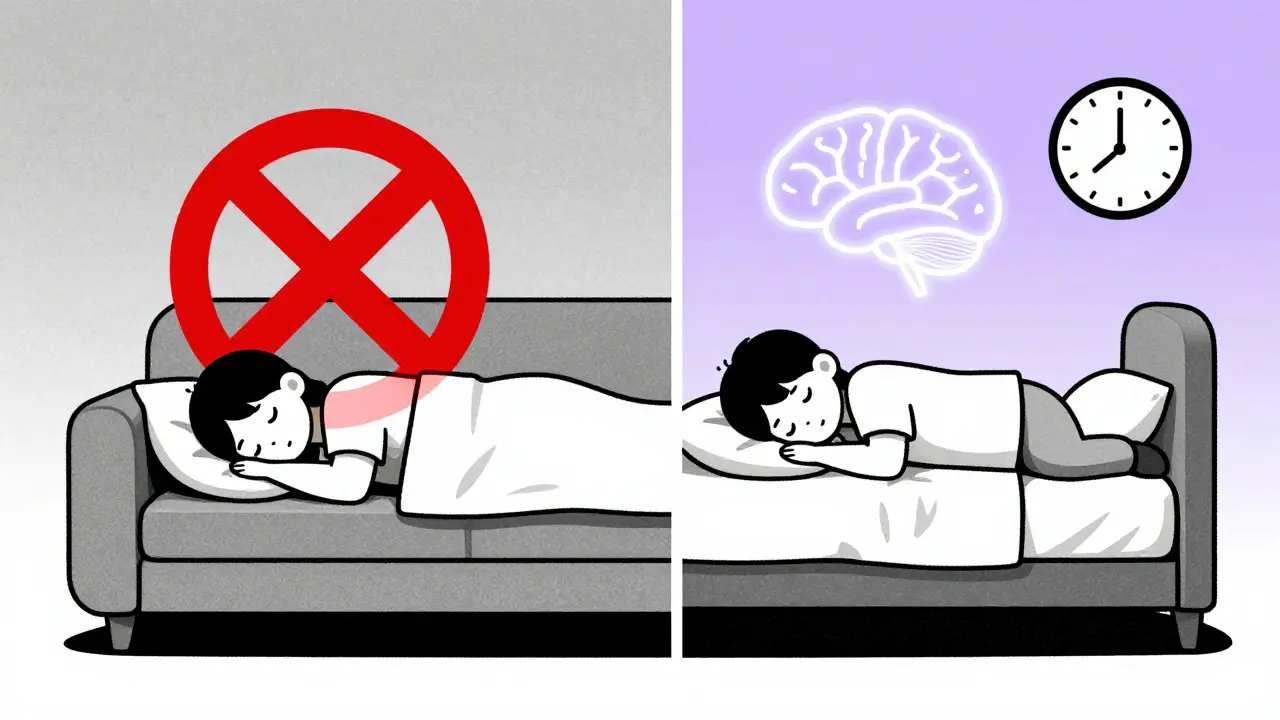
What to Expect in the First Two Weeks
The first 14 days are the hardest. You’ll feel tired. You might struggle to focus. You might snap at people. You might wonder if this is worth it. But here’s the truth: this fatigue isn’t dangerous. It’s temporary. It’s the price of rebuilding your sleep drive. Your body isn’t broken-it’s just out of sync. By week three, most people notice a shift. Falling asleep becomes easier. Waking up at night happens less. You start to feel like sleep is a reward, not a battle. And by week six? Many people report sleeping like they did in their 20s.When to Quit SRT
You shouldn’t quit because it’s hard. You should quit if:- You’re driving or operating machinery and feel dangerously sleepy.
- You have a medical condition that makes sleep deprivation risky (like heart disease or epilepsy).
- You’re unable to maintain a consistent wake-up time.
- You’re not tracking your sleep and are guessing your times.
Why SRT Is the Future of Insomnia Treatment
The global insomnia market is worth over $1.3 billion. But most of that money goes to pills, patches, and supplements that offer short-term relief. SRT is different. It’s the only treatment proven to create lasting change. The American College of Physicians gives it a strong recommendation. The NIH is investing $2.3 million to study personalized SRT using circadian biomarkers. Digital platforms are making it more accessible than ever. In 2024, the American College of Physicians officially recognized digital CBT-I as equivalent to in-person therapy. That means you can now get the same results from your phone. The barrier isn’t effectiveness. It’s awareness. Only 15% of people with insomnia ever get CBT-I. Most still turn to pills because they don’t know there’s another way. You now do.Can I do Sleep Restriction Therapy on my own?
Yes, you can start SRT on your own using a sleep diary and a fixed wake-up time. Many people successfully complete it using free tools like CBT-i Coach or apps like Sleepio. But if you have anxiety, depression, or other medical conditions, working with a CBT-I-certified therapist increases your chances of success and safety.
How long does Sleep Restriction Therapy take to work?
Most people see improvements within 2-3 weeks, but the full process usually takes 6-8 weeks. The key is consistency. Progress isn’t linear-some nights will feel worse before they get better. Stick with the schedule, track your sleep, and don’t rush the process.
Is it safe to be sleep-deprived during SRT?
The sleep restriction is controlled and temporary. It’s not the same as chronic sleep deprivation. But you should avoid driving, operating heavy machinery, or making critical decisions during the first 1-2 weeks when daytime sleepiness is highest. Plan your schedule accordingly-take it easy during this phase.
What if I can’t stick to the same wake-up time on weekends?
If you change your wake-up time on weekends, you’ll undo your progress. SRT relies on a consistent circadian rhythm. Even a 1-hour shift can delay your results by days. Treat your wake-up time like a medical appointment-non-negotiable. If weekends are a challenge, adjust your bedtime instead, not your wake-up time.
Will I ever be able to sleep longer again?
Yes. The goal of SRT isn’t to keep you in bed for only 5 hours forever. It’s to teach your body to sleep efficiently. Once your sleep efficiency reaches 85-90% consistently, you gradually add time back-usually 15-30 minutes every few weeks-until you’re sleeping 7-8 hours in a way that feels natural and restful.
Does SRT work for older adults or postmenopausal women?
Yes. A 2019 study found SRT improved sleep efficiency by 22.7% in postmenopausal women with insomnia-outperforming sleep medication, which only improved efficiency by 15.3%. Older adults often respond even better than younger people because their sleep drive has weakened over time. SRT rebuilds that drive safely and effectively.



Astha Jain
19 January, 2026 . 04:50 AM
so like... u just stop going to bed until ur *so* tired u pass out? lmao i tried this and ended up napping at my desk for 3 hours. why is everyone acting like this is genius??
Erwin Kodiat
20 January, 2026 . 16:36 PM
I tried this last year after 5 years of insomnia. First two weeks? Brutal. I cried at work. But by week 4? I fell asleep in 10 minutes. No pills. No apps. Just discipline. It’s not magic-it’s math. And it works.
Lydia H.
20 January, 2026 . 18:13 PM
There’s something deeply human about this approach. We’re so used to fixing things with more-more sleep, more meds, more gadgets. But SRT says: *less* is the cure. It’s not about forcing sleep. It’s about trusting your body again. And that? That’s healing.
Jake Rudin
22 January, 2026 . 17:40 PM
I appreciate the thoroughness of this post, but I must note: the claim that SRT 'cuts time-to-sleep by up to 50%' is misleading without specifying baseline metrics. Also, 'sleep efficiency' is not universally defined across studies-some use 85%, others 90%. Precision matters.
Josh Kenna
24 January, 2026 . 13:53 PM
I was skeptical until I did this. I used to be in bed 9 hours for 5 hours of sleep. Now? 7 hours in bed, 6.8 hours asleep. No naps. No alcohol. No 'just one more scroll'. I almost quit at week 2-I was a zombie. But I stuck with it. My brain finally stopped treating my bed like a coffee shop.
Valerie DeLoach
25 January, 2026 . 05:06 AM
To anyone thinking this is too rigid: it’s not about punishment. It’s about reprogramming. Your brain learned that bed = anxiety. Now you’re teaching it bed = sleep. That’s neuroscience, not torture. And yes, weekends matter. If you sleep in, you’re sabotaging your progress. Treat your wake-up time like a sacred ritual.
Christi Steinbeck
26 January, 2026 . 04:11 AM
I did this while working night shifts. No, it didn’t work perfectly-but I still got 30% better sleep. If you’re tired of being exhausted and blaming yourself, try this. Not because it’s easy. Because you deserve to rest.
Jacob Hill
27 January, 2026 . 10:22 AM
I’ve been doing SRT for 5 weeks. My sleep efficiency went from 62% to 88%. I’m not saying it’s easy. I’m saying it’s worth every sleep-deprived, foggy, angry day. The fatigue fades. The peace? It stays.
Lewis Yeaple
28 January, 2026 . 07:11 AM
The assertion that SRT is 'the only treatment proven to create lasting change' is empirically unsupported. While CBT-I components-including SRT-demonstrate durable outcomes, the comparative efficacy against pharmacological interventions remains context-dependent. Furthermore, generalizability across populations with comorbidities is under-researched.
Jackson Doughart
28 January, 2026 . 16:30 PM
I used to hate this method. Thought it was cruel. But after my third week, I woke up without checking the clock. For the first time in ten years, I didn’t dread bedtime. I started to look forward to it. That’s not just sleep. That’s peace.
Tracy Howard
28 January, 2026 . 22:38 PM
Americans love their 'biohacks' but ignore the root: stress, capitalism, and screens. SRT is just a band-aid on a bullet wound. In Canada, we just... sleep. No spreadsheets. No apps. We don't need to 'reset' our brains-we just live. This feels like overcomplicated nonsense.
Aman Kumar
28 January, 2026 . 23:41 PM
This is classic Western medical reductionism. You can't fix circadian dysregulation with arbitrary time-in-bed calculations. You need Ayurvedic detox, bhringraj oil, and pranayama. SRT is a placebo for the techno-obsessed. Real sleep comes from balance-not spreadsheet discipline.
Phil Hillson
29 January, 2026 . 07:33 AM
So you’re telling me I have to be a robot with a fixed wake up time and no naps and no weekends and no fun?? I’m sorry but I have a life and a cat who wakes me up at 5am anyway so this is just a waste of time