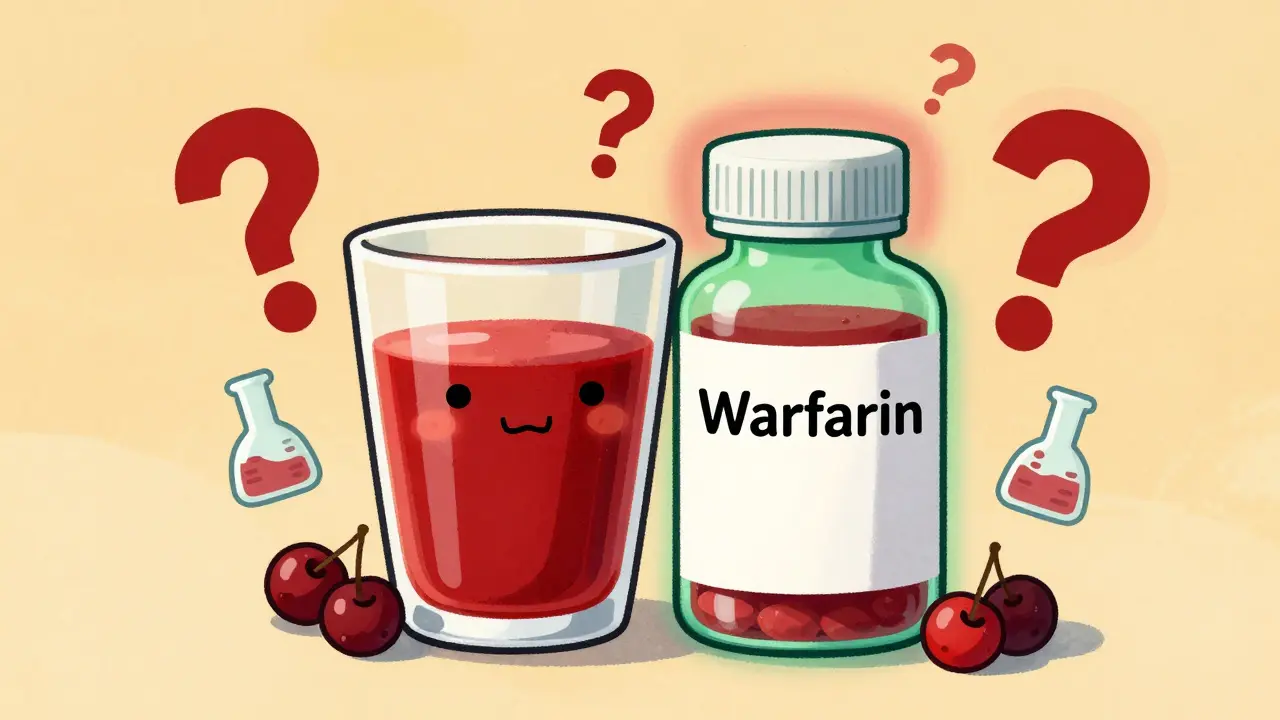
For decades, cranberry juice has been a go-to remedy for preventing urinary tract infections (UTIs). But if you’re on medication-especially blood thinners like warfarin-you’ve probably heard warnings to avoid it. Is the fear real? Or is it just another health myth that won’t die?
The truth isn’t black and white. Some people swear cranberry juice caused their INR to spike. Others drink it daily with no issues. And experts? They’re divided. The science doesn’t support a blanket warning, but it also doesn’t give you a clean green light. Here’s what actually matters.
Why the Confusion Exists
The alarm started in 2003, when a single case report suggested cranberry juice might boost the effects of warfarin, leading to dangerous bleeding. That one story spread like wildfire. Pharmacies started posting signs. Doctors began advising patients to stop drinking it. But one case doesn’t prove a pattern.
Since then, researchers have run dozens of studies. Four well-controlled clinical trials found no significant change in INR levels when people drank cranberry juice while on warfarin. One of them, led by Edwards in 2009, gave 12 healthy adults 250mL of cranberry juice three times a day for two weeks. No spike in INR. No bleeding. Nothing unusual.
So why do stories still pop up? Because humans notice outliers. If someone starts drinking cranberry juice and their INR jumps from 2.5 to 4.0, they’ll blame the juice. They won’t remember they also started a new antibiotic, skipped a dose of warfarin, or changed their diet. Correlation isn’t causation-and in medicine, that’s where things go wrong.
How Cranberry Juice Might Interact (Theoretically)
Cranberry juice contains compounds called proanthocyanidins and flavonoids. In lab tests, these can slow down certain liver enzymes-specifically CYP2C9 and CYP3A4-that break down drugs. That’s the same mechanism grapefruit juice uses to dangerously raise levels of statins, blood pressure meds, and sedatives.
But here’s the catch: what happens in a test tube doesn’t always happen in your body. The concentration of these compounds in a typical glass of cranberry juice (even the 100% kind) is too low to have a meaningful effect on most drugs. Studies show you’d need to drink several liters a day to reach the levels that inhibit enzymes in lab settings.
For example, a 2009 study tested cranberry juice with two common antibiotics-amoxicillin and cefaclor. Researchers thought cranberry might interfere with how these drugs are absorbed. The result? No change in overall drug levels in the bloodstream. Even though absorption was slightly delayed, the total amount absorbed stayed the same. No need to worry.
Warfarin: The One Real Exception
Warfarin is different. It has a narrow therapeutic window-meaning even small changes in blood levels can cause bleeding or clots. And while most studies show no interaction, the outliers are too dangerous to ignore.
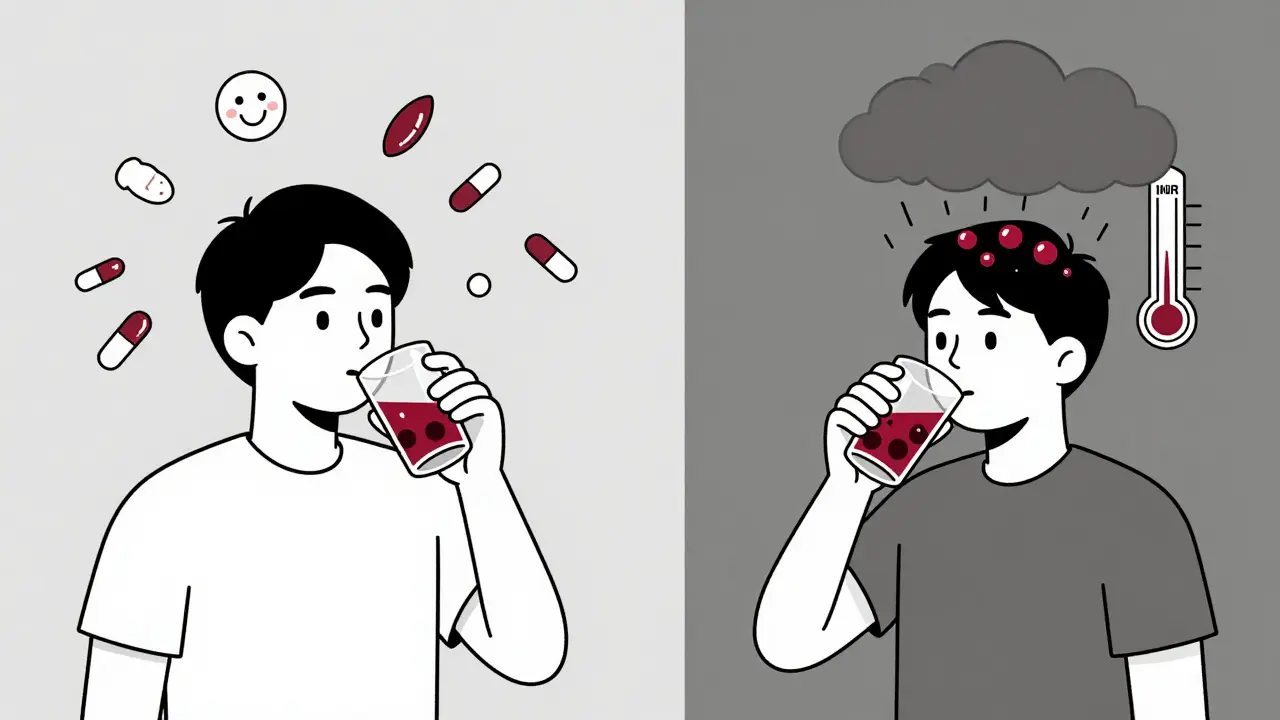
Eight case reports in medical journals describe people on warfarin who had sudden INR spikes after starting cranberry juice. One patient’s INR jumped from 2.8 to 6.1 after drinking two glasses a day. Another had a brain bleed after starting cranberry supplements. These aren’t hypotheticals. They’re real, documented events.
Why the inconsistency? It could be genetics. Some people metabolize warfarin differently. Or maybe they’re drinking concentrated cranberry extract, not juice. Or perhaps they’re also taking other supplements or changing their vitamin K intake. The exact reason isn’t clear. But the risk, however small, is serious.
That’s why the American College of Clinical Pharmacy says: if you’re on warfarin, avoid cranberry products-or be extremely consistent. If you drink it once a week, keep doing that. Don’t suddenly start drinking three glasses a day. And always get your INR checked more often if you start or stop.
What About Other Medications?
Here’s the good news: for almost every other medication, cranberry juice is fine.
Statins? No interaction shown. Blood pressure pills? No issue. Antibiotics? Proven safe. Antidepressants? No evidence of concern. Even diabetes meds and thyroid pills are unaffected.
One drug that sometimes gets flagged is alprazolam (Xanax). It’s broken down by CYP3A4-the same enzyme cranberry might affect in a lab. But no human study has ever shown cranberry juice raises alprazolam levels. Same with statins like atorvastatin. The theory exists, but the proof doesn’t.
The real danger isn’t cranberry juice. It’s confusing it with grapefruit juice. Grapefruit has 17 well-documented, life-threatening interactions. Cranberry? One possible one-with warfarin-and even that’s debated.
What About Cranberry Supplements?
This is where things get trickier.
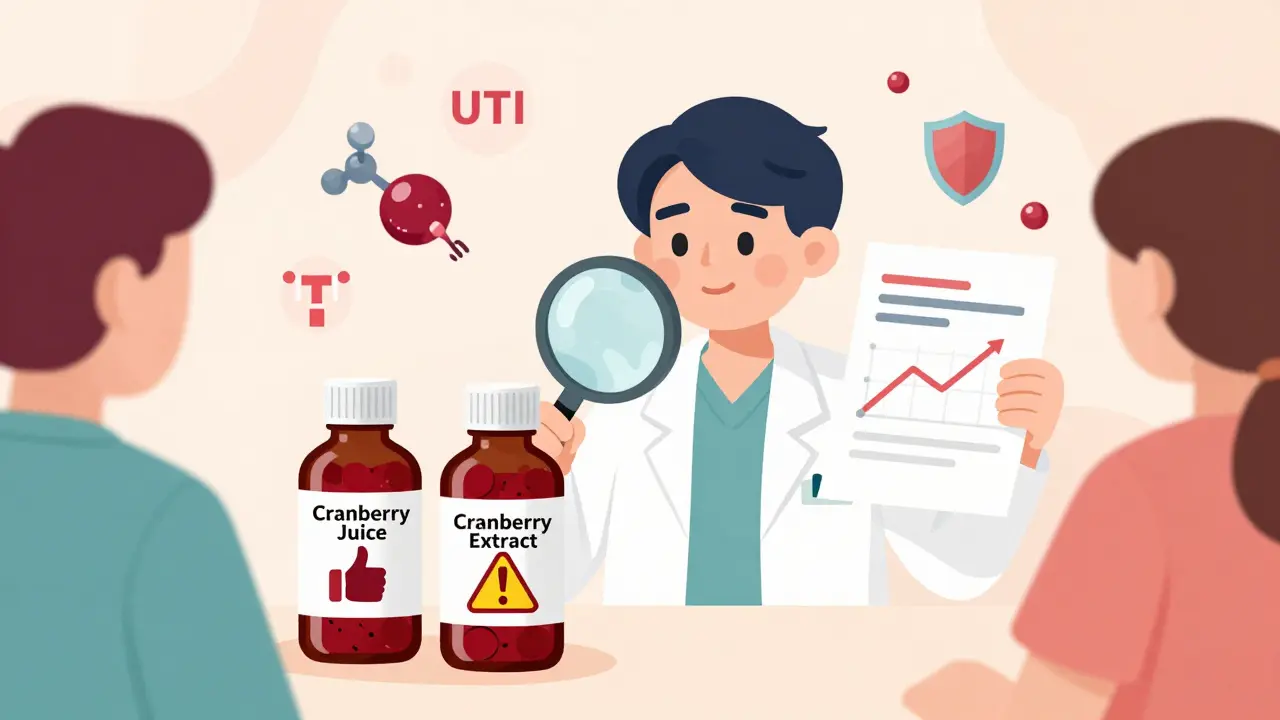
Cranberry juice cocktails? Usually only 27% cranberry. The rest is sugar and water. But supplements? Some contain concentrated extracts with up to 36mg of proanthocyanidins per pill. That’s the equivalent of drinking a full bottle of pure cranberry juice in one go.
These concentrated forms haven’t been studied as thoroughly. And that’s a problem. The 2023 multicenter trial looking at cranberry extract and direct oral anticoagulants (like apixaban) is still ongoing. Until we have solid data, it’s safer to assume these supplements carry more risk than juice.
Most people don’t realize they’re taking concentrated extracts. Labels say “cranberry extract” or “standardized to 36mg PACs.” They think it’s just a stronger version of juice. It’s not. It’s a different beast.
What Should You Do?
Let’s cut through the noise. Here’s what works in real life:
- If you’re on warfarin: Avoid cranberry supplements. Stick to no more than one 8oz glass of standard cranberry juice per day-and don’t change your intake suddenly. Tell your doctor or pharmacist you’re drinking it. Get your INR checked more often when you start or stop.
- If you’re on any other medication: Cranberry juice is almost certainly safe. You don’t need to stop. You don’t need to space it out from your pills. Just enjoy it.
- Don’t confuse juice with supplements. Juice = low risk. Supplements = higher uncertainty. If you’re unsure, ask your pharmacist. Bring the bottle.
- Don’t panic about grapefruit. If you’re avoiding grapefruit because of your meds, don’t assume cranberry is the same. They’re not interchangeable.
And if you’re taking cranberry juice to prevent UTIs? Good. It works. About 20% of women have recurrent UTIs, and cranberry is one of the few proven, non-antibiotic options. Stopping it over fear of a myth means you’re trading a real benefit for a theoretical risk.
Why This Matters Beyond the Juice
This isn’t just about cranberry. It’s about how we make decisions in medicine.
We hear one scary story. We panic. We warn everyone. Then we ignore the data that says it’s mostly harmless. Patients end up avoiding safe, helpful things because of misinformation. That’s how we hurt people-not by letting them drink juice, but by making them afraid to take care of themselves.
The goal isn’t to eliminate risk. It’s to understand it. Cranberry juice isn’t dangerous for 99% of people. For the 1% on warfarin, it’s a cautionary tale-not a ban. And that’s the difference between fear-based advice and evidence-based care.
Final Takeaway
You don’t need to give up cranberry juice. You just need to be smart about it.
For most people: drink it. Enjoy it. It helps with UTIs and has antioxidants. No problem.
For people on warfarin: be cautious. Stick to small amounts. Don’t switch to supplements. Talk to your doctor. Monitor your INR.
And if your pharmacist tells you to avoid it entirely-ask why. The science doesn’t support a blanket warning. If they can’t explain the evidence, they’re repeating a myth.
Knowledge beats fear every time.




Glendon Cone
30 December, 2025 . 23:43 PM
I’ve been drinking cranberry juice daily for years while on warfarin. My INR’s been stable as hell. My pharmacist freaked out when I told him, but my doctor just laughed and said, 'Show me the data.' Guess what? It’s on my side. 🍒
Henry Ward
31 December, 2025 . 17:50 PM
Anyone who drinks cranberry juice on warfarin is playing Russian roulette with their brain. One spike, one bleed, and you’re dead. Don’t be that guy. Just stop. It’s not worth it. 🤡
Aayush Khandelwal
1 January, 2026 . 04:03 AM
Let’s not conflate pharmacokinetic theory with clinical reality. The CYP2C9 inhibition is *in vitro* noise at physiological concentrations. The real issue is polypharmacy + genetic polymorphisms + poor INR monitoring. Blaming cranberry juice is like blaming rain for a car crash. 🧠
Sandeep Mishra
2 January, 2026 . 17:18 PM
It’s funny how we treat food like a drug sometimes. Cranberry juice isn’t a pill. It’s a beverage. If you’re worried about interactions, maybe check your diet, your sleep, your stress. Not the cranberry. 🙏
kelly tracy
3 January, 2026 . 21:11 PM
Of course the article says it’s fine. The same people who said coffee was safe for heart patients also said sugar was fine. We’re just being manipulated by juice lobbyists. 🤬
srishti Jain
4 January, 2026 . 03:08 AM
My aunt died from a bleed after cranberry juice. Case closed. Don’t be dumb.
Cheyenne Sims
5 January, 2026 . 09:28 AM
While the article presents a compelling narrative, it fails to acknowledge the potential for idiosyncratic reactions and the ethical obligation of clinicians to err on the side of caution. Anecdotes are not data, but neither is data a license for negligence.
henry mateo
6 January, 2026 . 18:27 PM
wait so if i drink cranberry juice and im on warfarin i should just not change how much i drink? like if i drink 1 glass a week for 2 years and then start drinkin 2? thats bad? idk i just wanna know if its ok
Kunal Karakoti
8 January, 2026 . 15:43 PM
Perhaps the real question isn’t whether cranberry juice interacts with warfarin-but whether our medical system is built to handle nuance at all. We want binary answers: safe or dangerous. But biology? It’s a gradient. 🌫️
Kelly Gerrard
9 January, 2026 . 02:26 AM
Knowledge beats fear every time. This is the most important line in the entire article. Thank you for writing this. I’ve been telling my patients this for years. 🙌
Joseph Corry
9 January, 2026 . 10:31 AM
Ah yes, the classic 'studies show' defense. Convenient how the evidence always aligns with the preferred narrative. Meanwhile, real people are ending up in ICUs because someone thought 'the data' was more important than the outlier. Philosophy 101: correlation ≠ causation. But neither does absence of evidence = evidence of absence.
Colin L
10 January, 2026 . 01:39 AM
Look, I’ve been on warfarin for 12 years. I used to drink cranberry juice every morning. Then one day my INR went from 2.4 to 5.9. No change in meds, no new supplements, no antibiotics. Just cranberry juice. I stopped. INR went back to 2.3. That’s not a myth. That’s my life. So don’t tell me it’s fine for everyone. I’m not a statistic. I’m the guy who almost died because someone told me 'the science doesn’t support it.' The science didn’t stop my bleeding. My doctor did.
Hayley Ash
10 January, 2026 . 11:49 AM
So let me get this straight - you’re telling me grapefruit is the villain, but cranberry is the innocent bystander? 😂 Next you’ll say sugar isn’t addictive and cigarettes are just ‘a flavor.’
Shae Chapman
11 January, 2026 . 03:27 AM
My grandma drinks cranberry juice every day and she’s 82 and her INR is perfect. She’s also on blood pressure meds and diabetes pills. She doesn’t read studies. She just listens to her body. Maybe that’s the real wisdom here. 🌸
Nadia Spira
12 January, 2026 . 07:55 AM
Typical pseudoscience dressed as evidence. 'Most studies show' - which ones? Who funded them? Did they control for vitamin K variability? Did they test concentrated extracts? No. Because the narrative is more profitable than truth. Cranberry supplements are a $2B industry. The juice? A Trojan horse.