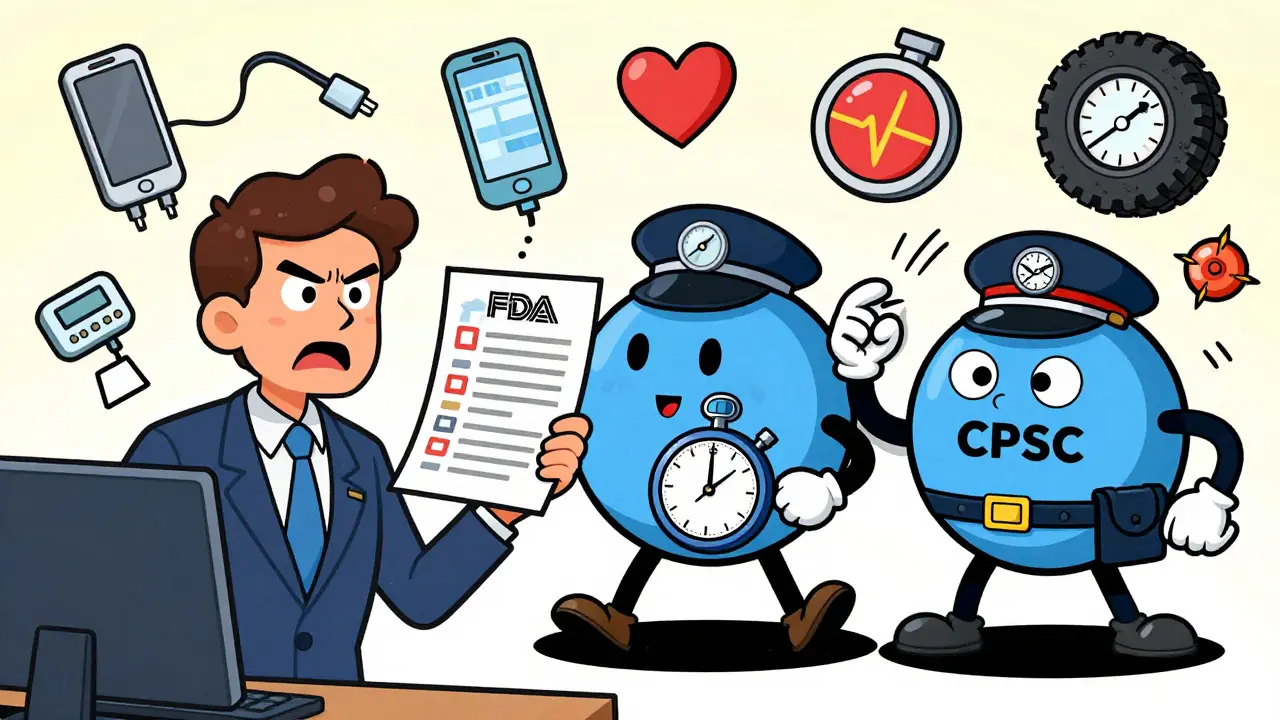
Imagine your phone charger overheats and starts smoking. Or worse, a heart monitor fails during a critical surgery. Who knows about it? Who fixes it before someone gets hurt? The answer isn't just luck-it’s **manufacturer safety reporting**. This is the legal backbone of product safety in the United States. It forces companies to tell government agencies when their products cause harm or pose a risk. If you make anything sold to consumers or used in healthcare, you are likely part of this system. Getting it wrong can mean massive fines, lawsuits, or even criminal charges. Getting it right saves lives.
This guide cuts through the bureaucratic noise. We will look at who needs to report, what they must report, and how to do it without burning out your quality team. Whether you manufacture medical devices, household appliances, or car parts, the rules differ, but the stakes remain high.
The Big Three: Which Agency Watches Your Back?
You don’t report everything to one place. Depending on what you build, three main federal agencies have jurisdiction. Knowing which one applies to you is step one.
- Food and Drug Administration (FDA): They watch medical devices. If you make anything from a simple thermometer to a complex MRI machine, you fall under FDA rules. Specifically, this is governed by the Medical Device Reporting (MDR) regulation, found in 21 CFR Part 803.
- Consumer Product Safety Commission (CPSC): They handle general consumer goods. Think toys, furniture, electronics, and clothing. Their rulebook is Section 15(b) of the Consumer Product Safety Act (CPSA).
- National Highway Traffic Safety Administration (NHTSA): They oversee vehicles and vehicle equipment. If you make tires, airbags, or brake systems, NHTSA’s Early Warning Reporting system is your playground.
Most manufacturers deal with only one of these. However, if you make a smartwatch that tracks heart rate (medical device) and also plays music (consumer electronic), you might need to talk to both the FDA and the CPSC. Confusion here is expensive.
FDA Rules: The Heavyweight Champion of Reporting
The FDA’s Medical Device Reporting (MDR) system is the most detailed and demanding. Established by the Medical Device Amendments of 1976, it requires manufacturers to report specific adverse events. You aren't just reporting complaints; you are reporting data points that suggest a pattern of danger.
- A death
- A serious injury (hospitalization, permanent damage, or life-threatening illness)
- A malfunction that would likely cause death or serious injury if it happened again
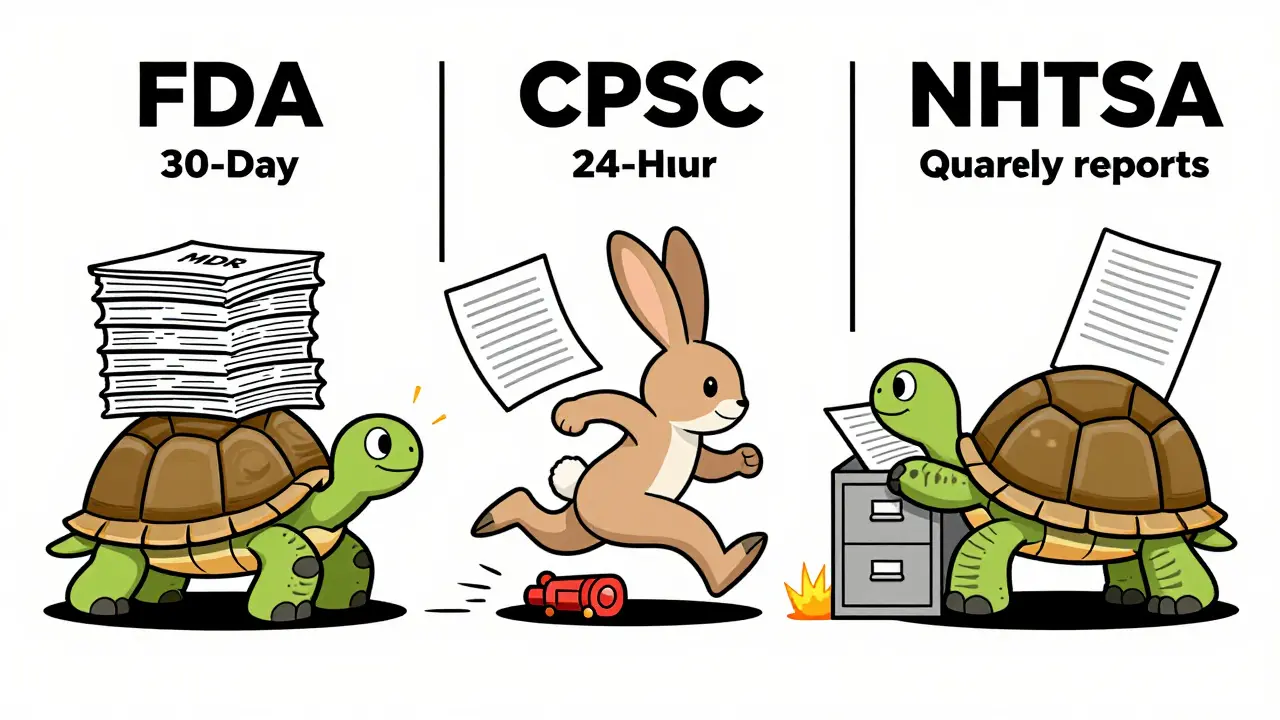
The clock starts ticking the moment you "become aware" of the event. For most deaths and serious injuries, you have 30 calendar days to submit Form FDA 3500A or its electronic equivalent. But there is a faster lane: if the device needs remedial action to prevent substantial harm (like a recall), you have only 5 working days.
Why so strict? Because the FDA receives about 1.2 million reports annually. As of 2023, Commissioner Robert M. Califf noted that improving real-world evidence collection is a top priority. The agency uses this data to spot trends. If ten different patients report pain from the same knee implant, the FDA investigates. If you delay reporting, you hide the trend. That’s why penalties for non-compliance can hit up to $252,756 per violation, adjusted for inflation in 2024.
CPSC Rules: Speed Over Detail
If you sell consumer products, the CPSC moves much faster than the FDA. Under Section 15(b) of the CPSA, you must report within 24 hours of obtaining "reportable information."
Here is the tricky part: "Reportable information" doesn’t require an actual injury. You must report if you know of:
- A product defect that creates a substantial risk of injury.
- An unreasonable risk of serious injury or death.
- A failure to comply with a safety standard.
Notice the difference? The FDA often waits for harm to occur. The CPSC wants to know about the risk before the harm happens. This 24-hour window is brutal for many companies. In 2023, CPSC guidance clarified that you don’t need proof of injury, just knowledge of the defect. Electronics manufacturers accounted for 34% of all CPSC reports in FY2023, largely due to battery fires and overheating issues.
Erin D. Garcia de Jesus of Consumer Reports pointed out in October 2023 that this speed often leads to messy initial reports. About 37% of first submissions need significant follow-up. Don’t panic. Submit what you have within 24 hours, then update as you investigate. Silence is not an option.
NHTSA: Quarterly Snapshots
Vehicle manufacturers play a longer game. NHTSA’s Early Warning Reporting requires quarterly submissions. You send crash, injury, and death data every three months. However, specific thresholds trigger immediate attention. For example, tire manufacturers must report immediately if they receive info about 5+ deaths, 10+ injuries, or 10+ property damage claims linked to a single tire model.
This system relies on volume. One crash might be bad luck. Fifty crashes involving the same door latch design is a signal. The TREAD Act of 2000 formalized this after tragic tire failures in the late 1990s. It remains a cornerstone of automotive safety.
Comparison Table: FDA vs. CPSC vs. NHTSA
| Feature | FDA (Medical Devices) | CPSC (Consumer Products) | NHTSA (Vehicles) |
|---|---|---|---|
| Governing Law | FD&C Act / 21 CFR 803 | CPSA Section 15(b) | TREAD Act |
| Reporting Deadline | 30 days (5 days for remedial action) | 24 hours | Quarterly (with threshold triggers) |
| Trigger Event | Death, Serious Injury, Malfunction | Defect creating substantial risk | Crash, Injury, Death patterns |
| Injury Required? | Yes (for most reports) | No (risk is enough) | Yes (for individual events) |
| Penalty Risk | Up to $252k/violation | Recall orders, Fines | Recalls, Civil Penalties |

The Hidden Costs: Time, Money, and Stress
Compliance isn’t free. It eats into your budget and your team’s sanity. A 2023 survey by the Medical Device Manufacturers Association (MDMA) found that 68% of member companies spend more than $50,000 annually just on MDR compliance. Small businesses with fewer than 50 employees spend an average of 18.7% of their quality department budget on this alone.
Sarah Chen, a Quality Manager at a MedTech company, reported spending 1,200 hours a year on MDR tasks. The hardest part? Interpreting when she "became aware" of an issue. FDA inspectors often disagree on this definition. One inspector might say a customer email triggered the clock. Another might say it was the internal engineering review. This ambiguity causes stress and inconsistent practices.
To manage this, companies invest in Quality Management Systems (QMS). Gartner’s 2023 market guide puts the cost at $185,000 for small manufacturers and over $750,000 for large enterprises. These systems automate tracking, document storage, and submission workflows. Without them, you are managing thousands of PDFs in shared folders. Good luck finding that one incident report from three years ago during an audit.
Pro Tips for Staying Compliant
You don’t need to be a lawyer to stay compliant, but you do need process. Here is how successful manufacturers handle the load:
- Define "Becoming Aware": Write a clear policy. Does a complaint from a sales rep count? Yes. Does a forum post count? Maybe. Train every employee. The FDA says if any employee reasonably should pass the info to quality, the clock starts.
- Use Voluntary Summary Reporting: If you’re under the FDA, check if you qualify for Voluntary Malfunction Summary Reporting. Modified in August 2024, this lets you group similar malfunctions into one summary report instead of filing hundreds of individual ones. Medtronic reported a 63% reduction in individual reports using this method.
- Automate Data Collection: Manual entry leads to errors. Use software that integrates with your CRM and helpdesk. When a ticket is marked "Safety Issue," it should auto-alert your quality team.
- Keep Records Forever (Almost): FDA requires keeping MDR files for two years after the device’s manufacture date or last distribution, whichever is later. Store them digitally with backups. Paper records get lost. Digital records get searched.
- Don’t Guess on CPSC Risks: When in doubt, report to the CPSC. Their 24-hour rule favors caution. An unnecessary report is better than a missed one. You can always clarify later.
Future Trends: AI and Faster Timelines
The landscape is shifting. Congress is pushing for stricter timelines. The Medical Device Safety Act of 2023 proposes cutting the FDA reporting window from 30 days to 15 days for high-risk devices. Meanwhile, technology is catching up. Deloitte predicts that AI-powered adverse event detection will cut false negatives by 45% and prep time by 60% by 2027. Companies like Philips Healthcare are already using machine learning to slash MDR preparation time from 8.2 hours to 3.5 hours per report.
The goal is clear: faster detection, smarter analysis, and safer products. As a manufacturer, you can wait for regulations to force change, or you can adopt these tools now to protect your brand and your customers.
Who exactly is considered a "manufacturer" under these laws?
It’s broader than you think. The FDA defines a manufacturer as anyone who fabricates, produces, processes, or prepares a device. This includes private-labelers. If you buy a generic device from China and put your brand name on it, you are the manufacturer in the eyes of the FDA. You cannot blame the overseas supplier for failing to report.
What happens if I miss a reporting deadline?
Consequences vary. The FDA may issue a Warning Letter, which becomes public and hurts your reputation. Repeated violations lead to civil penalties up to $252,756 per violation. In extreme cases, especially if harm resulted from delayed reporting, criminal charges are possible. The CPSC can force recalls and impose daily fines until compliance is met.
Do I need to report near-misses?
For the FDA, generally no, unless the malfunction could cause death or serious injury if it recurs. For the CPSC, yes, if the defect creates a substantial risk of injury, even if no one was hurt. Always err on the side of caution for consumer products.
How long do I need to keep my reporting records?
Under FDA 21 CFR 803.18, you must maintain MDR event files for two years after the date of manufacture of the device, or the date the device was last distributed, whichever is later. Some companies keep them indefinitely to protect against future litigation.
Can I use third-party software for submissions?
Yes, and it’s recommended. The FDA accepts electronic submissions via the Electronic Submission Gateway. Many QMS platforms integrate directly with this gateway. Ensure your vendor stays updated with FDA’s E3 standards for data exchange.