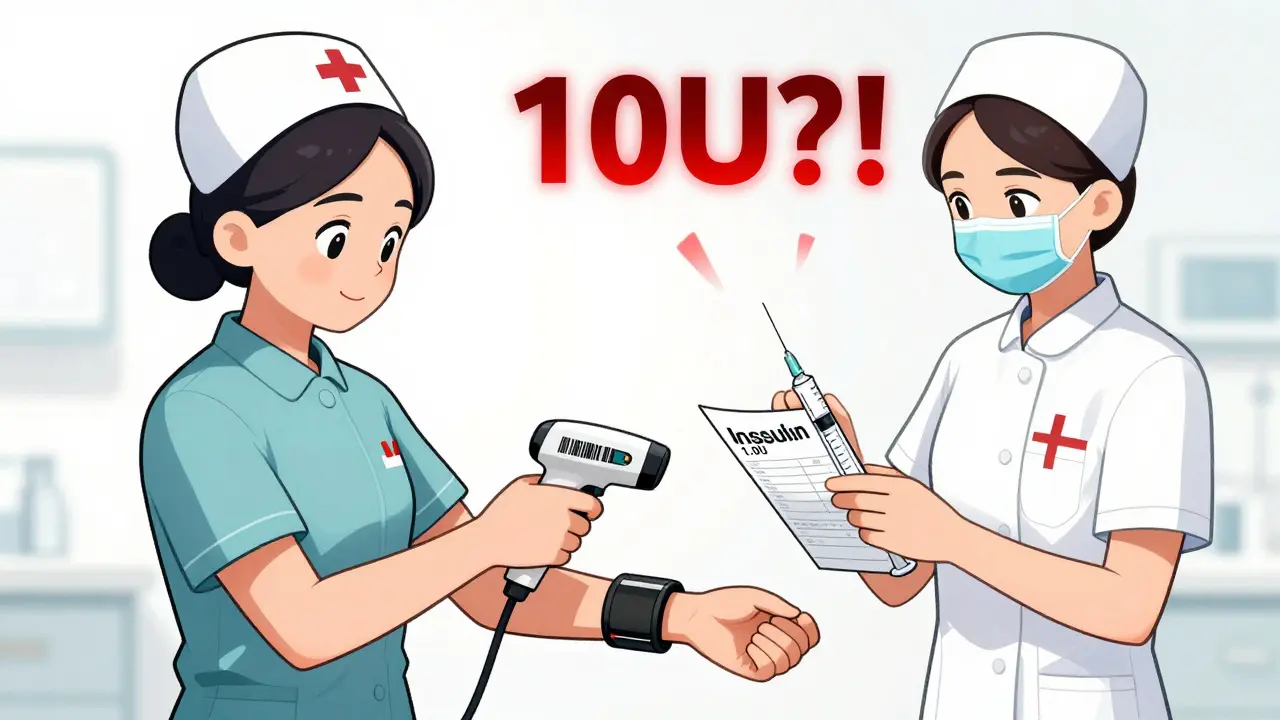
Getting a medication dose wrong can kill someone. It’s not a hypothetical. In 2022, over 1,200 reported incidents involved incorrect dose changes, and nearly 300 of those caused real harm. The problem isn’t usually one person being careless-it’s a system where communication breaks down, checks get skipped, and alerts become background noise. But it doesn’t have to be this way. With the right steps, you can stop these errors before they happen.
Why Dose Changes Are So Dangerous
Not all medications are created equal. Some, like insulin, heparin, and opioids, are called high-alert medications. A tiny mistake-writing 10U instead of 1.0U, or misreading a decimal point-can turn a safe dose into a lethal one. These drugs have narrow therapeutic windows. That means the difference between helping and harming is often just a fraction of a milligram. Pediatric patients are especially vulnerable. Doses are calculated by weight, often down to 0.1 mg/kg. A rounding error or a missed decimal can mean a child gets ten times the intended dose. For older adults with kidney issues, even standard adult doses can become toxic. And when a patient moves between units-say, from the ER to the ICU-dose changes get lost in handoffs. The Joint Commission found that miscommunication during these transitions is the root cause in 65% of serious medication errors.The Two-Part Solution: Technology and Human Checks
You can’t rely on just one layer of protection. You need both technology and human verification working together. Barcode medication administration (BCMA) systems scan the patient’s wristband and the drug label to confirm the right patient, drug, and dose. When used correctly, they prevent 86% of potential errors. But they’re not perfect. If a nurse enters the wrong concentration into the system, or if the barcode is smudged, the machine won’t catch it. One pharmacist reported a 10-fold dosing error slipped through because the concentration was entered correctly-but the actual dose was wrong. The machine didn’t know the difference. That’s where independent double checks come in. Two qualified staff members verify the same thing, separately and without talking to each other. They check the five rights: right patient, right drug, right dose, right route, right time. Studies show this catches 33% of dosing errors and nearly all wrong-vial mistakes. In sepsis simulations, double checks caught 100% of vial mix-ups. But here’s the catch: if you use them for everything, they lose their power. Nurses start treating them like a checkbox, not a safety net.When to Use Double Checks (And When Not To)
The Institute for Safe Medication Practices (ISMP) says it clearly: don’t double-check everything. Only use them where the risk is highest. Use independent double checks for:- High-alert medications: insulin, heparin, morphine, fentanyl, potassium chloride, and others on the ISMP’s 19-item list
- Pediatric doses, especially under 5 kg
- Changes to IV infusions or bolus doses
- Medications with narrow therapeutic indexes like warfarin, where INR levels must be checked within 24 hours of a dose change
- Low-risk, stable medications like routine antibiotics or antihypertensives
- Oral doses that haven’t changed from the previous day
- Situations where workflow disruption causes more harm than the risk you’re trying to prevent
Communication Is the Real Weak Link
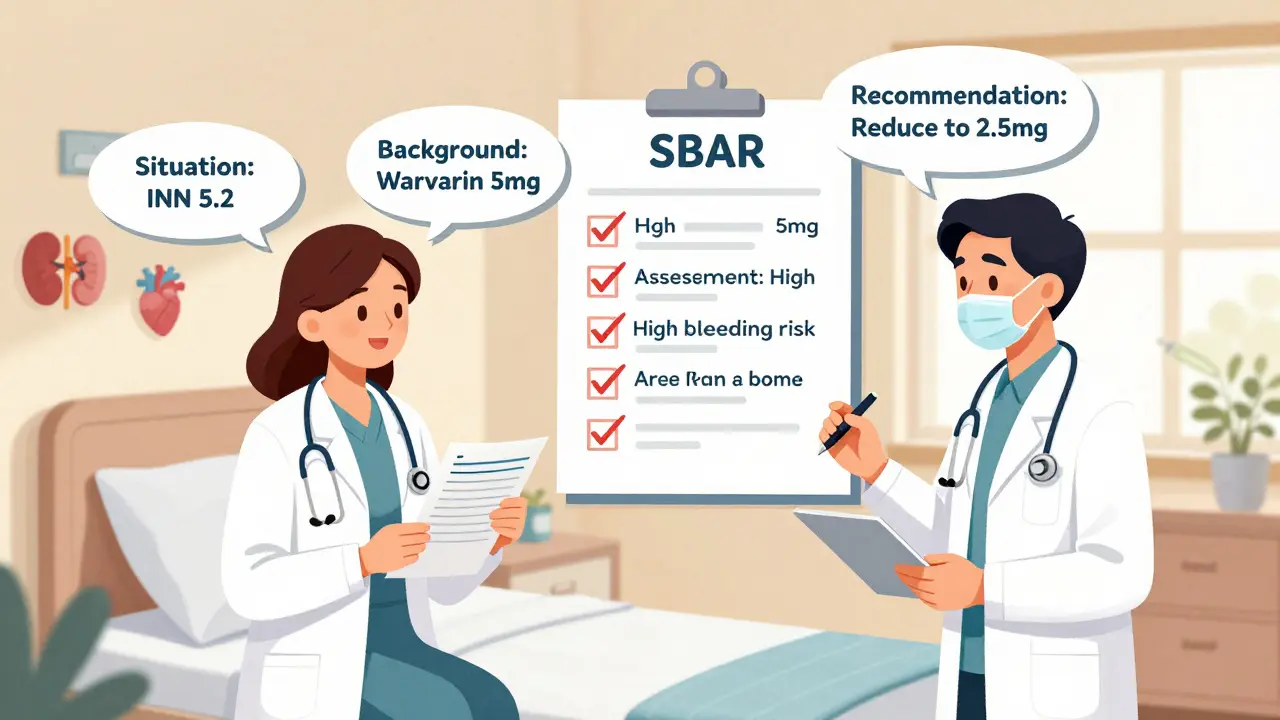
Technology can’t fix bad communication. The biggest failures happen during shift changes, handoffs, or when a provider scribbles a dose on a sticky note. Use SBAR-Situation, Background, Assessment, Recommendation-to structure every dose change conversation. For example:- Situation: “Mr. Jones’s INR is 5.2 this morning.”
- Background: “He’s been on 5 mg warfarin for atrial fibrillation since last month.”
- Assessment: “His INR is dangerously high. Risk of bleeding is elevated.”
- Recommendation: “I recommend holding the dose today and reducing to 2.5 mg starting tomorrow. Can you confirm?”
The 3-Step Verification Protocol
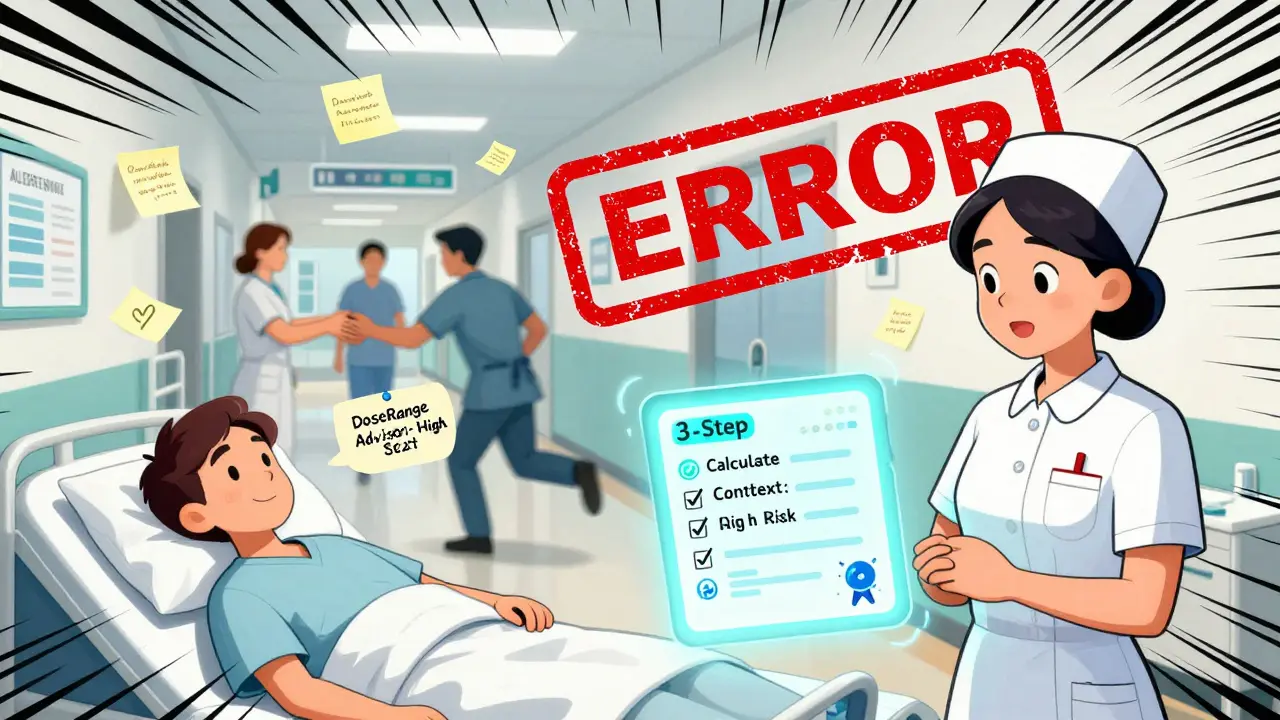
Here’s a simple, proven process for verifying any dose change:- Independent calculation: Two people calculate the dose separately-no sharing numbers. For insulin, this means checking the sliding scale, weight, and current glucose level. Takes 2-3 minutes.
- Context check: Review patient-specific factors: renal function, liver enzymes, recent labs, allergies, current meds. A dose that’s safe for one person could kill another. Adds 1-2 minutes.
- Bedside verification: Scan the barcode at the point of administration. Confirm the patient’s identity. Match the drug to the order. This step takes 30-60 seconds but is non-negotiable.
What Goes Wrong (And How to Fix It)
The biggest problems aren’t technical-they’re human.- Alert fatigue: Nurses get 50+ BCMA alerts in a 12-hour shift. Most are false. They start ignoring them. Solution: Tune the system. Only trigger alerts for true high-risk errors, not minor deviations.
- Time pressure: 73% of nurses admit skipping verification during busy shifts. Solution: Protect “safety time.” Johns Hopkins gives each nurse 15-20 minutes per shift to pause and verify without interruption. Errors dropped 22%.
- Incomplete documentation: If you don’t write down who verified what and when, you can’t trace a mistake. Solution: Use EHR templates that require fields for verifier names, time, and patient factors. Incomplete documentation causes 29% of verification failures.
- Shift handoffs: 61% of verification failures happen between 6-8 AM and PM. Solution: Mandate structured handoff protocols. No exceptions. Use checklists. Record verbal handoffs.
What’s Changing in 2026
The rules are getting stricter. The Joint Commission now requires reliable dose verification processes under NPSG.01.01.01, effective January 1, 2024. CMS penalizes hospitals with more than 0.5% dose verification error rates. That’s not a suggestion-it’s a financial risk. New tools are emerging:- AI predictors: Epic’s DoseRange Advisor analyzes patient history to flag inappropriate dose changes. In a 12-hospital trial, it reduced errors by 52%.
- Voice verification: Mayo Clinic’s pilot lets nurses say, “Verify insulin 5 units for patient Smith,” and the system logs it. Documentation time dropped 65%.
- Blockchain audit trails: Immutable records of every dose change-who ordered it, who verified it, when it was given. Still early, but promising.
Final Checklist for Safe Dose Verification
Before giving any dose change:- Is this a high-alert medication? If yes, trigger independent double check.
- Is the dose weight-based? Confirm the patient’s current weight and calculation.
- Has the patient’s renal or liver function changed? Check labs.
- Was the order communicated using SBAR? If not, clarify before proceeding.
- Was the dose entered correctly in the EHR? Check concentration and units.
- Did you scan the barcode at the bedside? Never skip this step.
- Did you document who verified it, when, and why?
What’s the most common cause of dose verification failures?
The most common cause is miscommunication during handoffs, especially between shifts or units. Studies show 65% of serious medication errors stem from unclear or incomplete communication when a dose is changed. This includes handwritten notes, rushed verbal reports, and lack of standardized tools like SBAR.
Do barcode systems really prevent errors?
Yes-but only if used correctly. Barcode systems prevent 86% of errors related to wrong drug, wrong patient, or wrong dose when scanning compliance is above 95%. However, they can’t catch errors in dose calculation, concentration entry, or wrong route. That’s why they must be paired with human verification for high-risk medications.
Should every nurse do a double check for every dose?
No. The Institute for Safe Medication Practices recommends targeted double checks only for high-alert medications, pediatric doses, and complex infusions. Using double checks for everything leads to fatigue and complacency. Focus your efforts where the risk is highest.
How long should a dose verification take?
A full verification-calculation, context check, and bedside scan-should take 4 to 6 minutes total. The independent calculation takes 2-3 minutes, reviewing patient factors adds 1-2 minutes, and the barcode scan takes 30-60 seconds. Rushing this process increases risk. Protect this time as essential patient care.
What should I do if I catch a dose error?
Stop the medication immediately. Notify the prescriber and document the error in detail, including how it was caught. Report it through your facility’s safety system-even if no harm occurred. These reports help improve systems. Most errors are caused by flawed processes, not individual mistakes.
Are there legal consequences for skipping verification?
Yes. Skipping verification steps can be considered negligence under healthcare law. If a patient is harmed due to a missed double check or unverified dose change, both the individual and the facility can face liability. The Joint Commission and CMS now treat verification failures as sentinel events, triggering mandatory reviews and potential penalties.


Harshit Kansal
6 January, 2026 . 10:38 AM
This post hits hard. I’ve seen nurses skip the barcode scan because they’re running late, and it’s never because they’re lazy-it’s because the system’s broken. No one’s protecting their safety time, and now we’re just going through the motions.
Vinayak Naik
7 January, 2026 . 10:14 AM
Man, I used to think double checks were just bureaucratic nonsense until my buddy got a 10x insulin dose because someone misread a decimal. Took him 3 days to come out of the coma. Now I do the full 3-step even for antibiotics. Better to look dumb than bury someone.
Molly McLane
7 January, 2026 . 12:13 PM
As someone who’s trained new nurses for 12 years, I’ve seen the same mistakes over and over. The tech is great, but the real win is culture. When the charge nurse says, ‘Stop if something feels off’-and actually means it-that’s when errors drop. It’s not about the checklist, it’s about the safety mindset. Train people to speak up, not just to scan.
And please, stop using sticky notes. If your EHR can’t handle a simple dose change note, it’s time to upgrade. Or at least give us better templates.
Also, shoutout to the team at Johns Hopkins. They didn’t just add steps-they made verification part of the rhythm of care. That’s the model everyone should copy.
Katie Schoen
8 January, 2026 . 17:20 PM
So let me get this straight-we spend 6 minutes verifying a dose but 3 hours in mandatory ‘compliance training’ about how to fill out a form in Comic Sans? Classic. The real problem isn’t the dose-it’s the fact that we treat safety like a PowerPoint slide instead of a sacred ritual.
Beth Templeton
10 January, 2026 . 08:36 AM
Double checks don’t work. People just fake them. The system is broken. Fix the culture not the checklist.
Tiffany Adjei - Opong
10 January, 2026 . 17:55 PM
Everyone’s obsessed with double checks but no one talks about how the EHRs are designed by people who’ve never held a syringe. Why does the system let you enter 10U as a valid entry for insulin? Why isn’t it auto-flagged? Why are we still relying on humans to catch what software should prevent? This whole thing is a band-aid on a gunshot wound.
And don’t get me started on SBAR. It’s not a protocol-it’s a performance. People recite it like a poem while their brain is on autopilot. It’s theater, not safety.
Ryan Barr
12 January, 2026 . 15:42 PM
It’s not about the protocol. It’s about competence. If your staff can’t calculate a weight-based dose, they shouldn’t be near a med cart. Stop treating symptoms and fix the hiring standards.
Cam Jane
12 January, 2026 . 20:51 PM
Let’s be real-this isn’t just about checking boxes. It’s about dignity. Every nurse who’s ever been yelled at for taking an extra 90 seconds to verify a dose knows this. The system doesn’t reward caution. It punishes slowness. But here’s the secret: the best units aren’t the fastest-they’re the ones where the charge nurse says, ‘I got your back.’ That’s the magic. That’s the culture shift. That’s what cuts errors, not tech or checklists.
And if you’re skipping verification because you’re busy? You’re not busy-you’re broken. Leadership needs to protect that time like it’s oxygen. Because it is. One wrong dose doesn’t just kill a patient-it kills trust. And once that’s gone, no algorithm can fix it.
So if you’re reading this and you’re in charge: stop asking for compliance. Start asking for courage. Give nurses the space to breathe, to question, to stop. And then-just listen. That’s how you save lives.