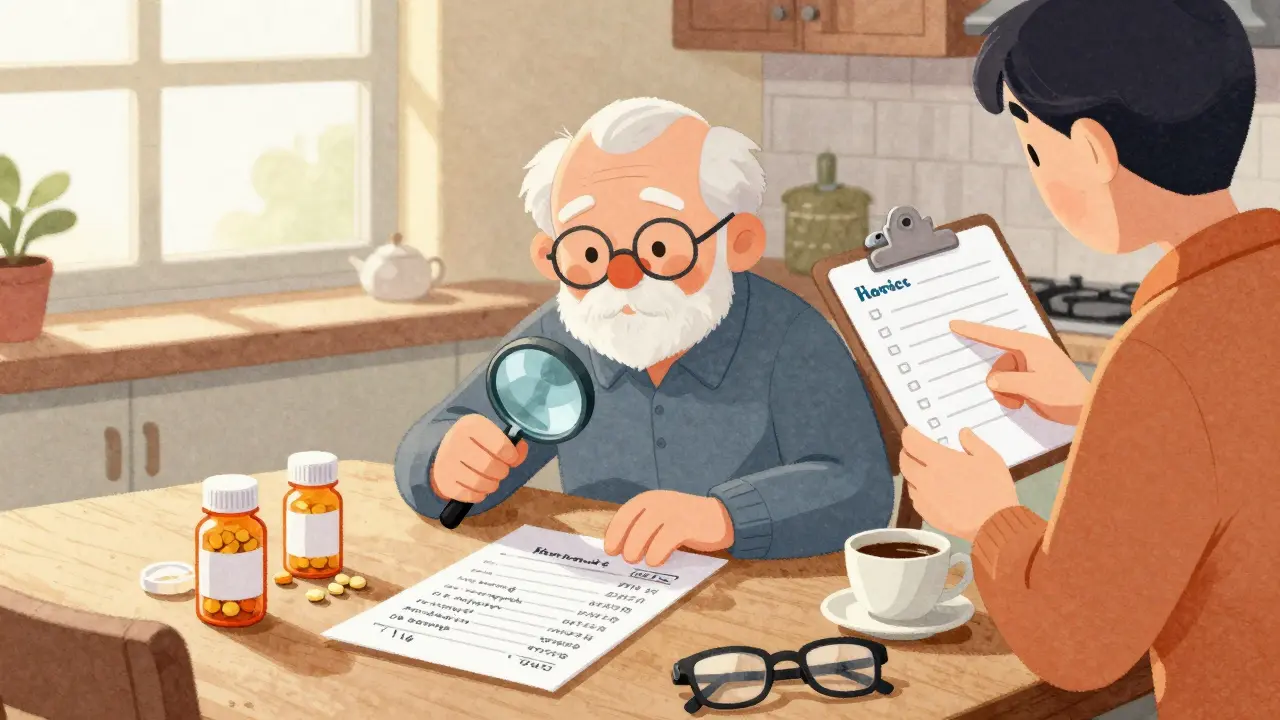
When someone you love is taking five, six, or even ten different pills every day, it’s easy to feel overwhelmed. You’re not alone. Nearly 9 out of 10 adults over 65 take at least two prescription drugs. One in six take five or more. And with that many medications, the risk of dangerous side effects, bad interactions, or simply taking something that’s no longer needed goes up-fast.
The good news? You don’t have to figure this out alone. Talking clearly and confidently with doctors, pharmacists, and nurses can cut hospital visits by more than 20%. It can stop dangerous mistakes before they happen. And it doesn’t require medical training-just preparation, questions, and a little courage.
Start with a Complete Medication List
Don’t rely on memory. Not even close. Studies show that when seniors try to list their own medications from memory, they miss or misstate about 25% of what they’re actually taking. That’s not just a small error-it’s a safety risk.
Go through every drawer, cabinet, and pill bottle in the house. Write down:
- The name of each medicine (brand or generic)
- The dose (e.g., 10 mg, 500 mg)
- How often it’s taken (once daily, twice a day, etc.)
- Why it was prescribed (e.g., "for blood pressure," "for arthritis pain")
- Any over-the-counter pills, vitamins, or supplements (including fish oil, melatonin, or herbal remedies)
Bring the actual bottles to the appointment. Not just the list. Seeing the labels helps the provider spot differences between what’s written and what’s in the bottle. Maybe the prescription changed, but the old label is still on the bottle. Maybe the dose was lowered last month, but the patient didn’t update their list. These mismatches are common-and dangerous.
Update this list every time a new medicine is added or an old one is stopped. Keep it in your wallet or phone. Make sure a family member or caregiver has a copy too.
Bring Someone With You
Doctor visits move fast. Appointments last 15 to 20 minutes. Seniors may be tired, anxious, or have hearing issues. They might forget to mention a new dizziness, a rash, or trouble sleeping.
Bringing a trusted person-spouse, child, neighbor, friend-makes a big difference. That person can:
- Remember questions the senior forgot to ask
- Listen for confusing terms and ask for clarification
- Take notes so the senior doesn’t have to
- Report changes in behavior or mood that the senior might not notice or think are important
Research shows seniors with a companion at appointments have 18% fewer adverse drug events. That’s not a small number. It’s life-changing.
Ask These Four Questions Every Time
Doctors don’t always explain everything. They assume you know the basics-or that you’ll ask. Don’t wait. Ask these four questions every time a new medicine is suggested or an old one is changed:
- How does this medicine help my specific condition? Don’t settle for "it’s for your heart." Ask: "How will this lower my risk of stroke?" or "Will this reduce my chest pain?"
- What are the most common side effects? Not just the scary ones on the label. What’s likely to actually happen? Drowsiness? Constipation? Dizziness when standing up?
- Could this interact with anything else I’m taking? Especially over-the-counter painkillers like ibuprofen or sleep aids like diphenhydramine. These are common culprits in bad reactions.
- What should I do if I miss a dose? Some pills are okay to skip. Others can cause serious problems if taken late or doubled up. Know the plan ahead of time.
These aren’t just questions-they’re tools to make sure the medicine is working for the person, not against them.
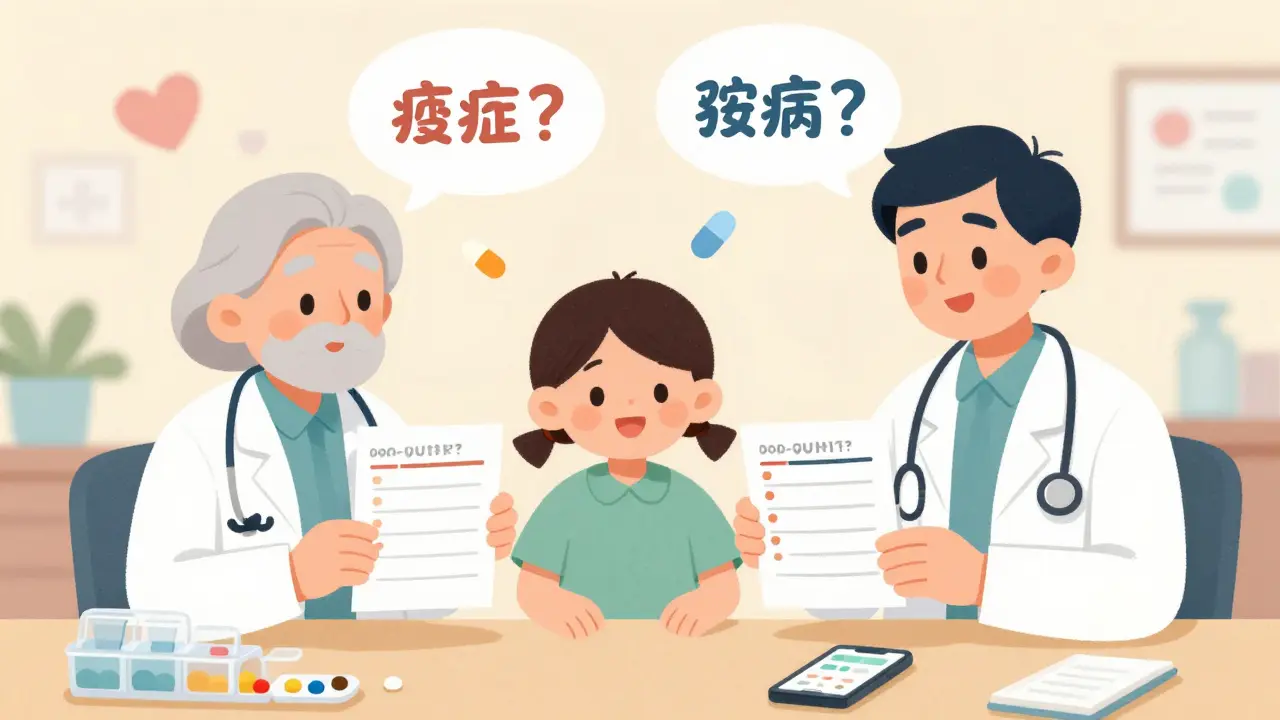
Use Tools to Stay on Track
Taking ten pills at different times of day is hard. Even with the best intentions, people forget. Studies show only about half of seniors take their meds exactly as prescribed.
Simple tools can help:
- Pill organizers with morning, afternoon, evening, and night compartments make it easy to see what’s been taken.
- Medication apps like Medisafe or Round Health send phone alerts, track doses, and can even notify a family member if a pill is skipped.
- Automated dispensers that unlock at the right time and record when a dose is taken give real-time feedback to caregivers.
- Linking meds to daily habits-like taking pills after brushing teeth or with breakfast-builds routine without needing to remember a clock.
One study found that seniors who used pill organizers and alarms improved adherence from 48% to 82% in just three months.
Review Everything Every Few Months
Medications aren’t set in stone. Conditions change. Side effects show up months later. Some drugs stop being useful-or become risky.
The American Geriatrics Society’s Beers Criteria, updated in 2023, lists 30 types of medications that are often inappropriate for seniors because they cause more harm than benefit. These include certain sleeping pills, anticholinergics for allergies, and some older antidepressants.
Ask: "Is every pill I’m taking still necessary?"
Don’t be afraid to say: "I’ve been taking this for years, but I’m not sure why anymore. Can we check if I still need it?"
Regular reviews reduce unnecessary drugs by nearly 30%, according to a 2022 study in BMJ Quality & Safety. That’s not just saving money-it’s reducing dizziness, confusion, falls, and hospital stays.
Speak Up When Something Feels Off
Seniors often downplay symptoms. "It’s just aging," they say. Or they don’t want to bother the doctor.
But new confusion, balance problems, nausea, fatigue, or sudden mood changes could be signs of a bad reaction-not just getting older.
Don’t wait for the next appointment. Call the office. Say: "I’ve noticed [specific change] since starting [medication]. Should we talk about it?"
Many clinics now offer nurse hotlines or secure messaging through patient portals. Use them. Medication problems are the leading cause of preventable hospital visits for older adults.
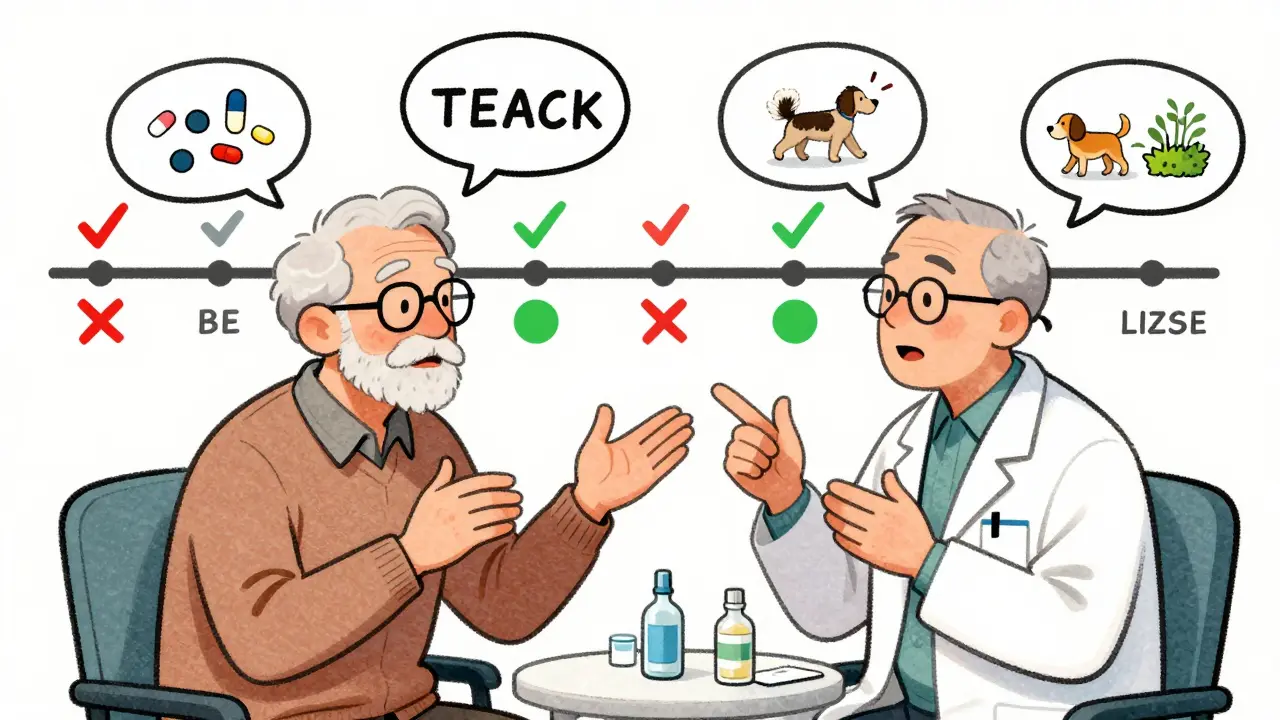
Use the Teach-Back Method
Doctors may say: "Take this twice a day with food." But do you really understand?
The "teach-back" method is simple: After the doctor explains something, say: "Just to make sure I got it right-you’re saying I should take [medication] at [time], with [food], and I should watch for [side effect]. Is that correct?"
This isn’t about testing the doctor. It’s about making sure the message landed. Studies show this technique improves understanding by 31% and reduces mistakes.
It also shows the provider you’re paying attention-and that you’re serious about safety.
Know the Big Picture
Most seniors have two or more chronic conditions-diabetes, high blood pressure, arthritis, heart disease. Each one might come with its own meds. But the whole system needs to work together.
Ask: "Are all these medicines working together? Or are they fighting each other?"
For example: A blood pressure pill might cause dizziness. A painkiller might raise blood pressure. A sleep aid might make memory worse. When all these are stacked up, the risks multiply.
That’s why coordinated care matters. If the cardiologist, the primary doctor, and the pharmacist aren’t talking to each other, someone’s going to miss the connection.
Ask if your doctor can coordinate with your pharmacist. Many pharmacies now offer medication synchronization-getting all refills on the same day. That makes it easier to track everything.
It’s Not Just About Pills-It’s About Quality of Life
The goal isn’t just to stay alive. It’s to feel well enough to enjoy life-to walk the dog, play with grandkids, sit on the porch without dizziness, sleep through the night without confusion.
Every medicine has a trade-off. Some help. Some hurt. Some just sit there, doing nothing.
Asking the right questions, bringing the right tools, and speaking up when something feels wrong isn’t being difficult. It’s being smart. It’s being your own best advocate.
And that’s not just a good idea-it’s the standard of care for older adults today.

Nina Stacey
20 December, 2025 . 01:05 AM
I wish someone had told me this when my mom was on 12 meds last year
She kept forgetting which ones were for what and would take double doses by accident
We ended up in the ER twice before I started making her a color coded chart with pictures
Turns out she couldnt read the tiny print anyway
Now she uses a pill box with alarms and I get texts if she misses one
Its crazy how simple stuff like this can save your life
Also bringing someone to appointments is non negotiable
Doctors talk so fast its like theyre in a race
Dominic Suyo
21 December, 2025 . 23:08 PM
Oh great another feel good pamphlet masquerading as medical advice
Let me guess the real solution is just cut the meds and pray
Meanwhile the geriatric pharmacology literature is screaming about polypharmacy risks but nope lets just hand out sticky notes and call it a day
Real solution requires systemic change not some cute checklist for exhausted families
Also who the hell has time to lug pill bottles to a 15 minute appointment when the wait is 47 minutes
And dont get me started on the fact that 70% of these meds are prescribed by non-geriatricians who think elderly means old and dumb
Marsha Jentzsch
23 December, 2025 . 18:48 PM
OMG I KNEW IT!! I TOLD MY SISTER HER DAD WAS TAKING TOO MANY PILLS AND SHE IGNORED ME!!
Now he's in a nursing home because of a drug interaction!!
And guess what?? The doctor never even asked about the melatonin!!
It's all connected you know!! The flu shot!! The turmeric!! The blood pressure pills!!
They're all part of a BIG PHARMA plot to keep us sick and dependent!!
And don't even get me started on how the VA is just dumping pills on vets!!
I read a blog once that said 80% of seniors are being overmedicated on purpose!!
It's not aging it's poisoning!!
And why is no one talking about the aluminum in the antacids??
It's literally turning their brains to mush!!
My cousin's neighbor's dog died from something similar!!
They're all just selling you pills!!
Don't trust anyone!!
Call your congressperson!!
And bring a video camera next time!!
Janelle Moore
25 December, 2025 . 11:12 AM
My grandma took 8 pills a day and she was fine
She never had any problems
She just took them like clockwork
People make this way too complicated
Just make a list and stick to it
Why do we need apps and organizers and people to come with us
Its just pills
She lived to 92
Maybe we just need to stop being so paranoid
Some of these guides make it sound like every pill is a landmine
Its not that bad
Just take them
Done
Danielle Stewart
25 December, 2025 . 15:31 PM
This is such an important guide and I’m so glad it exists
My mom is 81 and we’ve been using the teach-back method since last year
It changed everything
She used to nod along and then forget everything
Now she says back what she heard and we write it down
We also started doing monthly med reviews with her pharmacist
They’re free and they’re lifesavers
One time they caught a duplicate prescription for blood pressure meds
We would’ve never noticed
And bringing my sister to appointments? Game changer
She remembers the questions I forget
And the doctor actually listens when two people are asking
It’s not about being difficult
It’s about being smart
And you deserve to feel good
Not just survive
mary lizardo
26 December, 2025 . 12:58 PM
While the intent of this article is laudable, its pedagogical approach is fundamentally flawed. The conflation of anecdotal efficacy with evidence-based protocol undermines clinical rigor. The recommendation to "bring actual pill bottles" is not only logistically impractical in a high-volume primary care setting, but it also ignores the digital pharmacy records that have been standard since 2018. Furthermore, the assertion that 20% fewer hospital visits result from patient advocacy is statistically dubious without citation of peer-reviewed methodology. The "teach-back" technique, while validated in some contexts, is not universally applicable across cognitive impairments or language barriers. One must question whether this is a patient empowerment guide or a marketing tool for medication management apps. The tone, while well-intentioned, borders on paternalistic.
Kelly Mulder
27 December, 2025 . 09:06 AM
Oh please. This is what happens when you let nurses write medical advice
"Bring someone with you"
Like what? A 14-year-old who doesn’t know the difference between lisinopril and levothyroxine?
"Use apps"
My aunt’s phone dies at 2pm and she forgets to charge it
"Ask questions"
Doctors don’t have time for your emotional baggage
And what’s with the "quality of life" nonsense
Old people are supposed to be frail
It’s not a crime
Stop treating them like fragile porcelain dolls
Just give them the pills and let them be
They’re not your project
They’re your parents
And you’re tired
And you just want them to stop complaining
So stop making this so hard
Just give them the pills
And shut up
Tim Goodfellow
28 December, 2025 . 04:47 AM
Love this!!
My grandad’s on 7 meds and I swear he’s got a whole system now
He calls it "Medication Olympics"
He’s got his pillbox arranged like a track
Each compartment is a lane
He times it with his favorite podcast
And if he misses one? He does 10 jumping jacks as penalty
It’s ridiculous
But he hasn’t been to the hospital in 2 years
And he’s 88
Also we started doing "medication karaoke"
He sings the names of his pills to the tune of "Bohemian Rhapsody"
It’s weird
But now he remembers them all
And he laughs every time
That’s the secret right?
Make it fun
Or at least weird enough to stick
Elaine Douglass
28 December, 2025 . 21:27 PM
I just wanted to say thank you for writing this
My dad passed last year and I wish we’d known all this sooner
He was so scared to ask questions
He thought doctors were busy and didn’t want to bother them
He didn’t even tell us he was taking that herbal thing for his knees
Turns out it was making his blood thin
It was too late by then
But I’m telling everyone I know now
Don’t be shy
Ask the questions
Bring the bottles
Bring your cousin
Bring your dog if you have to
They’re not just pills
They’re pieces of your life
And you deserve to be safe
Takeysha Turnquest
29 December, 2025 . 00:58 AM
Medication is the new religion
We worship the pill
We sacrifice our clarity on the altar of longevity
They tell us to take it
So we take it
Even when the body screams
Even when the mind fades
We don’t question
Because to question is to doubt the system
And the system is afraid of silence
So it fills it with pills
But what if the silence was the answer?
What if the body knew better?
What if we stopped trying to fix aging
And started listening to it?
Maybe the pills aren’t the solution
Maybe they’re the symptom
Alex Curran
30 December, 2025 . 13:15 PM
As a pharmacist I see this every day
People think if it’s on the label it’s safe
But ibuprofen with blood thinners? Big problem
Melatonin with antidepressants? Can cause confusion
And don’t even get me started on OTC sleep aids with anticholinergics
That’s a one-way ticket to delirium
Most seniors don’t know their meds are interacting
They just see a new bottle and think "oh good more help"
Bring the bottles
Bring the list
Bring someone
And if you’re unsure call your pharmacist
They’re free
They’re trained
And they actually want to help
Not all doctors have time to explain every interaction
But we do
And we’re not selling anything
Just trying to keep you alive
Edington Renwick
30 December, 2025 . 20:36 PM
My cousin’s mom took 14 pills a day
She was fine until she started falling
Then they found out three of them were for things she didn’t even have anymore
One was for a heart condition she never had
Turns out the doctor misdiagnosed her in 2007 and never updated it
She was on beta blockers for 17 years because someone wrote a note wrong
And no one ever checked
That’s not medical care
That’s negligence
And now she’s in a wheelchair
And they’re still giving her the pills
Because the system doesn’t know how to stop
It just keeps going
And we’re all just along for the ride
Allison Pannabekcer
31 December, 2025 . 23:39 PM
This is beautiful
And I want to add one thing
Don’t forget to celebrate the small wins
My grandma finally stopped taking that sleep aid after 12 years
She was terrified
But we did it slowly
And the first night she slept without it? We had ice cream
And watched her favorite movie
She said she felt like herself again
That’s the goal
Not just avoiding hospital visits
But feeling like you
Even if you’re 85
Even if you need help
Even if you take pills
You still get to feel good
And you deserve that
Aboobakar Muhammedali
1 January, 2026 . 17:31 PM
I’m from India and we don’t have all these apps or pill boxes
But we have something better
We have family
My aunt takes her father’s pills every morning
She sits with him
She asks him how he feels
She remembers when he had that rash last month
She tells the doctor
She doesn’t need a phone alert
She just remembers
And she’s not a nurse
She’s just his daughter
Maybe the real solution isn’t technology
It’s showing up
Every day
Not just at the appointment
But at the table
With the pills
And the silence
And the love
Laura Hamill
3 January, 2026 . 13:10 PM
THEY’RE LYING TO YOU!!
THEY’RE PUTTING FLUORIDE IN THE PILLS TO MAKE YOU DUMB!!
THEY WANT YOU TO FORGET YOUR GRANDKIDS’ NAMES!!
THEY’RE USING THE PHARMACIES TO TRACK YOU!!
MY NEIGHBOR’S CAT GOT A MEDICATION ERROR AND NOW IT’S A GOVERNMENT SPY!!
THEY’RE USING THE BEERS CRITERIA TO CONTROL THE ELDERLY!!
THEY DON’T WANT YOU TO LIVE TOO LONG BECAUSE YOU’LL VOTE AGAINST THEM!!
CALL THE FEDS!!
TAKE A VIDEO!!
THEY’RE WATCHING RIGHT NOW!!
THEY’RE LISTENING TO THIS!!
THEY’RE IN THE WALLS!!
THEY’RE IN THE PILLS!!
THEY’RE IN THE APPS!!
THEY’RE IN THE PHARMACIST’S EYES!!
JUST STOP TAKING EVERYTHING!!
JUST DRINK WATER!!
JUST PRAY!!
THEY CAN’T CONTROL YOU IF YOU’RE NOT TAKING THE PILLS!!
THEY’RE AFRAID OF YOU!!