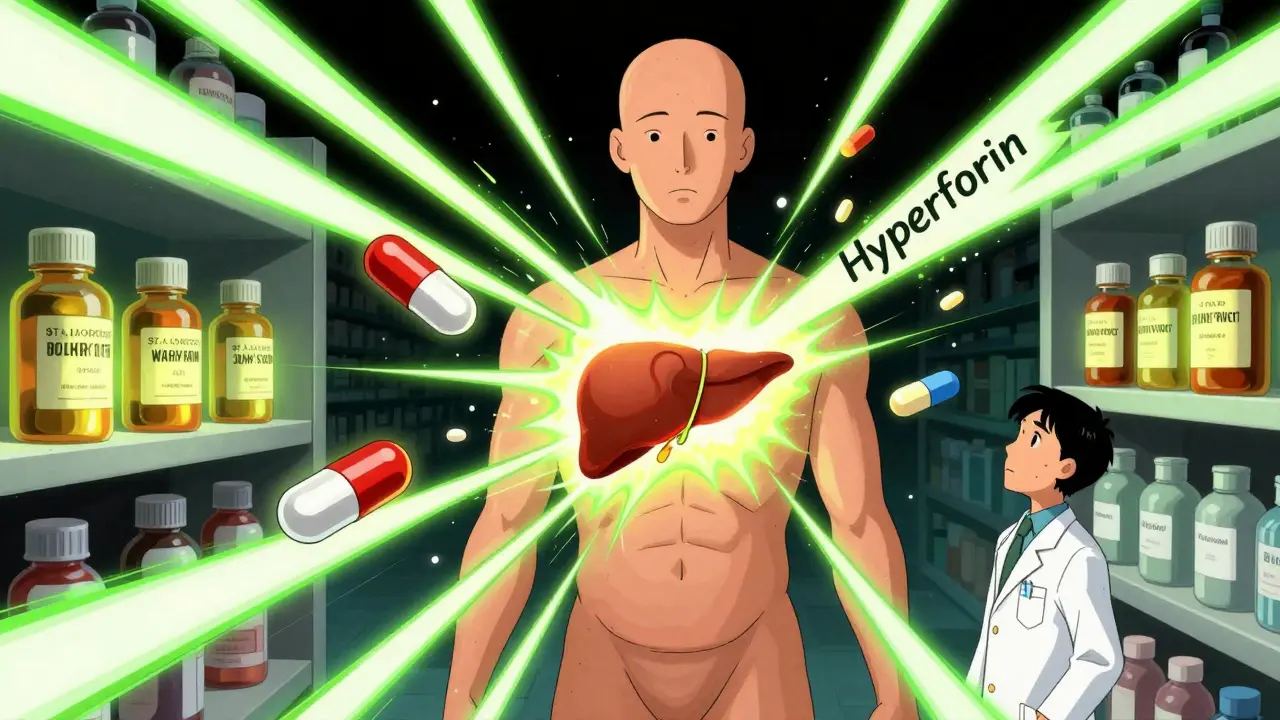
St. John’s Wort might seem like a harmless natural fix for low mood. After all, it’s been used for centuries, sold on pharmacy shelves next to vitamins, and praised online for lifting depression without the side effects of prescription pills. But here’s the truth most people don’t tell you: St. John’s Wort doesn’t just sit quietly in your body. It actively rewires how your system handles dozens of prescription drugs - and that can be deadly.
How St. John’s Wort Changes Your Body’s Chemistry
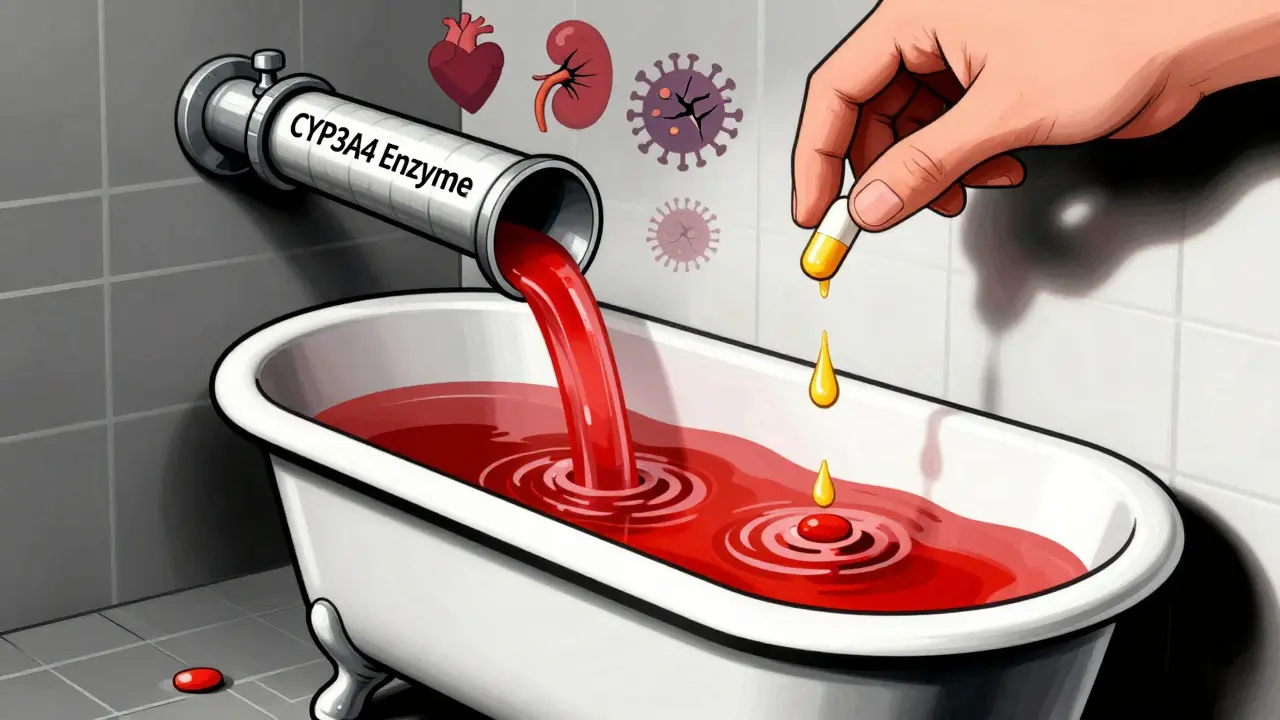
St. John’s Wort doesn’t work like a typical supplement. It’s a powerful enzyme inducer. The key player? Hyperforin. This compound triggers your liver to crank up production of CYP3A4, CYP2C9, and CYP1A2 - enzymes that break down medications. It also ramps up P-glycoprotein, a protein that shoves drugs out of your cells before they can do their job.
Think of it like installing a high-speed drain in your bathtub. The water (your medication) still flows in, but now it’s draining out way faster than it should. The result? Your drugs don’t build up to the level they need to work. You take your pill, but your body treats it like it’s half-dosed.
Standard St. John’s Wort supplements usually contain 0.3% hypericin and 2-5% hyperforin. The higher the hyperforin, the stronger the effect. A typical dose is 300 mg, taken three times daily. But even one pill a day can start changing your drug metabolism within 10 days - and those changes stick around for two weeks after you stop taking it.
Life-Threatening Interactions You Can’t Ignore
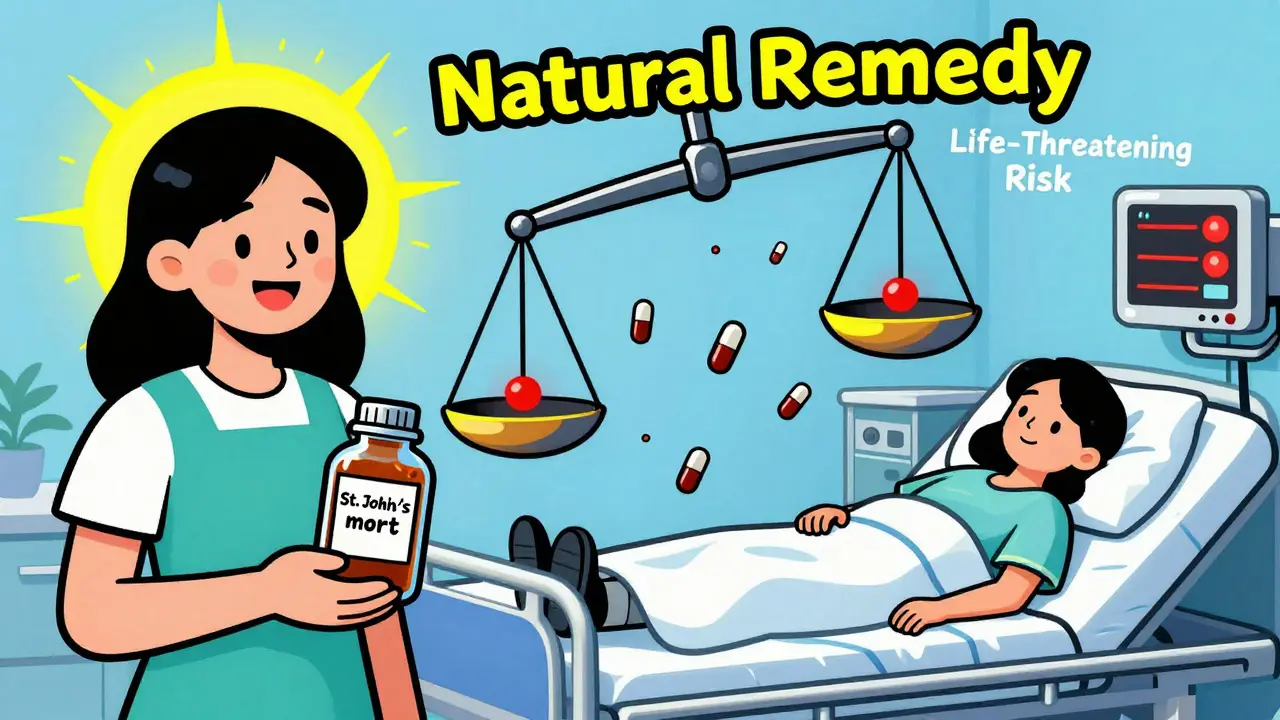
Over 50 prescription drugs have documented, clinically significant interactions with St. John’s Wort. Some of these aren’t just risky - they’re deadly.
- Organ transplant drugs: Cyclosporine, tacrolimus, sirolimus. These keep your body from rejecting a new kidney, liver, or heart. St. John’s Wort can slash their levels by 30-60%. In documented cases, transplant patients have suffered acute organ rejection - sometimes within weeks - after starting St. John’s Wort. One 2019 report described a woman who lost her transplanted kidney after her tacrolimus levels dropped from 12 ng/mL to 3 ng/mL.
- HIV medications: Protease inhibitors like ritonavir and non-nucleoside reverse transcriptase inhibitors. Lower drug levels mean the virus can rebound, leading to drug resistance and faster disease progression.
- Blood thinners: Warfarin. A 2000 case study showed a patient’s INR (a measure of blood clotting) plummeted from 2.5 to 1.4 in just 10 days after taking St. John’s Wort. That’s the difference between being protected from clots and being at high risk for stroke or internal bleeding.
- Birth control: Oral contraceptives. Multiple cases of unintended pregnancy have been reported. The European Medicines Agency issued a formal warning in 2004 after seeing women get pregnant while on the pill and taking St. John’s Wort. It’s not a myth - it’s a documented failure.
- Antidepressants: SSRIs, SNRIs, MAOIs. Combining St. John’s Wort with these can trigger serotonin syndrome - a dangerous spike in serotonin that causes high fever, seizures, irregular heartbeat, and even death.
- Painkillers: Oxycodone, methadone, tramadol. St. John’s Wort reduces their effectiveness, leaving patients in uncontrolled pain. The Merck Manual explicitly warns against this combo.
Why People Think It’s Safe - And Why They’re Wrong
Many users swear by St. John’s Wort. Reddit threads glow with stories like, “It fixed my anxiety without making me numb.” And yes, for some people with mild depression, it works. A 2015 German study found it accounted for 20% of all antidepressant use in the country.
But here’s the gap: people don’t realize they’re taking other meds. They might be on a beta-blocker for blood pressure. Or a statin. Or a thyroid pill. They don’t connect the dots. A 2017 study found it takes the average person 3-6 weeks to notice something’s off - by then, their drug levels have crashed, and the damage is done.
Even worse, the supplement industry isn’t held to the same standards as pharmaceuticals. In the U.S., the FDA doesn’t approve St. John’s Wort before it hits shelves. Labels often say “may interact with medications” in tiny print. But they don’t list which ones. You have to dig.
What’s Really on the Shelf - And What’s Missing
St. John’s Wort is still a $587 million global market. But sales have dropped 37% since 2000 as more people learn the risks. Europe leads in regulation: products there must warn about interactions with birth control, immunosuppressants, anticoagulants, and more. In the U.S., you’re on your own.
And it’s not just the dose that matters - it’s the product. Two bottles labeled “St. John’s Wort 300 mg” can have wildly different hyperforin levels. One might be safe for occasional use; another could be a chemical bomb. There’s no standardization. No third-party testing requirement. You’re guessing.
Some companies are trying to fix this. A 2022 study tested low-hyperforin extracts and found they reduced CYP3A4 induction by 90%. But these aren’t widely available. Most products you buy still pack the full interaction punch.
What to Do If You’re Already Taking It
If you’re on St. John’s Wort and any prescription drug, stop assuming it’s fine. Do this now:
- Make a list of every medication you take - including blood pressure pills, antibiotics, cholesterol drugs, and even over-the-counter pain relievers.
- Take that list to a pharmacist. Ask: “Which of these could be affected by St. John’s Wort?” Pharmacists have interaction checkers built into their systems. They’ll tell you in minutes.
- If you’re on a critical drug like warfarin, tacrolimus, or birth control - stop St. John’s Wort immediately and get blood levels checked. Don’t wait for symptoms.
- If you want to keep using it, switch to an alternative. SAM-e has minimal interactions. 5-HTP is safer for most meds. Neither has the same research backing for depression, but they’re far less dangerous.
There’s no safe gray area if you’re on immunosuppressants, HIV meds, or blood thinners. St. John’s Wort is not an option. Period.
The Bottom Line: Natural Doesn’t Mean Safe
St. John’s Wort isn’t evil. But it’s not harmless either. It’s a potent, poorly regulated drug that interacts dangerously with common prescriptions. Its benefits for mild depression are real - but only if you’re not taking anything else.
For the 4.7% of U.S. adults using it - mostly women aged 35-54 - the risk is rising. As people live longer and take more meds, the chance of a deadly mix grows. The FDA called it a “high-risk supplement” in 2023. Experts like Dr. David Flockhart called it the most important herbal supplement for drug interactions - and he wasn’t exaggerating.
If you’re thinking of trying St. John’s Wort, ask yourself: What am I already taking? And who checked if it’s safe? If you can’t answer that, don’t start. There are safer ways to manage mood. Don’t gamble with your life because a bottle says “natural.”



Helen Leite
23 January, 2026 . 14:20 PM
OMG I KNEW IT!!! 🚨 This is why my cousin went into a coma after taking St. John’s Wort with her birth control!! The FDA is hiding this!! Big Pharma doesn’t want you to know natural stuff works better!! 🤯
Marie-Pier D.
23 January, 2026 . 20:59 PM
Thank you for writing this. I’m a nurse and I’ve seen too many patients come in with dangerously low drug levels because they thought ‘natural’ meant ‘safe.’ Please, if you’re on anything prescription-stop googling herbs and talk to your pharmacist. 🙏
Alexandra Enns
24 January, 2026 . 23:45 PM
Ugh. Another fearmongering article. St. John’s Wort has been used in Europe for 30+ years without mass casualties. Your ‘life-threatening’ list is just a bunch of cherry-picked case studies. Meanwhile, SSRIs kill 10x more people annually-and no one’s banning them. Wake up. Natural doesn’t mean ‘dangerous,’ it means ‘unpatentable.’
Jamie Hooper
25 January, 2026 . 22:19 PM
so like… i took sjw for 3 months n my anxiety was gone. then i started on abx for a tooth infection n got super dizzy. i thought it was the antibiotics. turns out it was the sjw makin’ the abx useless?? 🤦♂️
Phil Maxwell
26 January, 2026 . 10:45 AM
My grandma’s on warfarin. She started taking SJW because her friend said it helped with ‘winter blues.’ She didn’t tell anyone. Two weeks later, she had a minor stroke. They found her INR was 0.9. I wish I’d read this sooner.
Luke Davidson
26 January, 2026 . 12:54 PM
I’ve been on SJW for 2 years with no issues-until I started taking metformin for prediabetes. My blood sugar went haywire. Turned out SJW was speeding up how fast my body cleared it. I switched to 5-HTP and now I’m stable. Don’t assume it’s fine-track your numbers.
Shelby Marcel
26 January, 2026 . 20:16 PM
i had no idea sjw affected birth control… i got pregnant last year and thought it was just bad luck. now im like… ohhhhh. my bad. 🤦♀️
Husain Atther
27 January, 2026 . 10:23 AM
This is a well-researched and balanced perspective. While herbal remedies hold cultural and historical value, modern pharmacology demands rigorous understanding of interactions. I encourage all users to consult clinical pharmacists before combining any supplement with prescription medication. Safety is not a compromise.
Sushrita Chakraborty
27 January, 2026 . 21:54 PM
As someone from India, where Ayurveda and Western medicine often coexist, I’ve seen patients suffer because they assumed herbal supplements were ‘harmless.’ This article should be mandatory reading for anyone taking even one prescription drug. Knowledge is not optional-it’s lifesaving.
Juan Reibelo
29 January, 2026 . 12:57 PM
Let’s be real: the supplement industry is a Wild West. I bought two bottles of ‘St. John’s Wort’ from different stores-same label, different hyperforin levels. One gave me mild nausea, the other made my antidepressant useless. No regulation. No accountability. Just profit.
Heather McCubbin
30 January, 2026 . 21:58 PM
They don’t want you to know that nature has the cure. Big Pharma makes billions off your dependence. SJW is just a plant. Your body knows how to heal itself. Stop trusting chemicals. Trust the earth. 🌿✨
asa MNG
1 February, 2026 . 15:50 PM
lol u think ur safe cuz u take sjw? i took it with my ocd meds n ended up in the er with serotonin syndrome. they said i was lucky i didnt die. now i call it ‘suicide tea’ 😭
blackbelt security
2 February, 2026 . 14:25 PM
Don’t gamble with your health. If you’re on meds, treat SJW like a loaded gun. Not because it’s evil-but because it’s powerful. Knowledge is power. Use it.
Tommy Sandri
3 February, 2026 . 10:37 AM
In my work as a cultural liaison, I’ve seen patients from multiple backgrounds assume herbal remedies are universally safe. This article bridges a critical gap. Education must be culturally sensitive, but the science is non-negotiable.
Josh McEvoy
4 February, 2026 . 10:49 AM
my mom took sjw for depression after dad passed. she didn’t tell her dr. 3 months later, her blood pressure meds stopped working. she ended up in the hospital. now she says ‘i’ll never trust a plant again.’