Many older adults are told their memory lapses, confusion, or sluggishness are just part of getting older. But what if those symptoms aren’t aging at all? What if they’re caused by a pill they’re taking every day? This isn’t rare. In fact, it’s one of the most common - and preventable - mistakes in senior care.
Medication Fog: When Pills Make You Feel Like You’re in Slow Motion
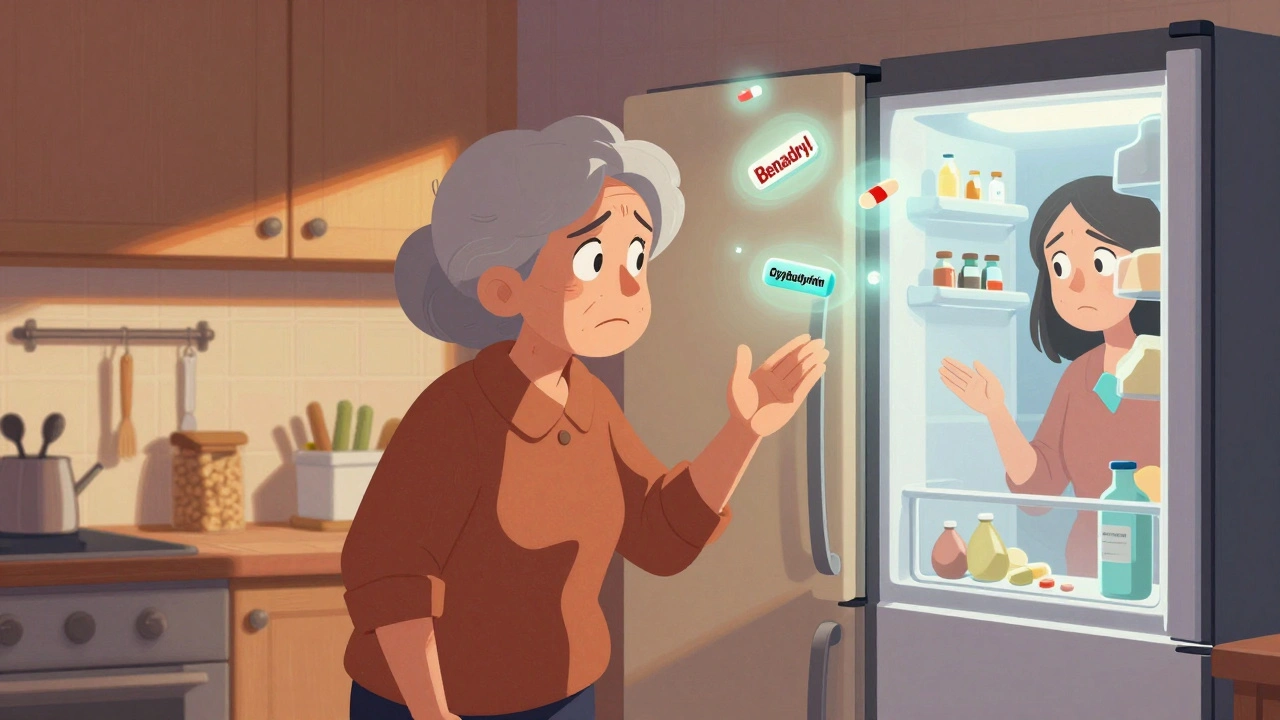
Picture this: A 72-year-old woman starts forgetting names, gets lost walking to the kitchen, and seems confused during conversations. Her family assumes it’s early dementia. But after a medication review, doctors find she’s been taking Benadryl for allergies, an oxybutynin pill for bladder control, and a tricyclic antidepressant for years. All three are anticholinergic drugs. When these were stopped over eight weeks, her memory returned. Within months, she was cooking again, remembering birthdays, and even joining her book club. This isn’t an isolated case. About 50 to 70% of seniors take at least one medication with anticholinergic properties. These drugs block acetylcholine, a brain chemical vital for memory and focus. In younger people, the body clears these drugs quickly. In older adults, liver and kidney function slows down by 30-60%, so the drugs build up. The brain gets hit harder. The result? Symptoms that look exactly like dementia. The signs are often sudden. Unlike Alzheimer’s, which creeps in over years, medication-induced confusion shows up fast - usually within days or weeks of starting or changing a drug. People report feeling like they’re in slow motion, forgetting where they put their keys, or struggling to follow a TV show. These aren’t just "senior moments." They’re red flags.Common Culprits: The Drugs That Trick Your Brain
Not all medications are dangerous. But some are far more likely to cause trouble in older adults. Here are the biggest offenders:- Antihistamines - Benadryl (diphenhydramine), dimenhydrinate (Dramamine), and other first-generation allergy meds. These are in many sleep aids and cold remedies. Dry mouth, drowsiness, and confusion are common.
- Bladder control drugs - Oxybutynin, tolterodine, solifenacin. Used for overactive bladder, they cause memory fog in up to 72% of seniors.
- Tricyclic antidepressants - Amitriptyline, nortriptyline. Older than modern SSRIs, these are still prescribed despite high risks. They’re linked to a 49% increased dementia risk after three years of use.
- Antipsychotics - Seroquel (quetiapine), risperidone. Often given for sleep or agitation, they can cause dizziness, tremors, and even Parkinson’s-like symptoms.
- Benzodiazepines - Ativan, Xanax, Valium. Used for anxiety or insomnia, they impair short-term memory in 65% of seniors. Long-term use may increase dementia risk.
- Opioids - Codeine, oxycodone. Even short-term use can cause confusion and memory loss in 57% of older adults.
- Corticosteroids - Prednisone. Can trigger mood swings, hallucinations, or psychosis in up to 18% of seniors.
Why Doctors Miss It - And How You Can Help
The problem isn’t just the drugs. It’s the assumption that memory loss in seniors is normal. Research from the Medical University of South Carolina found that physicians attribute anticholinergic symptoms to aging or age-related illness more than half the time. That means patients get labeled with dementia when they’re actually just reacting to a pill. You can change that. Start by asking these questions:- When did the symptoms start? Did they appear after a new prescription or dose change?
- Are symptoms worse at certain times of day? (Medication-induced confusion often peaks when drug levels are highest.)
- Is there a pattern? Does the person seem clearer after skipping a dose or on days they don’t take a certain pill?
- Have they gained or lost weight without trying? Dizziness? Dry mouth? Constipation? These physical signs often go hand-in-hand with cognitive changes.

The Beers Criteria and ACB Scale: Tools to Spot Risk
The American Geriatrics Society updated the Beers Criteria in 2019 to list 30 medications that are generally unsafe for seniors. These include first-generation antihistamines, certain bladder drugs, and older antidepressants. If your loved one is on any of these, ask: "Is there a safer alternative?" There’s also the Anticholinergic Cognitive Burden (ACB) scale. Each medication is scored from 1 to 3 based on how strongly it blocks acetylcholine:- Score 1: Weak anticholinergic (e.g., cetirizine)
- Score 2: Moderate (e.g., oxybutynin, doxepin)
- Score 3: Strong (e.g., diphenhydramine, amitriptyline, quetiapine)
Deprescribing: The Power of Stopping
The most powerful tool isn’t a new drug - it’s stopping the wrong one. Deprescribing means safely reducing or eliminating medications that do more harm than good. Studies show that 30-40% of seniors diagnosed with dementia see major improvement - even full reversal - after stopping anticholinergic or sedative drugs. One 2022 study in KFF Health News followed 87 seniors with suspected dementia. After a pharmacist-led medication review and gradual tapering, 38% showed significant cognitive recovery within six months. Deprescribing isn’t about quitting meds cold turkey. It’s about a slow, monitored plan:- Identify the highest-risk drug (usually a score 3 anticholinergic).
- Work with a doctor to reduce the dose over 4-12 weeks.
- Monitor for withdrawal symptoms (e.g., rebound anxiety, insomnia).
- Track cognitive and physical changes weekly.
- Repeat with the next high-risk medication if needed.

What’s Changing - And What You Should Know Now
The system is starting to catch up. As of 2023, Medicare’s Annual Wellness Visit now requires a full medication review. The FDA has mandated stronger warning labels on 17 high-risk drug classes since 2020. And by late 2025, 12 drug categories will require mandatory cognitive side effect monitoring. New tools are emerging too. Researchers at Indiana University are testing a blood test to measure acetylcholine levels - it’s 89% accurate at spotting medication-induced cognitive decline. AI systems are being trained to scan electronic health records and flag risky combinations before they’re prescribed. But none of this matters if you don’t ask the questions.What to Do Next
Don’t wait for a crisis. Take action now:- Make a complete list of every medication - including vitamins, supplements, and over-the-counter pills.
- Check each one against the Beers Criteria or ask a pharmacist to scan for anticholinergic burden.
- Ask your doctor: "Could any of these be causing memory problems?" and "Is there a safer option?"
- Request a medication review with a geriatric pharmacist - many hospitals offer this for free.
- Track symptoms for two weeks: confusion, dizziness, sleepiness, dry mouth, constipation.
- Bring the symptom log and medication list to the next appointment.
Frequently Asked Questions
Can over-the-counter meds like Benadryl really cause dementia-like symptoms?
Yes. Benadryl (diphenhydramine) is a strong anticholinergic drug. It blocks acetylcholine in the brain, which can cause sudden confusion, memory loss, and drowsiness in seniors. Studies show long-term use increases dementia risk by nearly 50%. Many seniors take it for sleep or allergies, not realizing it’s affecting their brain. Safer alternatives like loratadine (Claritin) or cetirizine (Zyrtec) don’t carry the same risk.
How do I know if my parent’s memory loss is from aging or medication?
Medication-induced memory loss usually appears suddenly - within days or weeks of starting a new drug. True aging-related decline happens slowly over years. Look for patterns: Does confusion get worse after taking a specific pill? Does your parent seem clearer on days they skip a dose? Physical signs like dry mouth, constipation, or dizziness often accompany medication side effects. A medication review and ACB score can confirm if drugs are the cause.
Is it safe to stop a medication on my own?
No. Never stop a prescribed medication without talking to a doctor. Some drugs, like antidepressants or benzodiazepines, can cause dangerous withdrawal symptoms if stopped abruptly. But you can ask your doctor to review the list and create a safe tapering plan. Many seniors improve after gradual deprescribing - but it must be done carefully.
What’s the difference between dementia and delirium in older adults?
Dementia is a slow, progressive decline in memory and thinking, usually caused by brain changes like Alzheimer’s. Delirium is a sudden, temporary confusion often triggered by infection, dehydration, or - most commonly - medication side effects. Delirium can come and go during the day. A person might seem fine in the morning but confused by afternoon. This fluctuation is a key sign it’s not dementia.
Can a pharmacist help with medication reviews?
Absolutely. Pharmacists are trained to spot dangerous drug combinations and high-risk medications for seniors. Many offer free medication reviews, especially if you bring all your pills - including OTCs and supplements. Ask your pharmacy if they have a geriatric pharmacist or offer a "medication therapy management" service. They can calculate your ACB score and suggest safer alternatives.






Rebecca Braatz
3 December, 2025 . 17:41 PM
This is life-changing info. My grandma was diagnosed with early dementia last year, but after we pulled her off Benadryl and oxybutynin, she started remembering our names again. She even baked her famous apple pie last week-something she hadn’t done in two years. Why isn’t this taught in med school? Why are doctors still prescribing these drugs like they’re harmless candy?
Stop normalizing brain fog as aging. It’s not normal. It’s negligence.
Pavan Kankala
5 December, 2025 . 02:32 AM
They’re hiding this on purpose. Big Pharma doesn’t want you to know that 70% of dementia cases are just drug-induced. They make billions off the labels, the memory clinics, the special diets, the ‘cognitive supplements.’ Meanwhile, your grandma’s brain is just full of anticholinergic sludge. The FDA? They’re on the payroll. Watch the documentary ‘Pill Pushers’-it’s all there.
Yasmine Hajar
6 December, 2025 . 22:54 PM
I’m a nurse in a senior care unit, and I see this every single day. One lady stopped taking her tricyclic antidepressant and suddenly started singing old songs from the 40s again-she hadn’t done that since her husband passed. Another guy stopped Seroquel and stopped trying to ‘talk to the people on the walls.’
It’s not magic. It’s just removing poison. We need to stop treating seniors like broken machines and start treating them like people who can heal when given the chance.
Ashley Elliott
7 December, 2025 . 03:28 AM
I’ve been using Zyrtec instead of Benadryl for years… and I still forget where I put my keys sometimes. But I also have a busy job, three kids, and no sleep. Maybe it’s not the meds? Maybe it’s just… life?
Still, I printed out the ACB scale and brought it to my doctor. Better safe than sorry. I’m not taking any chances.
Chad Handy
8 December, 2025 . 22:40 PM
My uncle was on 11 different medications. He was labeled with Alzheimer’s. We pulled six of them-three were anticholinergics. Within six weeks, he started recognizing his own children again. He cried. We cried. He’s now on three meds and walks his dog every morning. This isn’t science-it’s common sense. Why does it take a family crisis to get a doctor to listen?
Augusta Barlow
9 December, 2025 . 17:59 PM
They’re lying. They’ve been lying for decades. The Alzheimer’s Association gets funding from drug companies. The Beers Criteria? It’s a joke. They only list ‘high-risk’ drugs because they’re too obvious. What about the new SSRIs with hidden anticholinergic effects? What about the ‘natural’ supplements that block acetylcholine? No one talks about that. Why? Because the real villains aren’t the pills-they’re the institutions that profit from your confusion.
Jenny Rogers
10 December, 2025 . 10:19 AM
It is, regrettably, a profound failure of modern geriatric medicine that pharmacological interventions are so routinely prioritized over holistic, behavioral, and environmental remediation. The normalization of cognitive decline as an inevitable consequence of aging represents a catastrophic epistemological error-one that has been institutionalized through lazy diagnostic protocols and financial incentives embedded within the fee-for-service model.
Rachel Bonaparte
10 December, 2025 . 20:18 PM
Oh honey, I knew this was coming. I told my sister last year when she started giving her dad those ‘sleep aids’-she didn’t listen. Now he’s in a memory care facility. But guess what? His meds are still the same. The staff says, ‘He’s just advanced.’ No, he’s just drugged. I’m starting a nonprofit called ‘Wake Up Grandma’-we’re going to send free ACB score kits to every family in America. If you’re not doing this, you’re complicit.
Michael Feldstein
10 December, 2025 . 22:25 PM
Great breakdown. One thing I’d add: don’t just look at the drugs-look at the interactions. A 75-year-old on a score-2 bladder med plus a score-1 OTC sleep aid might seem fine, but together they hit score 3. That’s the sweet spot for cognitive decline. Also, check for polypharmacy: if someone’s on 5+ meds, the risk isn’t additive-it’s exponential.
Pro tip: Bring a list to the pharmacist, not just the doctor. They’re the unsung heroes here.
jagdish kumar
12 December, 2025 . 05:05 AM
Everything is a drug. Even sunlight. Even silence. Even love. Maybe the real problem isn’t the pills-it’s that we’ve forgotten how to be human.
zac grant
13 December, 2025 . 23:46 PM
Just did a med review for my 81-year-old mom. ACB score was 5. We tapered off the amitriptyline and oxybutynin over 10 weeks. She went from ‘I don’t know who you are’ to ‘When’s dinner?’ in six weeks. No more ‘senior moments.’ Just better living. This isn’t fringe science-it’s standard geriatrics. Why aren’t more people doing this?