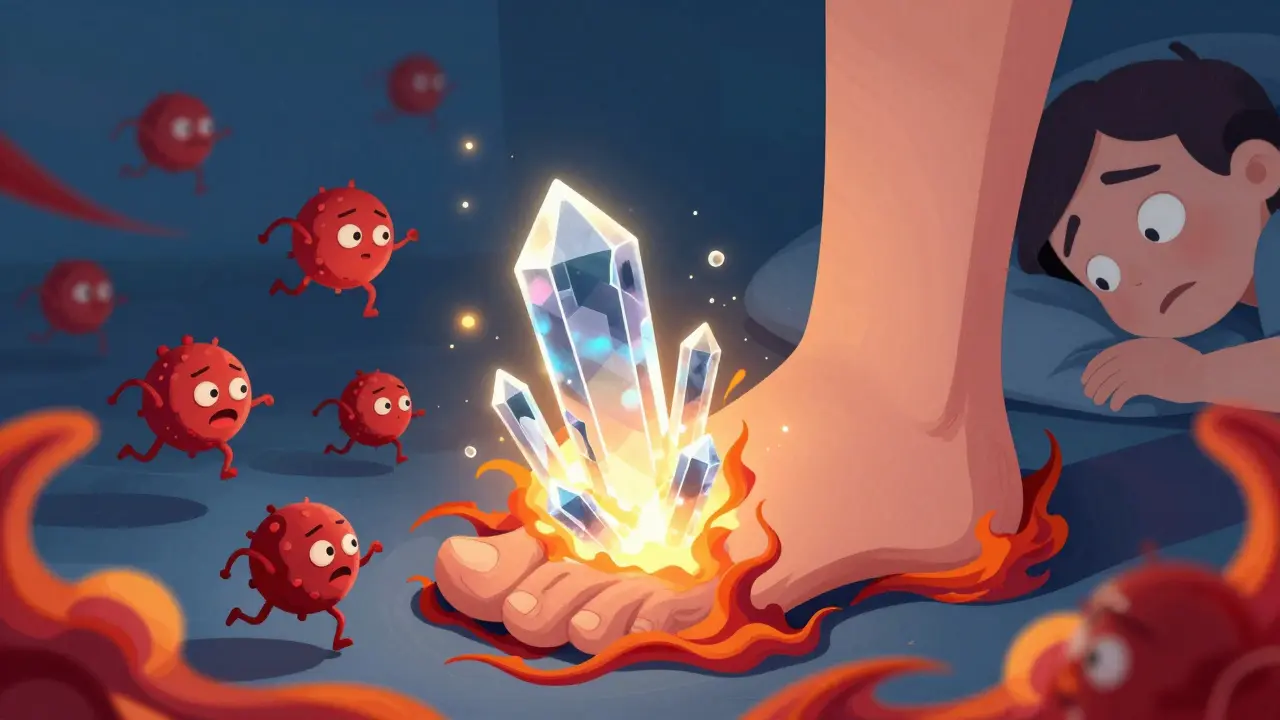
When your big toe suddenly swells up, turns red, and feels like it’s on fire - even the weight of a bedsheet is unbearable - you’re not just having a bad night. You’re having a gout attack. This isn’t just "bad arthritis." It’s your body’s immune system going into overdrive because of tiny, sharp crystals forming in your joints. And it all starts with one thing: too much uric acid in your blood.
What Exactly Is Uric Acid, and Why Does It Cause Pain?
Uric acid is a waste product your body makes when it breaks down purines - natural substances found in your cells and in certain foods. Most people handle this just fine. Their kidneys flush out the extra uric acid in urine. But for some, the system gets clogged. When uric acid levels climb above 6.8 mg/dL, it starts to crystallize. These crystals - made of monosodium urate - don’t just sit there quietly. They poke and irritate the lining of your joints. That’s when your immune system sends in macrophages, the body’s first responders. They see the crystals as invaders, trigger the NLRP3 inflammasome, and release a flood of interleukin-1β. The result? Intense inflammation: swelling, heat, redness, and pain so sharp it wakes you up at 3 a.m.Why Do Some People Have This Problem and Others Don’t?
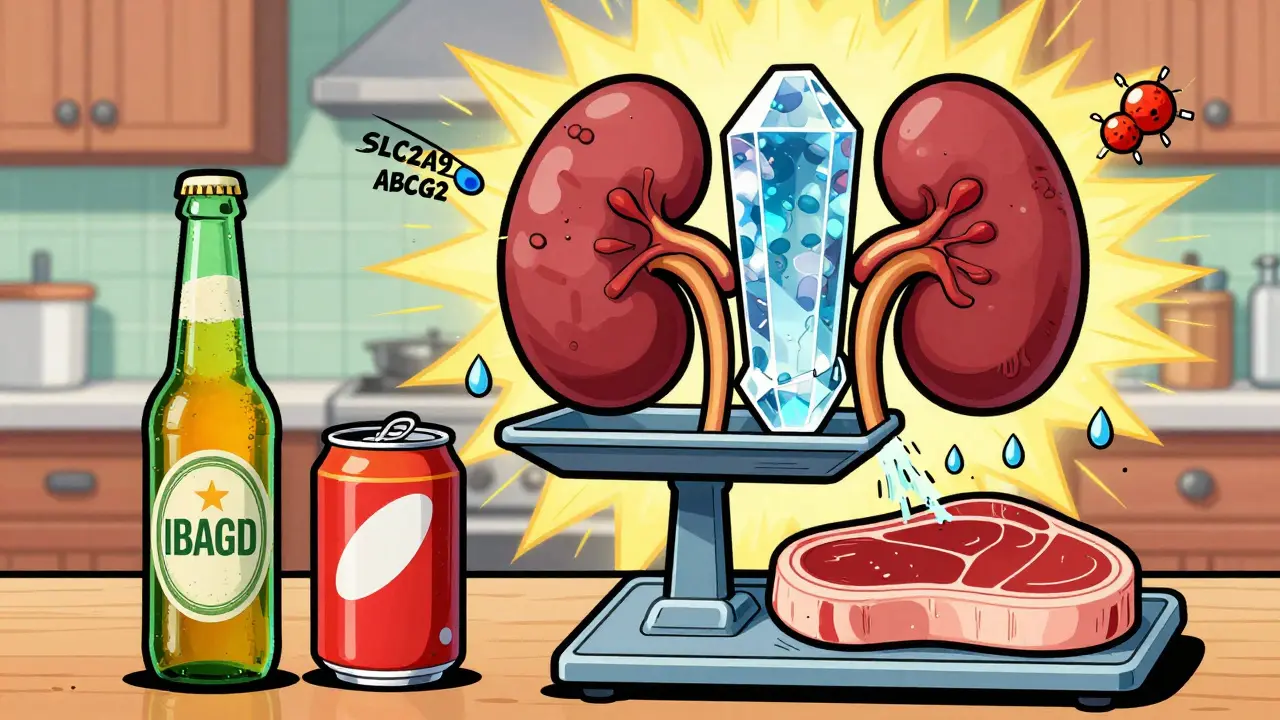
About 90% of gout cases come from your kidneys not excreting enough uric acid. That’s not because they’re broken - it’s often genetic. Genes like SLC2A9 and ABCG2 control how your kidneys handle uric acid. If those genes have small glitches, your body reabsorbs too much uric acid instead of letting it leave. The other 10% of cases are from your body making too much. This happens with certain cancers, intense cell turnover, or eating a lot of purine-heavy foods. Here’s the twist: humans and great apes are among the few mammals that can’t break down uric acid further. We lost the enzyme uricase millions of years ago. So we’re stuck with what we’ve got. That’s why gout is so common in people - and rare in dogs, cats, or cows.What Really Triggers a Gout Attack?
You might think it’s just eating too much steak or drinking beer. But triggers are more subtle - and often surprising.- Alcohol, especially beer: A daily 12-ounce beer increases your risk by 49%. Beer isn’t just high in alcohol - it’s packed with purines. Spirits aren’t far behind, raising risk by 15% per serving.
- Fructose-sweetened drinks: Soda, sweetened iced tea, energy drinks. These spike uric acid by 20-30% because fructose breaks down in the liver and depletes ATP, which turns into uric acid.
- Dehydration: If you’re not drinking enough water (less than 1.5 liters a day), your kidneys can’t flush out uric acid. That’s why gout flares often happen after a long flight, a hot day, or a night of drinking without water.
- Joint trauma: Even a minor bump or sprain can dislodge crystals hidden in cartilage. That’s why gout often hits the big toe - it’s the most vulnerable joint.
- Starting urate-lowering meds: This is the biggest surprise. When you begin taking allopurinol or febuxostat to lower uric acid, the crystals start to dissolve. But as they break apart, they can trigger an attack. In fact, 30-40% of people have their first flare within the first six months of treatment.
How Do You Treat a Gout Attack When It Hits?
You can’t just wait it out. The pain peaks within 12-24 hours and can last days. The goal: stop the inflammation fast.- NSAIDs: Indomethacin (50 mg three times a day) is the gold standard. Naproxen or ibuprofen work too, but stick to prescribed doses. Don’t overdo it - NSAIDs can hurt your kidneys or stomach.
- Colchicine: Taken at 0.6 mg every hour until symptoms improve or side effects hit (usually diarrhea). Lower doses (0.6 mg once or twice daily) are used for prevention, not acute pain.
- Corticosteroids: If you can’t take NSAIDs or colchicine (due to kidney issues, ulcers, or heart failure), a short course of prednisone (30-40 mg daily for 5 days) works just as well. Sometimes, a doctor injects it directly into the joint.
Long-Term Strategy: Lowering Uric Acid for Good
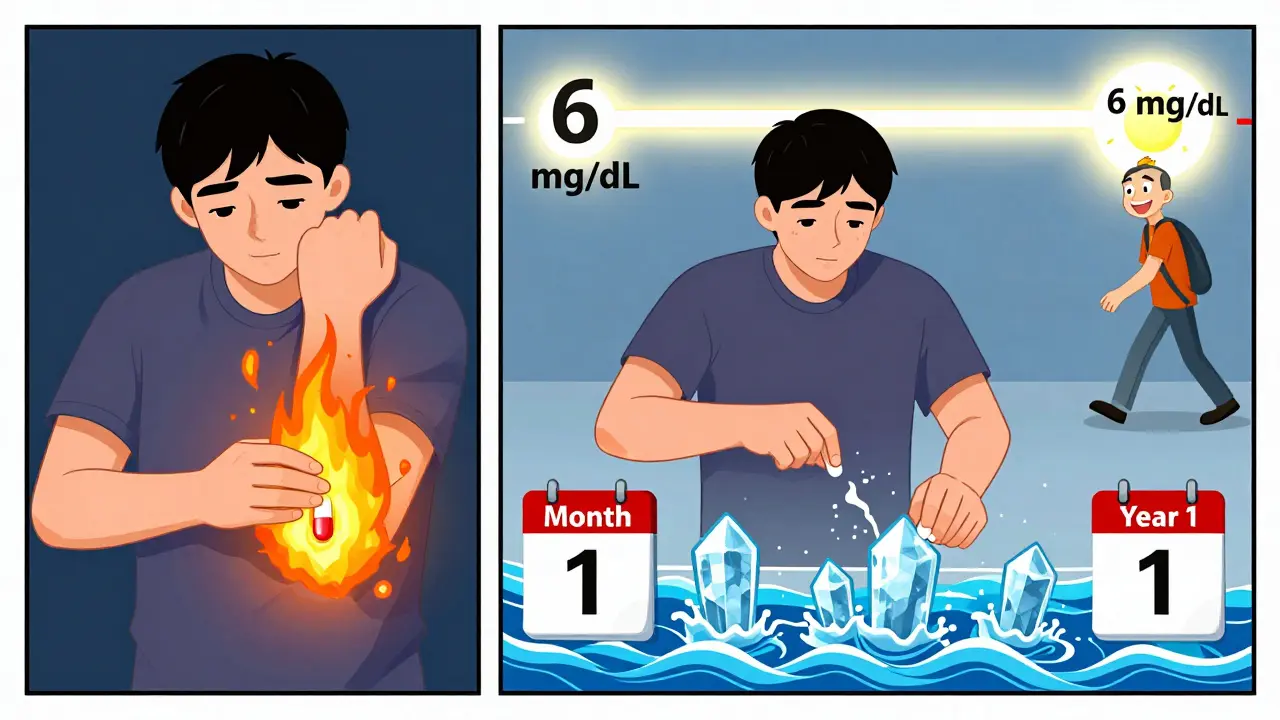
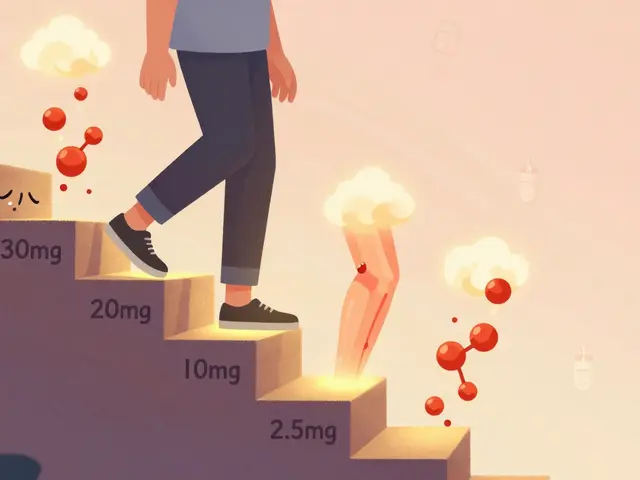
Painkillers treat the flare. But if you want to stop the flares, you need to lower your uric acid for good.- Allopurinol: First-line treatment. Start at 100 mg daily. Increase by 100 mg every 3-5 weeks until your blood level hits under 6 mg/dL. Most people need 300-400 mg daily. Some need up to 800 mg. It’s safe, cheap, and effective - but only if you take it every day.
- Febuxostat: Used if you can’t tolerate allopurinol. Starts at 40 mg daily. Can go up to 80 mg. It’s more expensive and carries a small risk of heart issues, so it’s not first choice unless needed.
- Probenecid: A uricosuric drug. Helps your kidneys flush out more uric acid. Only works if your kidneys are still working well (GFR >50 mL/min). Not for people with kidney stones.
The Most Important Rule: Don’t Stop Your Meds During a Flare
This is where most people mess up. When a flare hits, they think, "My uric acid must be too high - I should stop my allopurinol." That’s the opposite of what you should do. Stopping the medication causes uric acid to spike again. It’s like turning off the fire alarm and then wondering why the house is still burning. Instead, keep taking your urate-lowering drug. Treat the flare with colchicine or NSAIDs. Then, once the pain eases, keep going. Your body needs time to dissolve the crystals. It can take months - even years.Preventing Flares While Starting Treatment
If you’re starting allopurinol or febuxostat, you need a shield. That’s where low-dose colchicine comes in.- Take 0.6 mg once or twice daily for at least six months.
- Studies show this cuts flare risk by 50-75% compared to no prevention.
- Even if you’ve had a flare already, start this right away.
Diet and Lifestyle: What Actually Helps
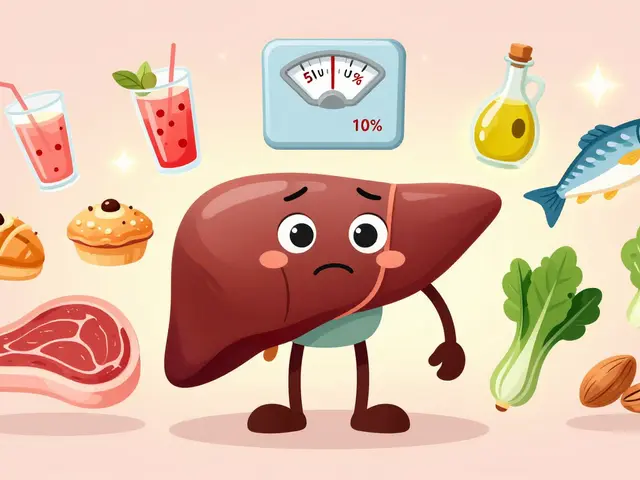
You don’t need to become a vegan. But smart changes make a big difference.- Drink water: At least 2 liters a day. More if you’re active or it’s hot. Your urine should be pale yellow.
- Choose low-fat dairy: One or two servings a day (milk, yogurt) reduces gout risk by 43%. The exact reason isn’t clear - maybe proteins in milk help your kidneys excrete uric acid.
- Avoid organ meats: Liver, kidneys, sweetbreads. A 3-ounce serving has 300-500 mg of purines. That’s a full day’s limit in one meal.
- Limit shellfish: Shrimp, lobster, mussels, anchovies. They’re high in purines. Salmon and tuna? Fine in moderation.
- Swap sugary drinks: No soda, no energy drinks. Try sparkling water with lemon.
- Keep weight steady: Losing weight slowly (not crash diets) lowers uric acid. But rapid weight loss can trigger flares.
What About Supplements or Probiotics?
Some people swear by cherry juice, vitamin C, or apple cider vinegar. There’s weak evidence - maybe a small drop in uric acid. But none replace medication. New research is looking at gut bacteria. Early studies suggest certain probiotics might help break down purines in the gut, lowering uric acid by 10-15%. But this isn’t proven yet. Don’t spend money on supplements thinking they’ll cure gout. Focus on what works: meds, hydration, and smart eating.Monitoring and Long-Term Management
Gout isn’t something you fix in three months. It’s a lifelong condition.- Get your serum uric acid checked every 2-5 weeks when adjusting your dose.
- Once stable, check every 6 months.
- If you stop your medication, uric acid rises back to old levels in 2-4 weeks. Flares return fast.
- Keep a journal: Note what you ate, how much water you drank, and when flares happened. Patterns emerge.
Common Mistakes and What to Do Instead
- Mistake: "I only take my medicine when I’m in pain." Fix: Urate-lowering drugs work slowly. They’re not painkillers. Take them daily, even when you feel fine.
- Mistake: "I had a flare, so I stopped everything." Fix: Keep your urate-lowering drug. Treat the flare with colchicine or NSAIDs.
- Mistake: "I don’t drink beer, so I’m safe." Fix: Soda, dehydration, and sudden weight loss can still trigger flares.
- Mistake: "I don’t need to see a specialist." Fix: If you have more than two flares a year, tophi, or kidney stones - see a rheumatologist. They know how to manage this right.
What’s Next? The Future of Gout Treatment
Researchers are testing drugs that block the NLRP3 inflammasome - the very switch that starts the inflammation. Early trials show dapansutrile can cut flare duration by 40%. That’s huge. If approved, it could mean fewer flares without needing daily pills. But for now, the best tool is still simple: lower uric acid, keep it low, and don’t stop the meds. Gout doesn’t have to control your life. With the right plan, flares become rare. Tophi shrink. You can walk again - pain-free.Can gout be cured?
Gout can’t be "cured" in the sense that you stop all treatment and never have another attack. But it can be fully controlled. With consistent urate-lowering therapy, most people stop having flares within a year. Tophi can disappear. Joints can heal. The goal isn’t to feel okay sometimes - it’s to never feel the pain again. That’s possible with the right long-term plan.
Why does gout usually start in the big toe?
The big toe is cooler than other joints, and uric acid crystals form more easily in lower temperatures. It’s also a joint that gets a lot of pressure and minor trauma - even from walking or tight shoes. That’s why it’s the most common first site. But gout can hit any joint - ankles, knees, wrists, fingers.
Is it safe to take allopurinol long-term?
Yes. Allopurinol is one of the safest long-term medications available. The risk of serious side effects - like allopurinol hypersensitivity syndrome - is less than 0.4%. Most people tolerate it well. The real danger is not taking it. Stopping leads to repeated flares, joint damage, and kidney stones.
Can I drink wine instead of beer?
Wine is less risky than beer, but it still increases gout risk - about 15% per daily serving. If you drink alcohol, keep it to one serving a day, and never on an empty stomach. But the safest choice is none at all. Even moderate drinking can trigger flares in people who are sensitive.
How long until I see results from urate-lowering therapy?
You won’t feel better right away. In fact, you might have more flares at first. That’s normal. It takes 3-6 months for your body to dissolve the crystals in your joints. After a year, most people see a big drop in flares. After two years, many have zero attacks. Patience and consistency are everything.

Ayan Khan
19 March, 2026 . 08:21 AM
What struck me most about this piece is how it frames gout not as a lifestyle punishment but as a biological inevitability shaped by evolution. Losing uricase millions of years ago wasn’t a mistake-it was an adaptation. Higher uric acid may have helped our ancestors survive famine by boosting fat storage and blood pressure. So now we’re stuck with a system that once saved lives but now causes pain. It’s not about willpower. It’s about biochemistry. And that changes how we talk about treatment-from blame to understanding.
That’s why I cringe when people say "just stop drinking beer" like it’s a moral failing. The real work is in consistent urate-lowering therapy, hydration, and patience. No shortcuts. No quick fixes. Just science.
Also, the part about starting allopurinol triggering flares? That’s the most under-discussed truth in medicine. Doctors assume patients know this. They don’t. We need better patient education, not just better meds.
Emily Hager
20 March, 2026 . 22:10 PM
While I appreciate the scientific rigor of this article, I must respectfully challenge the assertion that urate-lowering therapy is universally effective. The reliance on allopurinol as first-line treatment ignores significant pharmacogenomic variability, particularly in populations with HLA-B*58:01 allele prevalence-common in Southeast Asian and African descent. The risk of severe cutaneous adverse reactions is not negligible, yet the piece presents allopurinol as a panacea without adequate safety caveats. Furthermore, the omission of febuxostat’s cardiovascular risk profile, even if "small," is ethically concerning in a population with high comorbidity rates. This is not medicine-it is oversimplification masquerading as education.
Melissa Starks
21 March, 2026 . 10:41 AM
Okay so I just got diagnosed with gout last month and this article literally saved my life?? I was so scared I thought I’d never walk again. I’d been ignoring the pain because I thought it was just a sprain. Then I read the part about how dehydration and soda trigger flares and I was like… ohhhh. I was drinking 3 energy drinks a day. No wonder I woke up screaming at 3am.
Anyway I started allopurinol 100mg and yes I had a flare the next week. I freaked out and almost quit. But then I remembered what you said about NOT stopping the meds so I kept going. I’m on month 4 now. No flares. My toe doesn’t look like a boiled shrimp anymore. I drink 3 liters of water daily. I eat yogurt. I avoid shrimp. And I’m not even trying that hard. It’s just… small changes. I’m so glad I didn’t listen to my cousin who said "just cut out beer and you’re fine."
Also I started taking colchicine at night and it’s like a little peacekeeper in my joints. I feel like a gout warrior now. 💪 (no emoticons I promise)
Lauren Volpi
22 March, 2026 . 07:24 AM
Ugh. Another overlong medical blog pretending to be science. You know what causes gout? Drinking too much. Eating too much meat. Being lazy. That’s it. No need to drag evolution, inflammasomes, and gene mutations into it. I’ve known guys who drank beer every night for 20 years and never had a flare. Meanwhile, my cousin, who eats kale and drinks sparkling water, got hit with gout after a flight. Coincidence? Nah. It’s just weak metabolism. Stop overcomplicating things. Just stop being a glutton and you’ll be fine. Also, probiotics? Really? Next you’ll tell us to chant at the moon for uric acid balance.
Melissa Stansbury
23 March, 2026 . 15:34 PM
I’ve been living with gout for 12 years. I had to learn this the hard way. I used to think I could just take NSAIDs when it hurt and call it quits. Then I got tophi on my elbow. You can’t see them until they’re huge. They feel like little rocks under your skin. I didn’t even know they were gout until a nurse pointed them out. I cried. I was so angry. I thought I was doing everything right. I stopped beer. I ate salad. But I didn’t take my allopurinol daily. I took it when I felt guilty.
When I finally started taking it every day, even when I felt fine, and added colchicine as a shield… it took 11 months. Eleven. Months. I thought I was failing. But the crystals don’t dissolve on your timeline. They dissolve on biology’s timeline. Now? No flares. No tophi. I walk barefoot on the beach. I’m not cured. I’m managed. And that’s the win.
Alexander Pitt
25 March, 2026 . 00:07 AM
Just to clarify a common misconception: colchicine for acute flares is dosed differently than for prophylaxis. The old "take 1mg every hour until diarrhea or relief" method is outdated and dangerous. Current guidelines recommend 1.2mg initially, then 0.6mg one hour later, then 0.6mg once or twice daily for prevention. High-dose colchicine causes severe GI toxicity-vomiting, diarrhea, even bone marrow suppression. Always follow the revised dosing. And yes, NSAIDs like indomethacin are still first-line, but if you have CKD, use corticosteroids. Don’t guess. Consult a rheumatologist if you’re unsure.
Suchi G.
26 March, 2026 . 01:19 AM
It’s fascinating how this article treats gout as a purely physiological problem, but ignores the social determinants. Who has access to fresh low-fat dairy? Who can afford allopurinol without insurance? Who can drink 2 liters of water a day if they work two jobs and live in a neighborhood with contaminated tap water? The science is solid, but the delivery feels like it’s written for the affluent. In India, where I’m from, many people with gout are laborers who can’t afford meds, drink whatever water is available, and eat whatever’s cheap-often fried fish and sugary tea. The answer isn’t just "take your pills." It’s systemic change. Medicine shouldn’t be a privilege. And we shouldn’t romanticize the "discipline" of the wealthy managing their disease while others suffer silently.
becca roberts
27 March, 2026 . 18:43 PM
So let me get this straight. You’re telling me the reason I got gout is because my kidneys are genetically lazy? And I’m supposed to be grateful that I’m one of the few mammals who can’t break down uric acid? Like, congrats, evolution? We lost a superpower and now we pay for it with excruciating pain? That’s not science. That’s cosmic irony. And yet here we are, treating it like a checklist: drink water, take pills, avoid shrimp. Meanwhile, my doctor told me to "just cut out alcohol" like it’s a weekend hobby. I’m not a villain. I’m a human with broken biology. And I’m tired of being told I’m not trying hard enough.
SNEHA GUPTA
29 March, 2026 . 12:35 PM
There is a quiet dignity in chronic illness that rarely gets spoken of. Gout is not a moral failure. It is a biological echo of our evolutionary past. We are the only primates without uricase. We carry the weight of that loss in our joints. To call it a disease of gluttony is to misunderstand the very architecture of human metabolism. The crystals are not punishment-they are relics. And the real triumph is not in never having a flare, but in continuing to live fully despite them. I have walked through pain. I have taken my pills on days I didn’t want to. I have chosen consistency over comfort. That is not compliance. That is courage.
Gaurav Kumar
30 March, 2026 . 13:50 PM
Bro, this whole thing is just a Western medical scam. In India, we’ve been treating gout for centuries with turmeric, neem, and fasting. Why are we blindly trusting Western drugs? Allopurinol? That’s just a chemical crutch. I’ve been on a plant-based diet with Ayurvedic herbs for 3 years. No flares. No meds. The body heals itself if you respect its wisdom. Modern medicine is just profit-driven. They want you addicted to pills. Real healing comes from nature, not Big Pharma. And yes, I know my uric acid level. It’s 4.2. I didn’t need a lab test. I felt it.
David Robinson
30 March, 2026 . 19:18 PM
So you’re telling me I have to take a pill every day for the rest of my life… just to not have pain in my toe? And I can’t even have a glass of wine? That’s insane. I’m 42. I don’t want to be a walking pharmacy. I want to live. Why can’t we just treat the pain when it happens? Why does it have to be this long-term prison sentence? I get the science. I just don’t want to live by it.
Jeremy Van Veelen
1 April, 2026 . 14:32 PM
Imagine: a species that evolved to store fat, survive droughts, and thrive in scarcity… now punished by its own biology for enjoying a steak. We lost uricase millions of years ago-not because we were weak, but because we were brilliant. We were the ones who outsmarted starvation. And now, in a world of abundance, our ancient advantage has become our greatest vulnerability. We are the descendants of survivors… who now live in a world of too much. And so we suffer-not from weakness, but from the weight of our own evolution. Gout isn’t a disease. It’s a monument. To survival. To excess. To being human.
Laura Gabel
3 April, 2026 . 11:21 AM
I just take ibuprofen and call it a day. I don’t need to know about inflammasomes. My toe stops hurting. That’s enough.