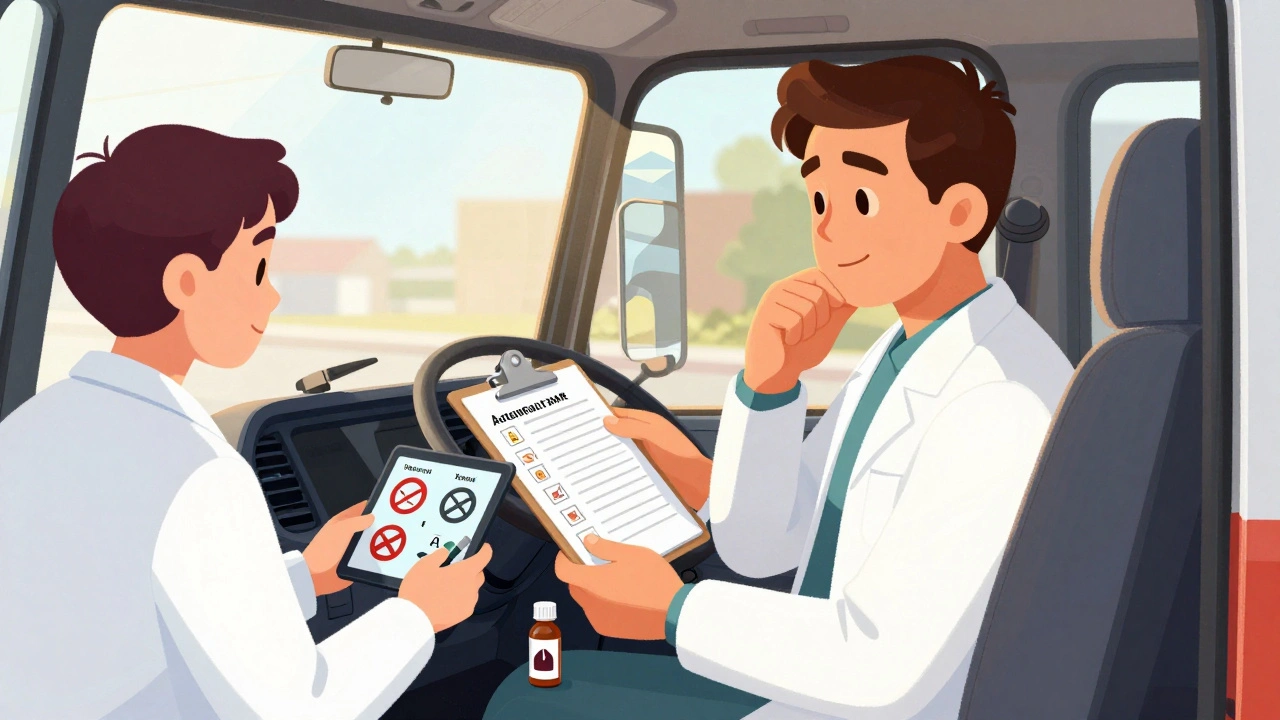
CDL Medication Compliance Checker
Driving a commercial truck isn’t just about knowing the roads-it’s about staying alert, focused, and legally clear of any substance that could slow your reaction time, blur your vision, or make you drowsy. The Federal Motor Carrier Safety Administration (FMCSA) doesn’t take chances. If you hold a Commercial Driver’s License (CDL), your medication use is under a microscope. Even something as simple as a cold pill can put your license at risk. This isn’t about being overly strict-it’s about keeping millions of people safe on the road every day.
What Medications Are Actually Banned for CDL Drivers?
The FMCSA doesn’t just look at illegal drugs. They care about any substance that could affect your ability to drive safely. That includes prescription meds, over-the-counter pills, and even herbal supplements. Schedule I drugs like marijuana, heroin, and LSD are outright banned-no exceptions, even if they’re legal in your state. But it’s the prescription drugs that catch most drivers off guard.
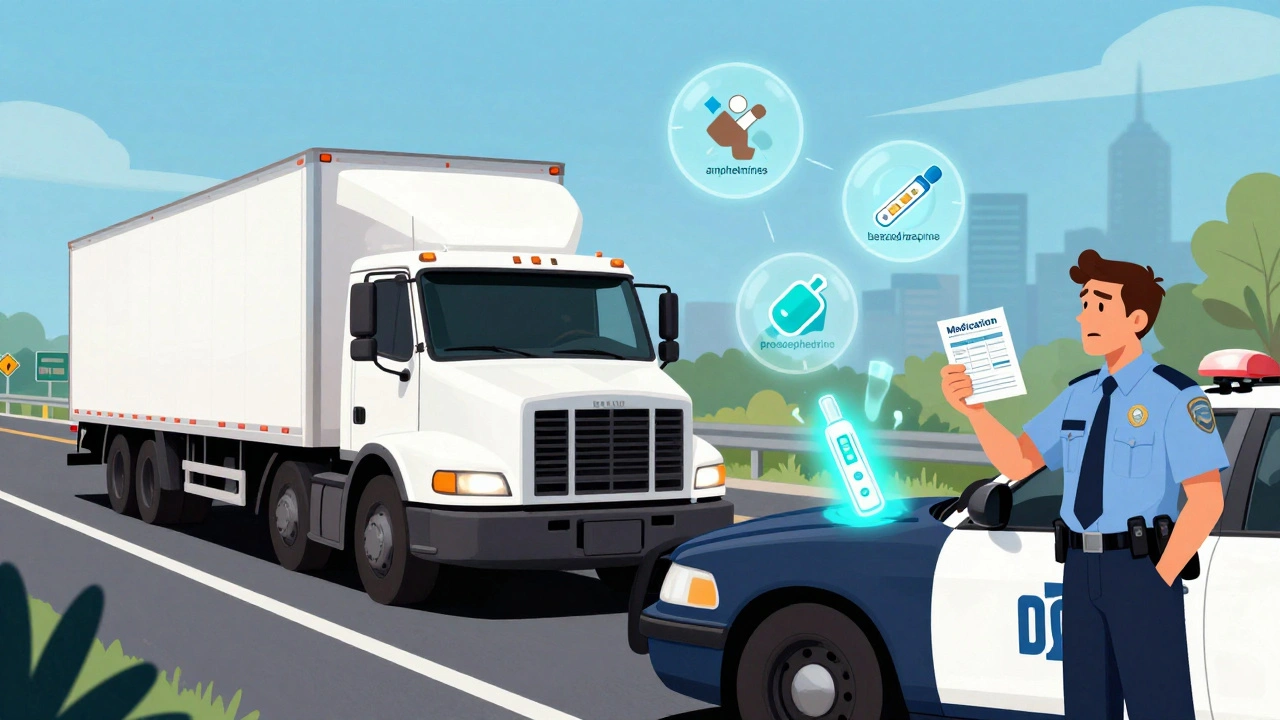
Amphetamines, including Adderall and Vyvanse, are prohibited-even if prescribed for ADHD. Narcotics like oxycodone, hydrocodone, and codeine are also banned, no matter how carefully your doctor says to take them. Benzodiazepines (like Xanax, Klonopin, Valium) are now under review for a full ban, after a 22% spike in crash-related positives from 2019 to 2023. Even some common cold and allergy meds containing pseudoephedrine or dextromethorphan can trigger false positives on DOT drug tests.
It’s not about the reason you’re taking it. It’s about the effect it has on your driving. A 2021 study by Dr. Gary Solomon, a certified Medical Examiner with over two decades of experience, found that 35% of drivers he examined were on medications requiring special review. Antidepressants topped that list. But even if you feel fine, the rules don’t care how you feel-they care about what the science says the drug can do.
Why Are the Rules So Strict Compared to Regular Jobs?
If you work in an office and take Adderall for ADHD, your employer might be required under the ADA to accommodate you. But for CDL drivers, safety overrides everything. The DOT’s rules come from a simple truth: a mistake while driving an 80,000-pound truck can kill dozens of people. That’s why the FMCSA’s standards are stricter than the Department of Defense’s, which allows certain stimulants under controlled military conditions. And it’s why the U.S. bans narcotics for commercial drivers, while 78% of European Union countries allow them under strict monitoring.
It’s not about distrust. It’s about scale. A single truck crash can involve multiple vehicles, bridges, and gas stations. The FMCSA reports that in 2020, 4.2% of large truck crashes involved drivers who tested positive for disqualifying substances-resulting in 1,247 deaths. That’s why the rules are non-negotiable. Your job isn’t just a job-it’s a public safety role.
What Happens During Your DOT Physical?
Your DOT physical every two years isn’t just a checkup-it’s a legal requirement with real consequences. You’ll sit down with a Medical Examiner listed in the National Registry of Certified Medical Examiners (NRCME). They’ll ask you for a complete list of every medication you take, including vitamins, supplements, and OTC drugs. You can’t skip anything. Not even melatonin or ibuprofen.
The examiner will check your medical history, your vision, your hearing, your blood pressure, and your ability to respond quickly. But the big one? Medication disclosure. If you’re on anything that could impair driving, they’ll ask your prescribing doctor to confirm it’s safe. That’s the key: the doctor must make a “good faith judgment” that the medication, at your prescribed dose, won’t interfere with safe operation.
And here’s the catch: if your doctor says it’s okay, but the FMCSA says it’s disqualifying, the FMCSA wins. No exceptions. You’ll get a Medical Examiner’s Certificate with restrictions-or you’ll be temporarily disqualified. That’s why so many drivers end up switching medications. A 2022 survey by the Owner-Operator Independent Drivers Association found that 63% of drivers had to stop taking effective pain meds because of DOT rules. Many say their chronic pain got worse as a result.
What If You Need a Disqualifying Medication?
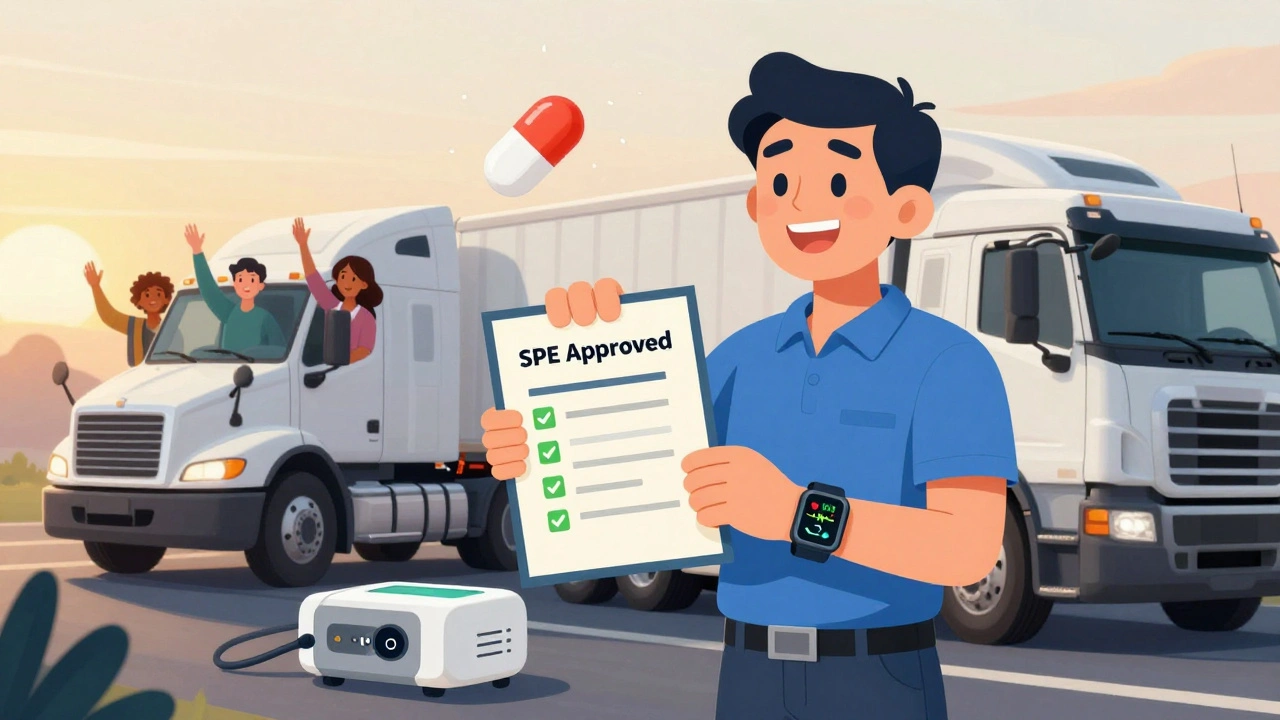
Some drivers can’t live without certain meds. Chronic pain, severe depression, or ADHD can’t always be managed with alternatives. But there’s a path forward. If you’re on a disqualifying drug, you can apply for a Skill Performance Evaluation (SPE) certificate. This isn’t a waiver-it’s a test. You’ll need to prove, through a series of driving assessments, that you can operate a CMV safely despite the medication.
The approval rate? About 68%, according to FMCSA’s 2023 report. That means most drivers who go through the process successfully get cleared. But it’s not easy. You’ll need documentation from your doctor, a detailed driving log, and often a follow-up evaluation every year. Some drivers have switched from Adderall to Strattera (a non-stimulant ADHD medication) and successfully regained their certification. Forums like TruckersReport.com have dozens of threads where drivers share their success stories.
And if you’re on CPAP for sleep apnea? That’s one of the most successfully managed conditions. With 92% compliance, the FMCSA recognizes that treating sleep apnea actually makes drivers safer. So if you need CPAP, don’t avoid it-get it. It’s not just good for your health-it’s good for your license.
How to Stay Compliant Without Losing Your Health
Here’s the reality: you can’t just guess. You need a plan. Start by creating a Medication Action Plan with your doctor. List every drug you take. Note the dosage, the time you take it, and how it affects you. Do you feel sluggish after lunch? Does your vision get blurry after taking your blood pressure pill? Write it down.
Use the FMCSA’s Driving Impairment Checklist. It’s free. It asks simple questions: Did you feel drowsy? Did you have trouble concentrating? Did you nearly drift out of your lane? Answer honestly. That’s your evidence. If you ever get pulled over for a roadside inspection, this document can save your job.
Also, always tell your employer. If you’re on a medication that might raise flags, give your dispatcher a heads-up. Many carriers now use electronic medication tracking systems-up from 18% in 2019 to 67% in 2024. If your company knows you’re compliant, they’re less likely to panic during an audit.
And never, ever hide a medication. The Drug and Alcohol Clearinghouse now requires all restrictions to be reported within 24 hours. If you lie and get caught, you’re looking at a $1,250 fine per incident-and a suspended license. That’s not worth it.
The Hidden Cost of Compliance
There’s a financial side to this, too. DOT physicals cost between $85 and $150. SPE evaluations can run $500 or more. Electronic tracking systems? Carriers pay thousands to implement them. But the biggest cost isn’t money-it’s the driver shortage.
The Commercial Vehicle Medical Research Foundation warns that 43% of drivers over 50 rely on medications that conflict with DOT rules. By 2027, that could mean a shortage of 54,000 drivers. Many are choosing to quit rather than give up their meds. Others are working through pain, risking accidents because they’re too afraid to speak up.
And it’s not just older drivers. Younger drivers with ADHD, anxiety, or chronic conditions are leaving the industry because they feel trapped. The FMCSA is aware. In February 2024, they proposed expanding the list of reportable medications to include all benzodiazepines. They’re also funding a $4.7 million pilot with Samsara and KeepTruckin to test real-time biometric wearables that detect impairment-not just drugs.
That’s the future: not just banning meds, but measuring actual performance. But until then, the rules stay strict. Your job is to know them, follow them, and protect your health within them.
What’s Next for Drivers and Medications?
The industry is changing. Real-time monitoring, AI-driven fatigue detection, and personalized health dashboards are coming. But the core rule won’t change: if a drug impairs your ability to drive safely, it’s not allowed. The goal isn’t to punish drivers-it’s to prevent tragedies.
If you’re struggling with your meds, don’t suffer in silence. Talk to your doctor. Find a certified Medical Examiner who understands your situation. Look into non-disqualifying alternatives. Join a driver support group. You’re not alone. Thousands have walked this path-and many made it through.
Stay informed. Stay compliant. And most of all-stay safe. Your license isn’t just a piece of plastic. It’s your livelihood. And every mile you drive safely? That’s a life you’ve protected.
Can I drive a commercial truck if I take antidepressants?
Yes, if your prescribing doctor confirms the medication doesn’t impair your ability to drive safely. Antidepressants like SSRIs (e.g., sertraline, escitalopram) are commonly approved, but sedating ones like trazodone or older TCAs may require a medical evaluation. You must disclose all prescriptions during your DOT physical, and your Medical Examiner may request a note from your doctor stating the dosage and your stability on the medication.
Is Adderall banned for CDL drivers even with a prescription?
Yes. Adderall and other amphetamine-based stimulants are prohibited for CDL holders regardless of prescription status. Even if your doctor says it helps you focus, the FMCSA classifies these drugs as disqualifying because they can cause jitteriness, insomnia, or mood swings-all of which affect driving safety. Switching to non-stimulant options like Strattera is the most common way drivers regain compliance.
What happens if I get caught driving while taking a banned medication?
If you test positive for a disqualifying substance during a DOT drug test, your license will be immediately suspended. You’ll be removed from duty until you complete the Substance Abuse Professional (SAP) evaluation and treatment program. You may also face fines from your employer and the FMCSA. If you lied on your medical form, you could be permanently disqualified. Always disclose everything upfront-it’s the only way to stay protected.
Can I use CBD oil if I’m a commercial driver?
No. Even if the CBD product claims to be THC-free, federal law still classifies all cannabis-derived substances as Schedule I. DOT drug tests can’t distinguish between hemp-derived CBD and marijuana, and even trace amounts of THC (which may be present in unregulated products) can trigger a positive result. The FMCSA does not recognize CBD as an exception. Avoid it entirely while holding a CDL.
Do I have to tell my employer about my medications?
You’re not legally required to tell your employer directly, but you must disclose all medications to your DOT Medical Examiner. Your employer will receive your Medical Examiner’s Certificate, which may include restrictions. If you’re on a disqualifying medication and have an SPE certificate, your employer must be informed so they can comply with FMCSA reporting rules. Being transparent with your employer helps avoid misunderstandings during audits or inspections.
How often do I need to renew my DOT medical certificate if I’m on medication?
The standard renewal is every 24 months. But if you’re on medication that requires monitoring-like blood pressure pills, insulin, or sleep apnea treatments-the Medical Examiner may issue a certificate for 3 months, 1 year, or another shorter term. This gives your doctor time to confirm the medication is stable and not affecting your driving. Always follow up with your provider before your certificate expires.


Clare Fox
7 December, 2025 . 01:08 AM
i mean... if you're on adderall and you're not crashing, why does it matter? the system's punishing people for being functional. it's not about safety, it's about control.
Kumar Shubhranshu
8 December, 2025 . 16:34 PM
dot rules are outdated. real impairment is measured by performance not pill bottles.
brenda olvera
10 December, 2025 . 13:25 PM
my uncle drove trucks for 30 years on antidepressants and never had an accident. trust the driver not the drug list
Dan Cole
10 December, 2025 . 19:21 PM
The FMCSA's approach is not just outdated-it's fundamentally flawed. They treat medication like a moral failing rather than a medical condition. This isn't safety-it's institutionalized ableism dressed up as regulation. You don't ban a drug because it's 'dangerous.' You assess the individual's functional capacity. That's what medicine is. That's what science is. But no, let's just blanket ban everything that sounds scary and call it progress.
Max Manoles
10 December, 2025 . 19:55 PM
I work with a lot of drivers who are on SSRIs and they're some of the most focused, calm people on the road. The real danger is the ones who are self-medicating with alcohol or sleeping pills because they're too scared to tell anyone they need help. The system pushes people into the shadows. That's the opposite of safety.
Inna Borovik
11 December, 2025 . 04:38 AM
so you're telling me a guy on 20mg of citalopram is more dangerous than a guy who drank 3 beers last night and didn't get tested? the math doesn't add up.
Akash Takyar
11 December, 2025 . 14:02 PM
Dear friend, please remember: your health is your greatest asset. If you are on medication, speak with your certified medical examiner. Do not fear disclosure. Transparency is not weakness-it is wisdom. Many drivers have successfully transitioned to non-disqualifying alternatives. You are not alone. The road is long, but you are strong.
Jackie Petersen
12 December, 2025 . 06:50 AM
this is all a government power grab. next they'll ban caffeine. they don't care about safety-they care about control. and don't even get me started on how they let foreign drivers in with worse rules.
Katie O'Connell
12 December, 2025 . 20:07 PM
The structural inefficiencies inherent in the FMCSA's pharmacological regulatory framework reflect a profound epistemological disconnect between clinical medicine and bureaucratic governance. The categorical prohibition of psychopharmacological agents-without individualized functional assessment-constitutes a violation of both medical ethics and the principle of proportionality. One must question the ontological basis of a regulatory regime that privileges chemical taxonomy over behavioral outcome.
Annie Gardiner
13 December, 2025 . 03:50 AM
so let me get this straight... you'd rather let a guy with chronic pain drive while on a banned opioid than let someone with ADHD take a pill that lets them stay awake? wow. the real tragedy here is the people who don't speak up because they're scared. and now you're making them feel guilty for being human.
Arjun Deva
15 December, 2025 . 02:27 AM
CBD is banned? lol. the feds are scared of hemp because it competes with pharma. and the 92% cpap compliance rate? that's because they're forcing it on people. you think that's safety? it's corporate surveillance with a medical label.
Kenny Pakade
15 December, 2025 . 05:45 AM
if you're taking meds that make you drowsy, you shouldn't be driving. period. this isn't about being mean, it's about not killing families. if you can't handle the rules, get a different job.
Rashmi Gupta
16 December, 2025 . 16:55 PM
they banned adderall but let drivers take melatonin? that's like banning beer but allowing cough syrup. the system is broken and everyone knows it.