By the time most people hear the words type 2 diabetes, the damage has already been building for years. It’s not sudden. It doesn’t strike out of nowhere. It creeps in with tired mornings, stubborn belly fat, and a hunger that never quite goes away-even after eating. This isn’t just about sugar. It’s about your body’s broken communication system with insulin, the hormone that tells your cells to take in glucose. And when that system fails, it doesn’t just lead to diabetes-it triggers a cascade of problems called metabolic syndrome, which silently raises your risk of heart attack, stroke, and liver disease.
What Actually Happens When You Have Insulin Resistance?
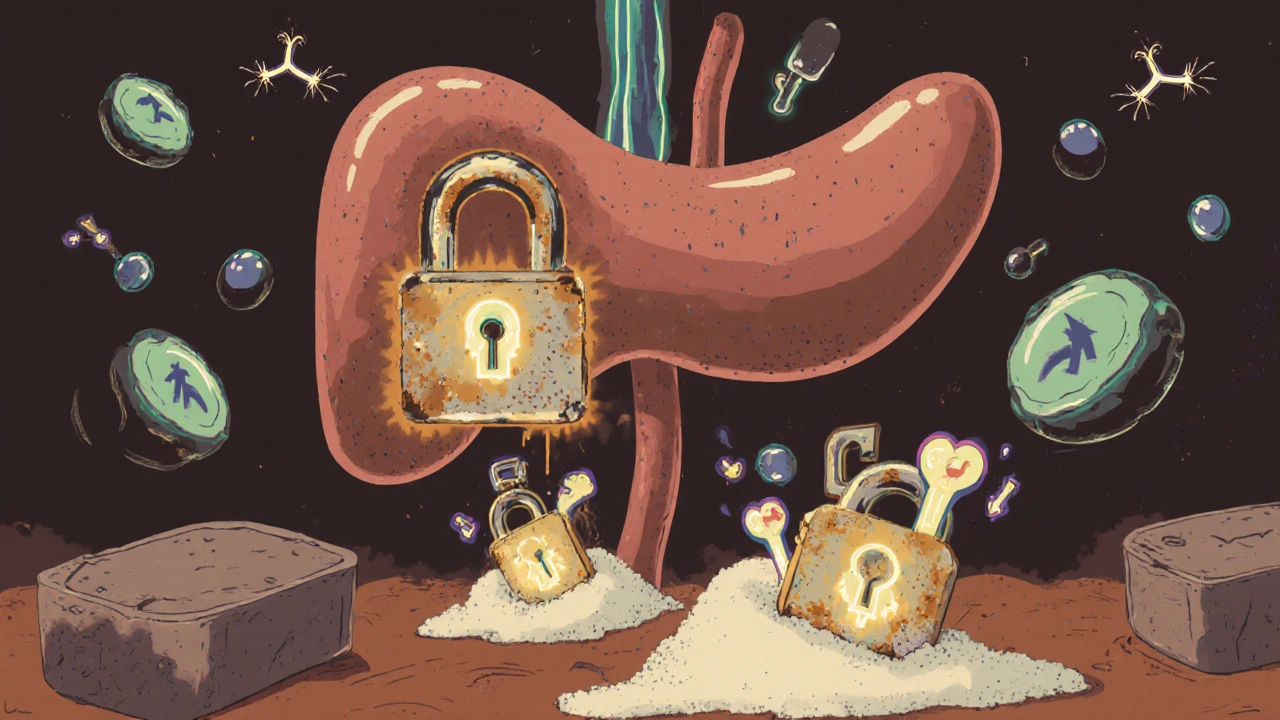
Imagine insulin as a key. Your cells have locks-called receptors-and insulin turns those locks to let glucose (sugar) inside to be used for energy. In insulin resistance, the locks start to rust. They don’t respond as well. So even though there’s plenty of insulin floating around, glucose stays in your blood. Your pancreas notices. It panics. It starts pumping out more insulin to force the door open. That’s called hyperinsulinemia.
This isn’t normal. It’s your body screaming for help. Over time, your pancreas gets worn out. Beta cells-the ones that make insulin-start to burn out. By the time your fasting blood sugar hits 126 mg/dL or higher, you’ve crossed into type 2 diabetes. But here’s the thing: most people have had insulin resistance for 10 to 15 years before that diagnosis. The real problem isn’t sugar intake alone. It’s the constant overload of calories, especially from refined carbs and unhealthy fats, that floods your liver and muscles with fat. That fat interferes with insulin signaling at a molecular level. Studies show that non-esterified fatty acids (NEFAs) block the insulin receptor pathway, triggering inflammation and stress inside cells. This isn’t just a lifestyle issue-it’s a biochemical breakdown.
Metabolic Syndrome: More Than Just a List of Numbers
Doctors used to call it Syndrome X. Now, many experts prefer the term metabolic dysfunction syndrome (MDS). Why? Because it’s not just a collection of risk factors-it’s a single disease with one root cause: insulin resistance.
The official diagnosis requires at least three of these five markers:
- Waist size: 94 cm or more for men in Europe, 90 cm for South Asian or East Asian men; 80 cm or more for women
- Triglycerides: 150 mg/dL or higher
- HDL cholesterol: under 40 mg/dL for men, under 50 mg/dL for women
- Blood pressure: 130/85 mmHg or higher
- Fasting blood sugar: 100 mg/dL or higher
Here’s what most people don’t realize: having just one of these doesn’t mean much. But having three? That’s a red flag. Your risk of heart disease jumps 200-300%. Your chance of developing type 2 diabetes? Five to six times higher than someone without it. And if you have fatty liver disease-especially the inflammatory kind called NASH-your risk doubles again. This isn’t coincidence. It’s connected. Insulin resistance drives fat storage in your liver, raises triglycerides, lowers good cholesterol, and makes your blood vessels stiff and inflamed. It’s all one system failing.
Why Some People Get It and Others Don’t
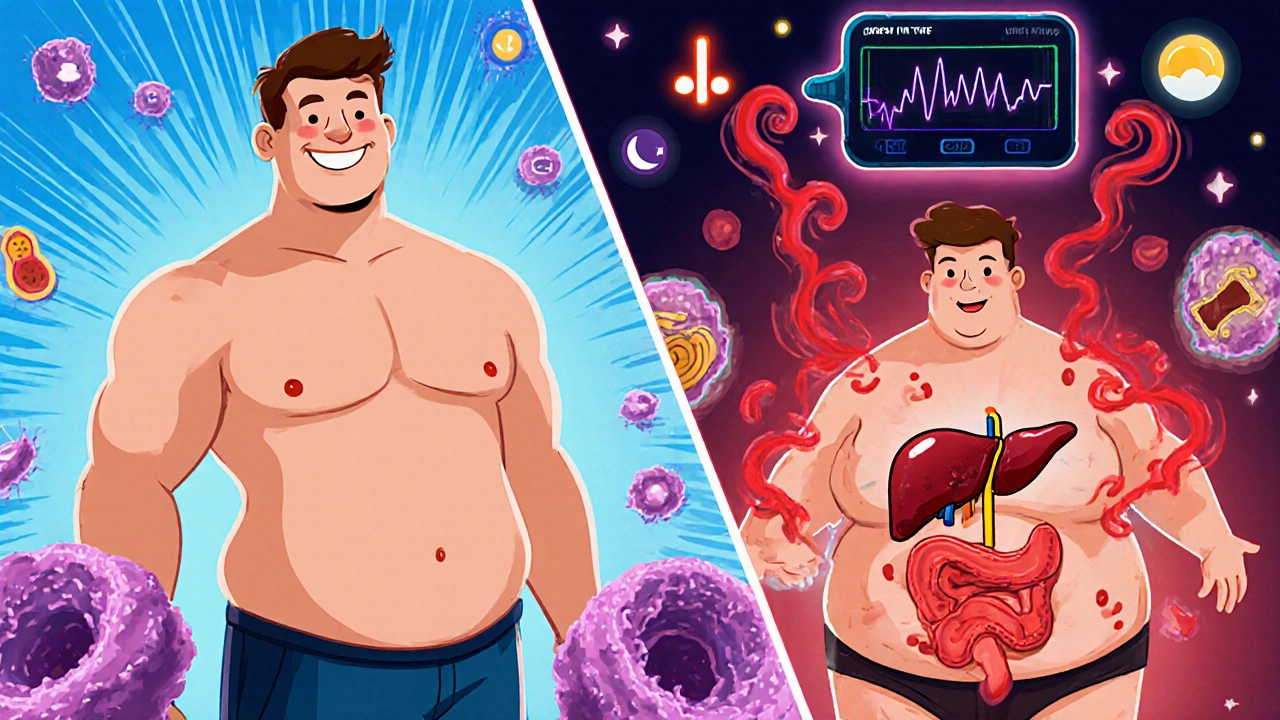
Not every overweight person has metabolic syndrome. And not every person with type 2 diabetes is overweight. About 30-40% of people with obesity never develop insulin resistance. Why? Genetics. Fat distribution matters more than total weight. If your fat is stored under your skin (subcutaneous), you’re less at risk. But if it’s pooling around your organs-your liver, pancreas, and belly-you’re in trouble. That’s visceral fat. It’s not just fat. It’s an active organ that spits out inflammatory chemicals and free fatty acids, directly poisoning insulin signaling.
And then there are lean people with type 2 diabetes-especially those of South Asian descent. Research from Oxford shows that in some genetic groups, beta cell dysfunction may be the primary driver, not insulin resistance. Their bodies just can’t make enough insulin, even if their cells are still responsive. This is why blanket advice like “just lose weight” doesn’t work for everyone. One size doesn’t fit all.
The Real Progression: From Insulin Resistance to Diabetes
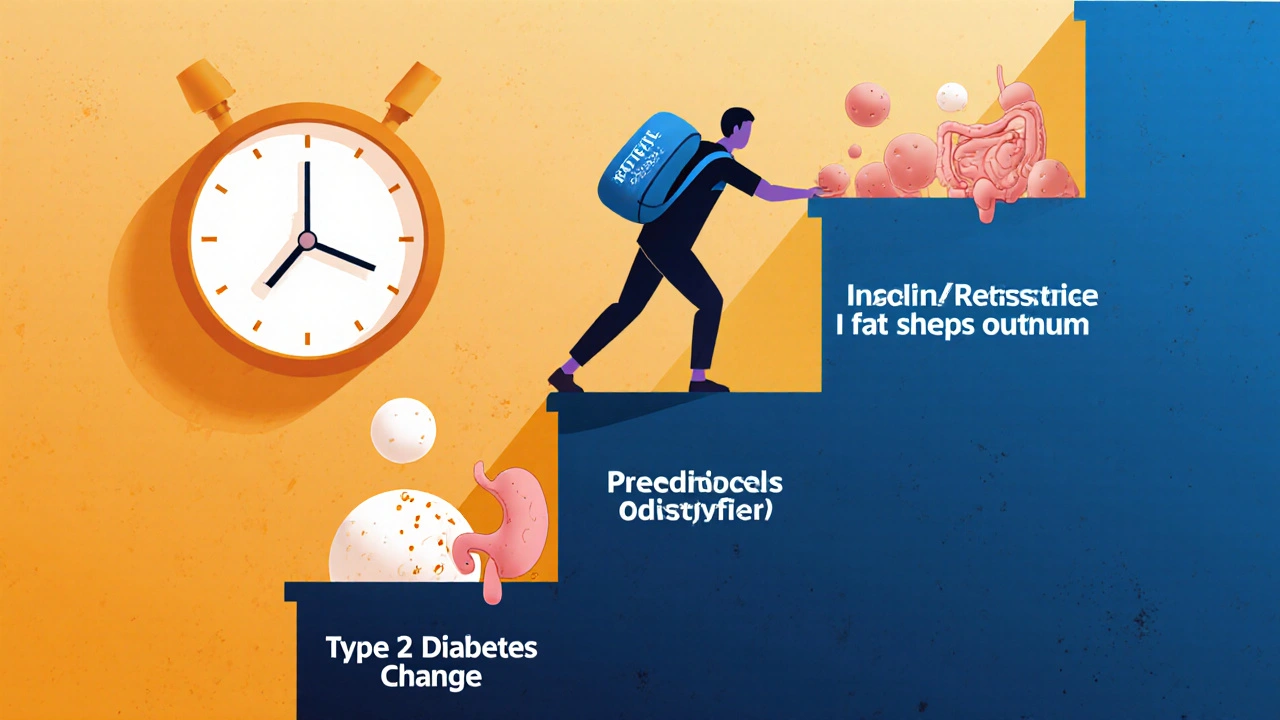
It’s not a straight line. It’s a staircase.
Stage 1: Insulin resistance. Blood sugar is normal, but insulin is already high. You might feel tired after meals, crave carbs, or struggle to lose weight. No diagnosis yet.
Stage 2: Prediabetes. Fasting blood sugar is 100-125 mg/dL. Your pancreas is still working overtime. You’re not diabetic-but you’re close. The Diabetes Prevention Program showed that 70% of people with prediabetes will develop type 2 diabetes within 10 years if nothing changes.
Stage 3: Type 2 diabetes. Beta cells are failing. Fasting sugar hits 126 mg/dL or higher. Your body can’t keep up. You need medication. But even now, it’s not too late to reverse some of the damage.
Here’s the key insight: beta cells decline by about 4-5% per year once insulin resistance sets in. That’s why early action matters. If you wait until you’re diagnosed with diabetes, you’ve already lost a third of your insulin-making capacity.
What Actually Works to Reverse It
Medication helps-but lifestyle changes are the only thing that can truly reverse insulin resistance.
The gold standard? Losing 7% of your body weight. For someone weighing 200 pounds, that’s 14 pounds. The Diabetes Prevention Program proved this cuts diabetes risk by 58% over three years. It’s not magic. It’s biology. Less fat means less inflammation. Less fat in the liver means better insulin response. Less fat in muscles means better glucose uptake.
Exercise? Not just any kind. You need 150 minutes a week of moderate activity-brisk walking, cycling, swimming. But strength training matters too. Muscle is the biggest consumer of glucose. The more muscle you have, the better your body handles sugar.
Medications like metformin reduce diabetes risk by 31% in prediabetes. But newer drugs like semaglutide and tirzepatide are changing the game. In the STEP trials, people lost nearly 15% of their body weight on semaglutide. In the SELECT trial, 66% of those with type 2 diabetes achieved remission-meaning their blood sugar returned to normal without medication. These aren’t just weight-loss drugs. They reset your metabolism.
Monitoring matters too. HbA1c tells you your average blood sugar over three months. Normal is under 5.7%. Prediabetes is 5.7-6.4%. Diabetes is 6.5% or higher. Most doctors aim to keep it under 7% for people with diabetes. But the goal should be lower if possible-closer to normal.
What Doesn’t Work (And Why People Get Frustrated)
Many people do everything “right.” They count calories. They eat salads. They take their pills. And still, the scale won’t budge. Why?
Because most advice is too vague. “Eat less sugar” doesn’t help if you’re eating whole grain bread, fruit juice, and low-fat yogurt loaded with hidden carbs. “Exercise more” doesn’t help if you’re doing 10 minutes of yoga and calling it a day.
And the emotional toll? Real. People report constant hunger, brain fog, and fatigue-even when their numbers look okay. They feel blamed. “If I just had more willpower,” they think. But insulin resistance isn’t about willpower. It’s biology. Your body is fighting to survive in an environment designed to overfeed you.
That’s why support matters. People in online communities like r/diabetes who stick to structured plans-meal timing, carb control, consistent movement-see far better results than those trying to wing it. One study found that 58% of people with metabolic syndrome and prediabetes avoided diabetes after three years of consistent lifestyle changes. That’s not luck. That’s science.
The Future Is Here-And It’s Not Just Pills
Scientists are now testing stem cell therapies that replace damaged beta cells. Vertex Pharmaceuticals’ VX-880 therapy has already helped patients stop insulin injections after just one treatment. In trials, 71% reached normal HbA1c levels without needing external insulin.
Continuous glucose monitors (CGMs) like the Dexcom G7 are now affordable and accurate enough for everyday use. They show you how your body reacts to food, sleep, and stress in real time. No more guessing. You see the spikes. You see the crashes. You learn what works for your body.
And the big shift? The move from “metabolic syndrome” to “metabolic dysfunction syndrome.” This isn’t just semantics. It’s a recognition that this isn’t a collection of symptoms-it’s a disease. And it’s treatable.
The World Health Organization warns that without major intervention, diabetes deaths could rise 76% by 2045. But the Lancet Commission says we could cut type 2 diabetes incidence by 40-60% by 2035-with coordinated action: better food policies, access to healthy meals, community support, and early screening.
You don’t need to wait for policy changes to act. Start with one thing: measure your waist. If it’s over the threshold, get your fasting blood sugar checked. If you’re overweight and tired all the time, don’t assume it’s just aging. It might be your body telling you it’s time to reset.
Insulin resistance isn’t a life sentence. It’s a signal. And signals can be answered.




Peter Axelberg
29 November, 2025 . 19:34 PM
Man, this post hit different. I used to think diabetes was just 'eating too much sugar' until my dad got diagnosed and I saw how his body just... stopped responding. It's not laziness. It's not willpower. It's your cells screaming for help while your pancreas is working overtime like a broke guy with three jobs. The part about visceral fat being an active organ? That stuck with me. I started measuring my waist last month. 98 cm. Time to change.
Monica Lindsey
30 November, 2025 . 11:48 AM
Typical. Another post blaming modern food while ignoring the real issue: genetic decay.
Jennifer Wang
1 December, 2025 . 04:39 AM
Excellent synthesis of current evidence. The distinction between subcutaneous and visceral adipose tissue is critical and often overlooked in public health messaging. The 4-5% annual beta-cell decline is supported by longitudinal data from the UKPDS and remains a key rationale for early intervention. HbA1c targets should ideally be <5.7% for prediabetic individuals, not merely <7%.
Bernie Terrien
1 December, 2025 . 21:02 PM
Insulin resistance? More like insulin betrayal. Your body’s got a traitor in the lab coat - your own pancreas - and it’s been smuggling glucose out while pretending to play nice. The fat in your liver? That’s not storage. That’s a hostile takeover. And no, kale smoothies won’t fix it.
Tina Dinh
3 December, 2025 . 04:30 AM
THIS. 🙌 I’ve been on this journey for 3 years. Lost 22 lbs. HbA1c dropped from 6.8 to 5.4. It’s not easy but it’s possible. You’re not broken - your system just needs recalibration. Start with one walk. One less sugary drink. One more sleep hour. You got this 💪🔥
Peter Lubem Ause
3 December, 2025 . 16:31 PM
Let me tell you something from the frontlines of Lagos: we’re seeing type 2 diabetes skyrocket among young professionals here who never thought they’d be at risk. It’s not just about Western diets - it’s about processed rice, instant noodles, and sugary teas that pass as ‘traditional.’ The science in this post is spot-on. Insulin resistance doesn’t care where you’re from. It only cares about what’s in your belly and how often you feed it. The good news? Movement is universal. Even 20 minutes of brisk walking after meals helps. You don’t need a gym. You just need consistency.
LINDA PUSPITASARI
4 December, 2025 . 04:01 AM
so true about the CGMs i got mine last year and wow it opened my eyes i thought fruit was healthy turns out mangoes spike me to 180 😱 now i eat berries and avocado and my energy is insane also strength training changed everything i used to think cardio was the only way but no muscle is the real sugar sponge 💯
jamie sigler
4 December, 2025 . 12:26 PM
I mean... I guess. But what if the real problem is that we’re all just too stressed to care? My doctor says lose weight. My boss says work harder. My phone says eat this. My fridge says eat that. Who’s actually listening to me?
stephen idiado
4 December, 2025 . 14:03 PM
Insulin resistance is a myth propagated by Big Pharma. The real issue is mitochondrial dysfunction due to glyphosate exposure in genetically modified crops. Your liver isn’t clogged with fat - it’s poisoned by Roundup. Test your urine for glyphosate. That’s the root cause.
Andrew Keh
4 December, 2025 . 18:30 PM
This is one of the clearest explanations I’ve read. I appreciate how you separated the stages. Most people don’t realize prediabetes is a window - not a sentence. I’ve shared this with my sister. She’s got the numbers but won’t believe it’s serious. Maybe this will help.
gerardo beaudoin
4 December, 2025 . 22:09 PM
Just started walking 30 mins a day after dinner. First week felt weird. Second week felt better. Third week I actually slept through the night. No magic. Just movement. And yeah, I stopped drinking soda. Small stuff adds up.
linda wood
5 December, 2025 . 09:42 AM
So you’re telling me my 3 a.m. cravings aren’t just ‘weak willpower’… but my body’s literally screaming for help because my liver is drowning in fat? And I’ve been blaming myself for 7 years? 😭
Brandy Johnson
5 December, 2025 . 10:44 AM
While I acknowledge the biological mechanisms described, the cultural implications of this narrative are deeply concerning. The emphasis on individual responsibility obscures systemic failures in public health infrastructure. In the United States, food deserts, wage stagnation, and the commodification of wellness disproportionately burden marginalized communities. To suggest that ‘one walk’ or ‘one less sugary drink’ is sufficient ignores structural violence. This is not biology - it is policy.
Subhash Singh
6 December, 2025 . 00:25 AM
Very informative. However, in the Indian context, the role of refined rice consumption - particularly polished white rice with high glycemic index - is significantly underemphasized. Traditional diets included millets and legumes, which modulate insulin response. The shift to urbanized diets has accelerated metabolic dysfunction. Genetic predisposition combined with dietary transition creates a perfect storm. We must reintroduce ancestral foods, not just count calories.
Geoff Heredia
7 December, 2025 . 04:23 AM
Wait… so they’re saying CGMs are ‘affordable’? That’s a joke. They cost $1000 a month. And who’s paying for them? The same people who can’t afford healthy food. This whole thing is a scam. They want you hooked on devices while Big Pharma sells you semaglutide at $1200 a shot. They’re not curing you. They’re monetizing your suffering. Wake up.