Imagine receiving a stack of papers after a doctor’s visit. The font is tiny, the sentences are long, and words like "hypertension" or "contraindication" pop up everywhere. For many older adults, this isn’t just confusing-it’s frightening. If you can’t understand your care plan, how can you follow it? This gap in understanding leads to missed medications, preventable hospital visits, and unnecessary stress for patients and families alike.
Senior patient education is the practice of designing health information specifically for adults aged 65 and older to overcome barriers like poor vision, hearing loss, and cognitive changes. It is not simply about shrinking text; it is about rebuilding the way we communicate critical health data. When done right, these materials save lives by ensuring that patients actually know what to do when they leave the clinic.
The Urgent Need for Specialized Health Communication
We often assume that if someone has a college degree, they can read a medical brochure. That assumption is dangerous. According to data from the National Assessment of Adult Literacy (NAAL), a major U.S. study on adult literacy skills, 71% of adults over age 60 had difficulty using standard print materials. Even worse, 80% struggled with forms or charts, which are staples in healthcare settings.
This isn't just an inconvenience; it's a safety risk. The Agency for Healthcare Research and Quality (AHRQ) estimates that limited health literacy costs the U.S. healthcare system between $106 billion and $238 billion annually. Older adults bear the brunt of this cost. A report from the Centers for Disease Control and Prevention (CDC) found that older adults with limited health literacy were 2.3 times more likely to report poor health status than those who understood their medical instructions clearly.
As the population ages, this problem grows. The U.S. Census Bureau reported that adults aged 65 and older made up 17.3% of the population in 2022, a number projected to hit 22% by 2040. We cannot afford to use one-size-fits-all communication strategies anymore.
Design Rules for Senior-Friendly Materials
Creating effective materials requires following specific design standards. You might think a 12-point font is readable, but for aging eyes, it is often too small. The National Institute on Aging (NIA) guidelines specify a minimum 14-point font size. They also recommend easy-to-read typefaces-sans-serif fonts like Arial or Verdana work better than decorative ones.
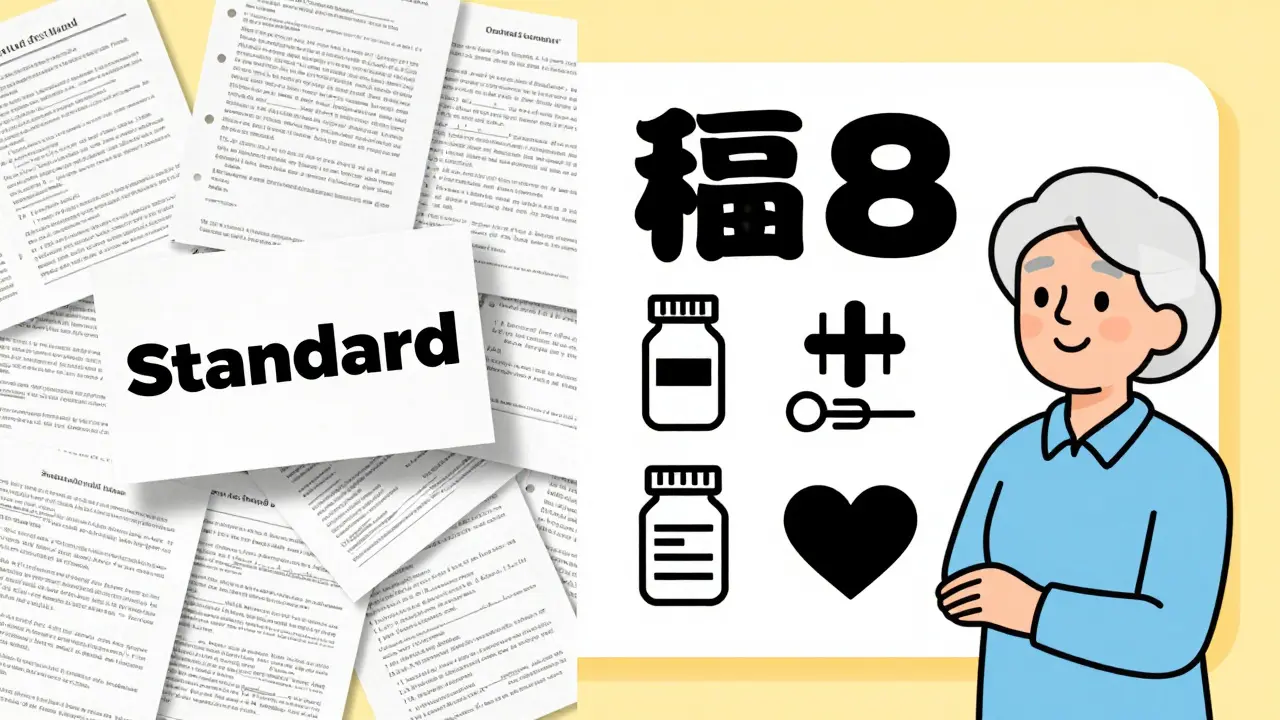
Reading level matters just as much as font size. Most medical documents are written at a 9th to 12th-grade reading level. However, only about 20% of U.S. adults read at or below a 3rd to 5th-grade level. To be truly accessible, senior patient education materials should aim for that lower reading range. Research published in the Journal of General Internal Medicine in 2021 showed that materials written at a 3rd to 5th-grade level improved comprehension by 42% among adults over 65 compared to standard medical texts.
- Font Size: Use at least 14-point font for body text.
- Contrast: Use black text on white or off-white backgrounds. Avoid gray text on white paper.
- Simplicity: Write at a 3rd to 5th-grade reading level. Short sentences. Active voice.
- Visuals: Include drawings or photos that match the text. Do not use complex charts unless explained step-by-step.
The Plain Language Act of 2010 established federal guidelines requiring government agencies to use clear communication. While this law applies to government entities, its principles serve as the gold standard for all healthcare providers aiming to reduce confusion.
Multimodal Communication: Beyond Printed Pages
Relying solely on printed handouts is outdated. Many older adults experience sensory declines that make reading difficult. Hearing loss affects nearly one-third of adults aged 65-74. Vision issues like macular degeneration are common. Therefore, effective education must be multimodal.
The CDC recommends offering information through multiple channels: fact sheets, verbal explanations, videos, and physical models. For example, instead of just telling a patient to "take this pill twice a day," show them the pill bottle, demonstrate how to open it, and use a pill organizer to visually map out morning and evening doses.
Technology is also changing the landscape. Telehealth utilization among older adults jumped from 17% in 2019 to 68% in 2023, according to Commonwealth Fund data. This shift means digital literacy is now part of health literacy. The NIA updated their Go4Life exercise program in January 2024 to include voice-activated technology and simplified video demonstrations, recognizing that some users prefer listening or watching over reading.
| Channel | Best For | Limitations |
|---|---|---|
| Printed Handouts | Reference material, medication schedules | Requires good vision and literacy skills |
| Video Demonstrations | Physical exercises, device usage | Requires internet access and digital comfort |
| Verbal Teach-Back | Confirming immediate understanding | Does not provide a lasting reference |
| Illustrated Guides | Step-by-step procedures | Can be misinterpreted if images are unclear |
The Power of the Teach-Back Method
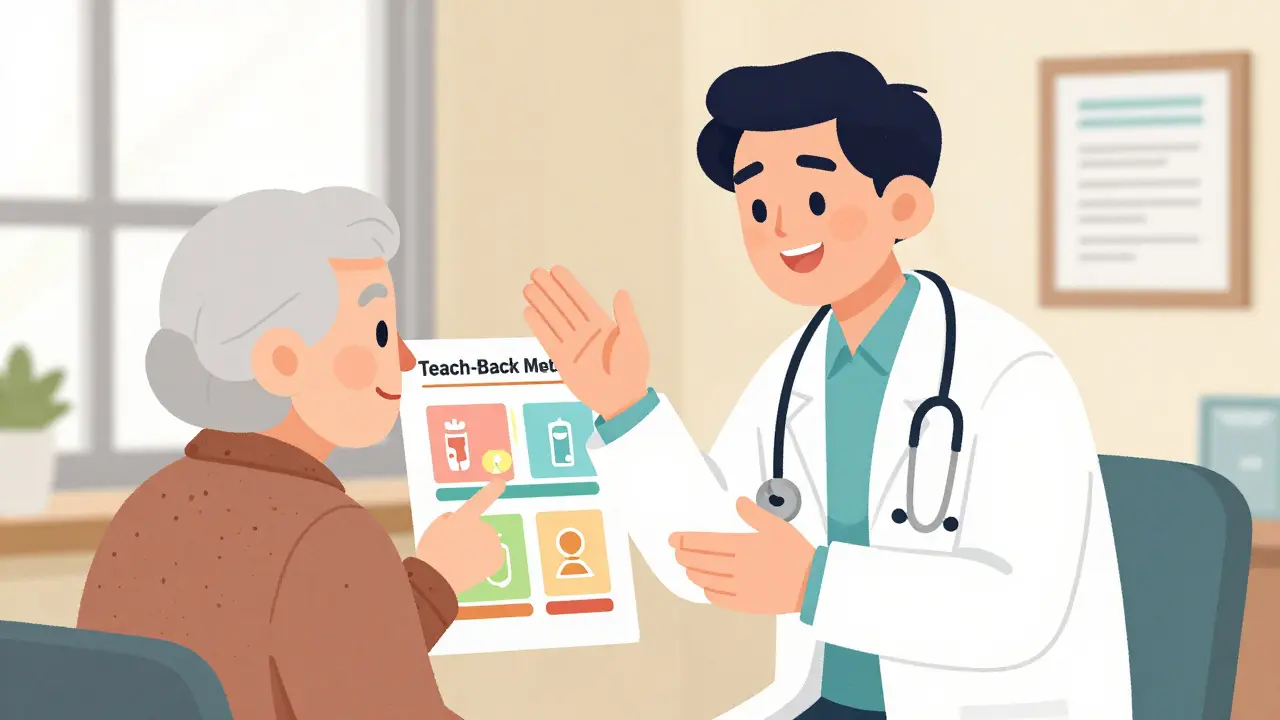
You can give the best-designed pamphlet in the world, but if the patient doesn’t understand it, the effort is wasted. This is where the Teach-Back Method comes in. Recommended by the American Geriatrics Society (AGS), this technique asks patients to repeat information in their own words.
It works like this: Instead of asking, "Do you understand?" (to which most people will say yes out of politeness), ask, "Just to make sure I explained this clearly, can you tell me how you’re going to take this medicine tonight?" If they get it wrong, you re-explain using simpler terms and try again. There is no blame; it is a check for clarity.
A systematic review in the Journal of the American Geriatrics Society analyzed 47 studies and found that illustrated step-by-step instructions combined with teach-back improved medication adherence by 37% among older adults with low health literacy. The NIA reports that 87% of healthcare providers who implemented these techniques observed improved patient understanding.
Overcoming Implementation Barriers
Why aren’t all clinics doing this? Time and money are the biggest hurdles. A 2023 survey by the American Medical Association found that 78% of healthcare providers cited limited staff time as a barrier to implementing health literacy strategies. Developing a single high-quality patient education resource takes approximately 8-12 weeks, involving 5-7 rounds of testing with target demographic representatives, according to the HealthPartners Institute.
Furthermore, Dr. Jane Johnson of the University of Michigan noted in a 2023 Health Affairs article that only 28% of U.S. healthcare systems have fully integrated universal precautions for health literacy into their standard operating procedures. Despite this, the benefits are clear. Healthcare systems that adopted these universal precautions saw a 22% reduction in emergency department visits among older adult patients within 18 months.
Funding is another challenge. 65% of community health centers reported insufficient funding for specialized material development. However, the return on investment is significant. Medicare’s 2023 Annual Report highlighted that hospitals with comprehensive senior patient education programs saw 14.3% fewer readmissions, saving approximately $1,842 per patient.
Where to Find Trusted Resources
If you are a caregiver, family member, or provider looking for pre-vetted materials, several authoritative sources exist. You do not need to start from scratch.
HealthinAging.org, run by the Health in Aging Foundation, is a public education portal launched in 2002. As of 2020, it sees 2.3 million accesses annually. Users praise its ability to distill technical scientific information into plain language. Amanda C., a caregiver from San Diego, noted in June 2023 that the site made complex topics easier to comprehend for her family.
MedlinePlus, a service of the National Library of Medicine, offers an "Easy-to-Read Health Information" section containing 217 resources as of October 2023. These are assessed using the Health Education Materials Assessment Tool (HEMAT) to ensure they meet readability standards.
The NIA’s "Talking With Your Older Patients" resource, first published in 2005 and updated in June 2023, provides a comprehensive guide for clinicians on how to adjust their communication style during appointments.
What font size is best for senior patient education materials?
The National Institute on Aging recommends a minimum font size of 14 points for body text. Using sans-serif fonts like Arial or Verdana improves readability further. High contrast, such as black text on a white background, is also essential.
What is the teach-back method?
The teach-back method is a communication technique where healthcare providers ask patients to repeat information in their own words to confirm understanding. It helps identify gaps in knowledge without blaming the patient for not understanding.
Why is health literacy important for older adults?
Limited health literacy is linked to higher rates of hospital readmissions, medication errors, and poorer overall health outcomes. Older adults with low health literacy are 2.3 times more likely to report poor health status, making clear communication a critical safety measure.
Where can I find free, easy-to-read health materials for seniors?
Trusted sources include HealthinAging.org, MedlinePlus (specifically the Easy-to-Read section), and the National Institute on Aging’s website. These platforms provide materials vetted for readability and accuracy.
How does telehealth impact senior patient education?
Telehealth usage among older adults rose significantly from 17% in 2019 to 68% in 2023. This shift requires educators to address digital literacy alongside health literacy, incorporating video demonstrations and voice-activated tools to assist patients who may struggle with traditional text-based interfaces.