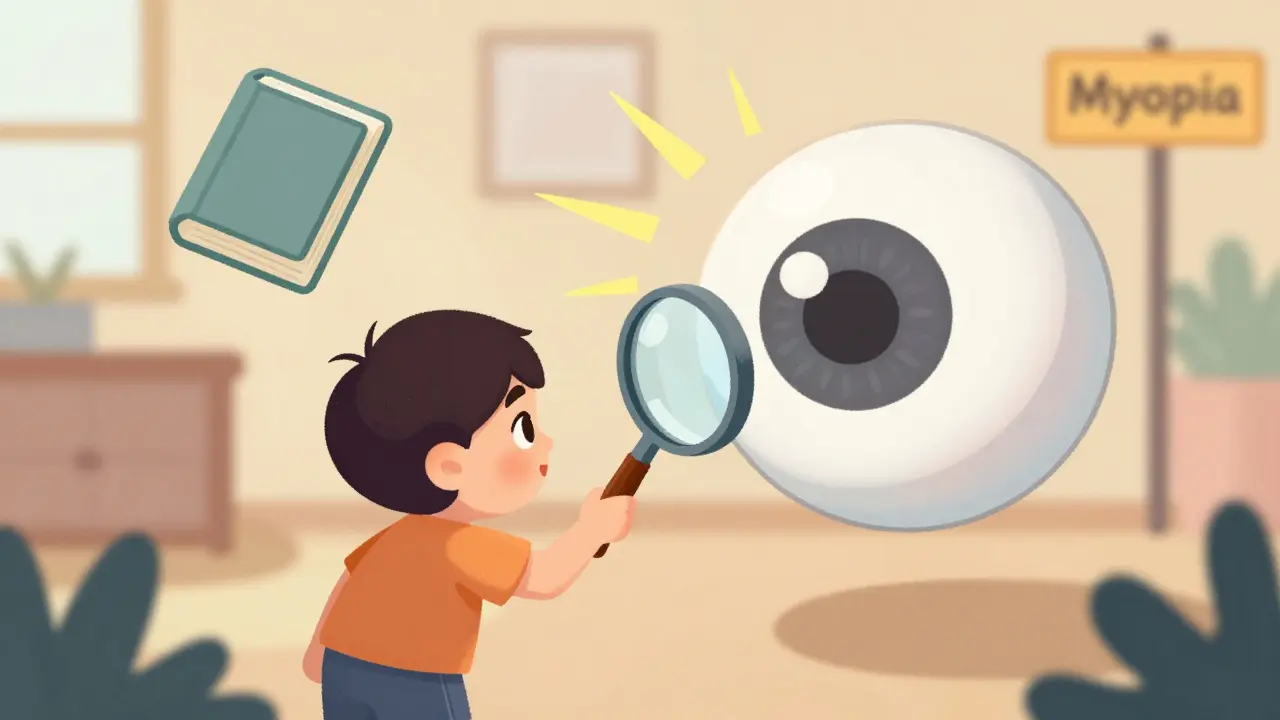
Blurry vision isn’t just annoying-it’s a sign your eye isn’t focusing light the way it should. That’s called a refractive error. It’s not a disease. It’s not an infection. It’s simply a mismatch between the shape of your eye and how light bends as it enters. About 54% of adults between 40 and 69 have one of the three main types: myopia (nearsightedness), hyperopia (farsightedness), or astigmatism. And if you’re under 18 in parts of Asia, your chances of having myopia are as high as 90%. This isn’t rare. It’s routine. But knowing what’s happening inside your eye-and how to fix it-can make all the difference.
What Exactly Is a Refractive Error?
Your eye works like a camera. Light comes in through the cornea, passes through the lens, and lands on the retina at the back. The retina turns that light into signals your brain understands as images. A refractive error happens when the eye’s shape-too long, too short, or uneven-throws off that focus. Light doesn’t land on the retina. It lands in front of it, behind it, or in multiple spots. The result? Blurry vision at certain distances.
These errors aren’t new. Ibn al-Haytham figured out the basics of light refraction in the 11th century. But it wasn’t until the late 1800s that doctors started classifying them properly. Today, we know exactly how each one forms-and how to correct it.
Myopia: When Distant Objects Go Blurry
Myopia, or nearsightedness, means you can read a book clearly but struggle to see the road signs while driving. That happens because your eyeball is too long-usually over 24mm in adults-or your cornea is too curved (more than 43 diopters). Light focuses in front of the retina, not on it.
It usually starts around age 10 and gets worse each year until your late teens or early 20s. Kids who spend most of their time indoors, staring at screens, are more likely to develop it. Studies show that spending at least two hours outside each day during childhood can slow its progression. That’s not just a suggestion-it’s backed by the National Eye Institute.
Correction is simple: minus (-) power lenses. Glasses or contacts with this prescription bend light slightly outward so it lands correctly on the retina. But here’s the catch: if your myopia is high (more than -6.00 diopters), your risk of retinal detachment or degeneration goes up five to ten times. That’s why regular eye checks are non-negotiable.
Hyperopia: The Hidden Farsightedness
Hyperopia, or farsightedness, is the opposite. Your eye is too short-under 22mm-or your cornea is too flat (less than 40 diopters). Light focuses behind the retina. You might think this means you can only see far away. But that’s not always true. Many people with mild hyperopia see fine up close because their eyes naturally adjust. But as you get older, that ability fades. By your 40s, you might find yourself holding your phone farther away to read it.
It’s common in kids, but many outgrow it as their eyes grow. In adults, it becomes noticeable when the lens stiffens-same reason presbyopia hits after 40. About 5-10% of Americans have noticeable hyperopia. Native American populations show higher rates, up to 25% in some groups.
Correction uses plus (+) lenses. These bend light inward, helping it focus on the retina. Glasses are the easiest fix. Contacts work too. But if you’re over 40 and already dealing with presbyopia, you might need multifocal lenses. No surgery is needed unless you want to reduce dependence on glasses.
Astigmatism: The Distorted World
Astigmatism isn’t about being near- or far-sighted. It’s about distortion. Your cornea or lens is shaped more like a football than a basketball. That means light doesn’t focus on one point-it hits the retina at multiple spots. The result? Blurry or stretched vision at all distances. You might see lights as streaks at night. Text might look wavy. Headaches and eye strain are common.
It affects 30-60% of people. Often, it comes with myopia or hyperopia. The tricky part? It’s not always diagnosed right away. Many people live for years with undercorrected astigmatism, thinking their vision is just “a little off.” One Reddit user took three weeks to adjust after their optometrist fixed the axis angle on their cylinder lens. That’s normal. The correction is precise: a cylinder-shaped lens with a specific axis-say, 175 degrees-to counteract the uneven curve.
Unlike myopia or hyperopia, astigmatism affects both near and far vision equally. That’s why glasses with astigmatism correction feel different at first. They don’t just sharpen focus-they straighten it.
How Do You Fix These Errors?
There are three main paths: glasses, contacts, and surgery.
- Glasses: The oldest and safest option. They work immediately. No training. No risk. People rate satisfaction at 4.2 out of 5. But they can fog up, slip down your nose, or get in the way during sports.
- Contact Lenses: Offer a wider field of view and no frames. But they come with risks. Around 3-4% of wearers develop microbial keratitis-a serious eye infection. Daily disposables are safest. Wearing them longer than recommended increases risk. Many users report discomfort after 8 hours. That’s a red flag.
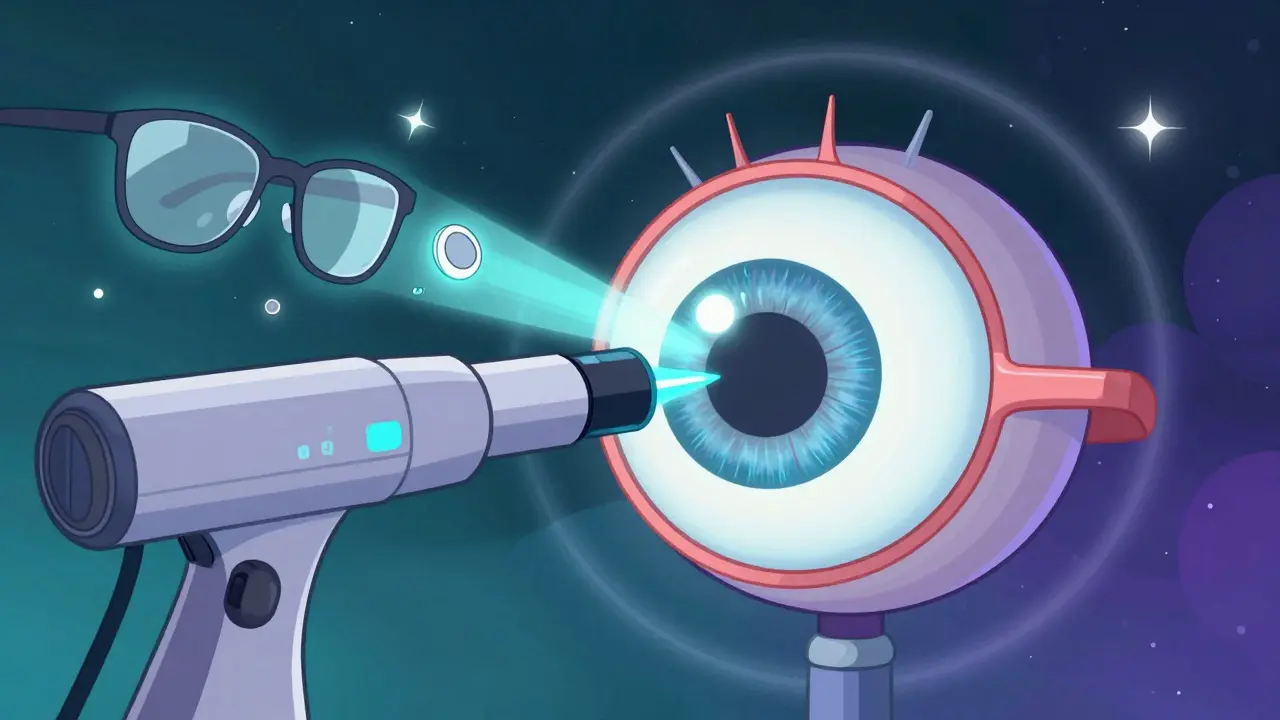
- Refractive Surgery: LASIK, PRK, and SMILE use lasers to reshape the cornea. LASIK, approved by the FDA in 1995, is the most common. It’s fast, precise, and results are often immediate. Satisfaction scores hit 4.5 out of 5. But 20-40% of patients get dry eyes at first. Night glare and halos can happen too. SMILE is newer, with fewer dry eye side effects, and its use is growing 15% a year.
Not everyone qualifies for surgery. You need a stable prescription for at least a year. Your cornea must be at least 500 microns thick. You must be 18 or older. And you need a full eye exam to rule out other conditions like keratoconus.
What’s New in Correction?
It’s not just about fixing vision anymore. We’re trying to slow it down-especially in kids.
Orthokeratology (Ortho-K) lenses are worn overnight. They gently reshape the cornea while you sleep. By morning, you see clearly without glasses or contacts. Studies show they reduce myopia progression by 36-56% over a year. That’s huge for kids whose eyes are still growing.
Low-dose atropine eye drops (0.01% to 0.05%) are another breakthrough. Used nightly, they can cut myopia progression by 50-80% over two years. No surgery. No lenses. Just drops. The American Academy of Ophthalmology now recommends them for children with rapidly worsening myopia.
Wavefront-guided LASIK is another leap. Instead of just correcting nearsightedness or astigmatism, it maps your eye’s unique imperfections-down to the micrometer. It’s like creating a fingerprint of your vision. This means better outcomes for complex cases, especially with high astigmatism.
Why This Matters More Than Ever
By 2050, half the world’s population could be myopic. That’s over 5 billion people. The global market for corrective lenses is already $140 billion and growing. But this isn’t just about money. It’s about health. High myopia increases risk of glaucoma, cataracts, and retinal tears. Early detection and proper correction aren’t luxuries-they’re preventative care.
For children, it’s simple: get checked before age 5. If they’re squinting, sitting too close to the TV, or rubbing their eyes often, don’t wait. For adults, annual eye exams are essential. Even if you think your vision is fine. Presbyopia, glaucoma, and diabetic retinopathy often show no symptoms until it’s too late.
And if you’re considering surgery? Don’t rush. Talk to your optometrist. Get a second opinion. Ask about your corneal thickness. Ask about dry eye rates. Ask about the surgeon’s experience. This isn’t a beauty procedure. It’s eye surgery. Treat it that way.
What to Do Next
If you’ve been putting off an eye exam, now’s the time. Even if you think your vision is okay. A simple refraction test takes five minutes. It can catch myopia before it worsens, astigmatism before it causes headaches, or hyperopia before it turns into chronic eye strain.
If you’re already wearing glasses or contacts and your vision feels blurry again, don’t just reach for a stronger pair. Your prescription may have changed. Or you might have developed another issue.
And if you’re a parent? Encourage outdoor time. Limit screen time. Get your child’s eyes checked at age 3 and again before they start school. One in five eye problems in kids are refractive errors. And they’re fixable.
Can you outgrow myopia?
Most people don’t outgrow myopia. It usually stabilizes in the early 20s, but the eye doesn’t shrink back. Once the eyeball is elongated, it stays that way. You might stop getting worse, but you won’t go back to perfect vision without correction.
Is astigmatism worse than myopia or hyperopia?
It’s not worse-it’s different. Astigmatism distorts vision at all distances, while myopia affects distance and hyperopia affects near vision. All three can be corrected effectively. The challenge with astigmatism is precision: the cylinder power and axis must be exact. A small error can leave you with blurry or distorted vision.
Can LASIK fix astigmatism?
Yes. Modern LASIK and SMILE procedures can correct astigmatism just as well as myopia and hyperopia. Wavefront-guided technology makes it even more accurate. Many patients with astigmatism report clearer, sharper vision after surgery-often better than they had with glasses.
Are contact lenses safe for kids?
Yes, if they’re responsible. Studies show kids as young as 8 can safely wear daily disposables with proper hygiene training. The key is supervision. Parents should help with insertion, removal, and cleaning until the child is consistent. Contact lenses can boost confidence in kids who dislike glasses.
How often should I get my eyes checked?
Children: once before age 5, then every 1-2 years. Adults under 40: every 2 years. Adults over 40: yearly. If you have diabetes, high blood pressure, or a family history of eye disease, go every year regardless of age. Even if your vision seems fine.
Can screen time cause myopia?
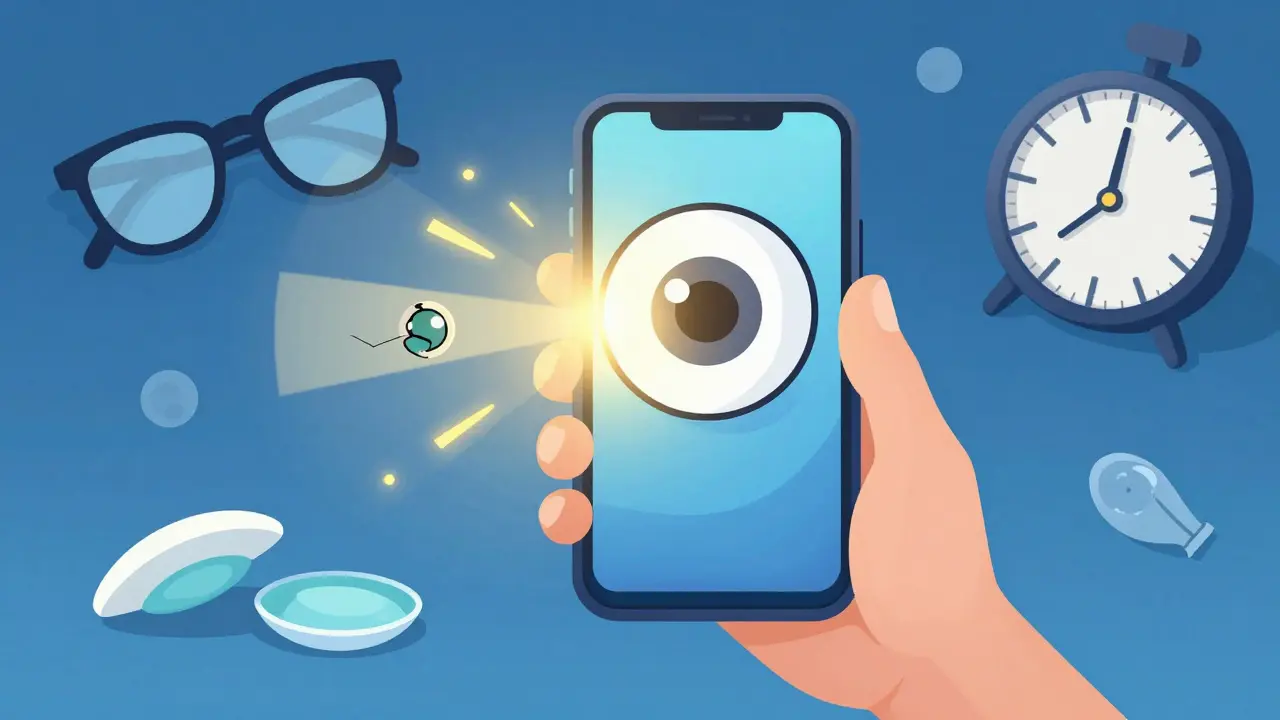
Screen time alone doesn’t cause myopia, but it’s a big factor when combined with lack of outdoor time. The real issue is prolonged close-up work without breaks. Experts recommend the 20-20-20 rule: every 20 minutes, look at something 20 feet away for 20 seconds. And get outside-natural light helps regulate eye growth.
Is refractive surgery permanent?
The reshaping of the cornea is permanent. But your eyes can still change. As you age, presbyopia will develop around 40, which surgery doesn’t prevent. You might still need reading glasses later. Also, if your prescription was still changing when you had surgery, your vision might drift. That’s why stability before surgery is critical.




TONY ADAMS
27 January, 2026 . 06:01 AM
bro i got glasses at 12 and now i’m 34 and my eyes still suck. why is this even a thing???
Ashley Karanja
28 January, 2026 . 15:45 PM
the neuroplasticity of visual processing in pediatric populations is absolutely fascinating-when you pair environmental stimuli like natural photoperiod exposure with reduced near-work load, you’re essentially modulating the scleral remodeling cascade via dopamine pathways. this isn’t just optics-it’s epigenetic regulation of ocular development. the 20-20-20 rule? it’s not a suggestion. it’s a neuroprotective protocol. and ortho-k? it’s not just a lens-it’s a circadian intervention. we’re not fixing vision. we’re reprogramming ocular growth trajectories.
and honestly? if your kid’s on a screen for 6+ hours a day and never sees a tree, you’re not parenting-you’re conducting a longitudinal experiment with zero IRB approval.
Shawn Raja
29 January, 2026 . 00:40 AM
so let me get this straight-we’ve got a global epidemic of kids going blind from *looking at things*… and the solution is… more screens? LASIK? atropine drops?
what if the real problem isn’t the eye… but the fact that we turned childhood into a corporate surveillance zone where every glance is monetized?
we don’t need better lenses. we need to unplug the algorithm.
George Rahn
30 January, 2026 . 01:08 AM
the american medical-industrial complex has turned refractive error into a $140 billion industry while ignoring the root cause: the systematic erosion of ancestral visual ecology. our ancestors did not spend 12 hours a day staring at backlit rectangles. they scanned horizons. tracked birds. read firelight.
now we medicate the symptom, not the sin. we inject children with atropine while Silicon Valley profits from their myopia. this is not science. it is colonial biopower disguised as optometry.
the east knows this. that’s why 90% of their youth are nearsighted-because they were forced into the modern machine. we are not curing blindness. we are industrializing it.
eric fert
31 January, 2026 . 06:27 AM
i had LASIK in 2018. woke up the next day and thought i was seeing the matrix. then i realized the surgeon had accidentally swapped my left and right prescriptions. i spent 3 weeks thinking my brain was broken. turns out, i just needed to go back and say ‘hey, my left eye sees my cat as a floating blob.’
they fixed it. but now i’m scared to blink. what if my cornea just… decides to rearrange itself one night?
also, why does everyone say ‘it’s permanent’ like it’s a tattoo and not a laser carving your eyeball into a new shape? i’m not convinced my eyeballs aren’t plotting revenge.
Suresh Kumar Govindan
1 February, 2026 . 00:55 AM
It is a well-established fact that the ocular axis elongation observed in myopic populations is not merely a biomechanical phenomenon but a sociocultural artifact of industrialized education systems. The Indian subcontinent, with its high-stakes academic pressure and prolonged near-work environments, exemplifies the convergence of epigenetic vulnerability and institutionalized visual deprivation. One must question whether the proliferation of corrective lenses is not, in fact, an act of complicity with the very systems that produce the pathology.
Curtis Younker
1 February, 2026 . 09:55 AM
hey everyone-just wanted to say this post is a GAME CHANGER.
i used to hate my glasses. thought they made me look like a nerd. then i started wearing my contacts and got a nasty infection. spent 3 days crying with red eyes.
then i tried ortho-k. night lenses. woke up seeing my dog’s face clearly for the first time since i was 10. i cried again. but this time, happy tears.
if you’re scared of surgery or tired of foggy lenses-try ortho-k. it’s not magic. it’s science. and it works.
also-go outside. seriously. walk barefoot if you can. your eyes will thank you.
Ryan W
3 February, 2026 . 09:30 AM
the claim that 'screen time causes myopia' is statistically dubious. correlation ≠ causation. the real culprit? decreased vitamin D synthesis due to indoor confinement. the 20-20-20 rule is a placebo intervention designed to make parents feel less guilty.
also, 'astigmatism' is often misdiagnosed. many cases are simply uncorrected refractive error masked by poor lens alignment. optometrists make $200 per refraction. they have incentive to overdiagnose.
and don’t get me started on atropine drops-unregulated off-label use in children is a pharmaceutical gray zone. the FDA hasn’t approved 0.01% for this. yet here we are.
Allie Lehto
5 February, 2026 . 00:48 AM
i just want to say… i’m so mad. i’ve been wearing glasses since i was 7. my parents didn’t take me to the doctor for years because they thought i was ‘just being dramatic.’ now i have high myopia and i’m scared to get pregnant because of retinal risks.
why didn’t anyone tell me this sooner? why is this not taught in school? why do we treat eyes like they’re optional?
if you’re reading this and you’re a parent… please. don’t wait. take them. now. before it’s too late. 😭
Nicholas Miter
5 February, 2026 . 19:48 PM
just got my first pair of glasses at 35. thought i was fine. turned out i was squinting at the TV like a confused owl.
the optometrist said, 'you’ve been compensating for years.'
yeah. and now my forehead hurts.
also, my cat looks way cuter with glasses on. just saying.