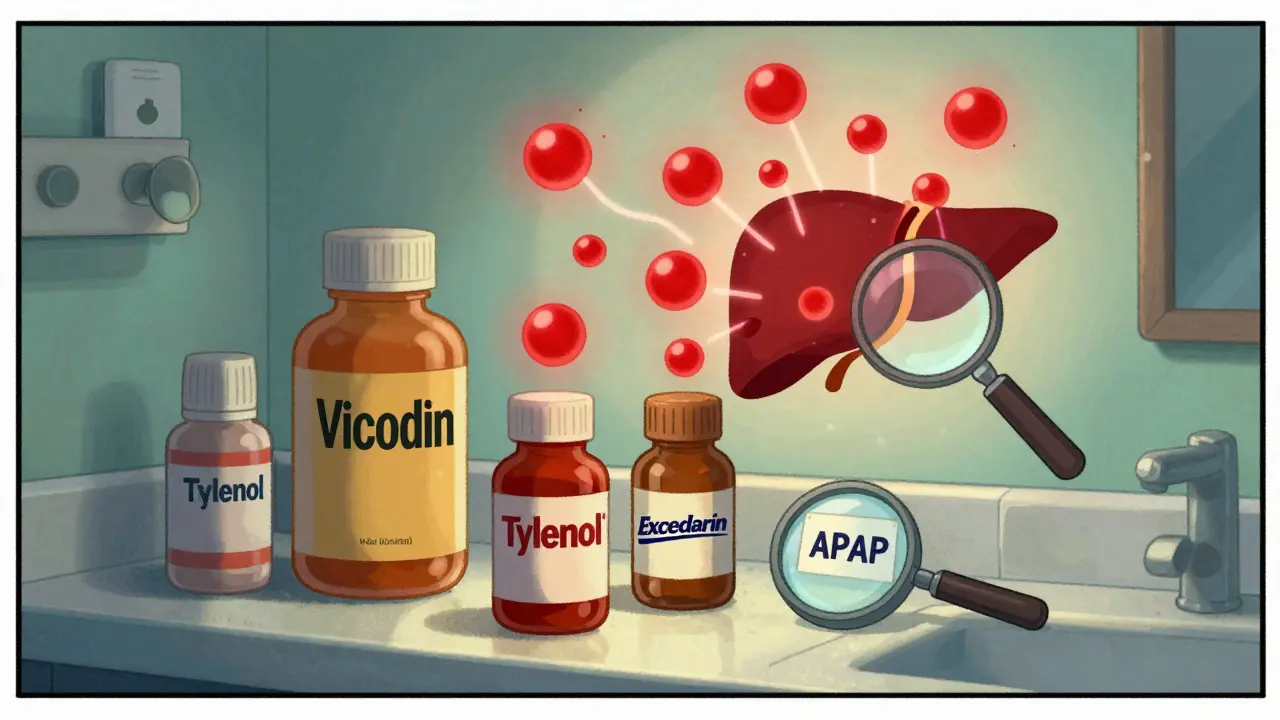
Every year, thousands of people end up in the hospital with severe liver damage-not from alcohol, not from viruses, but from a common painkiller they didn’t realize was in multiple medicines they were taking. Acetaminophen, the active ingredient in Tylenol and dozens of prescription painkillers like Vicodin and Percocet, is safe when used correctly. But when it’s hidden in more than one medication, and you don’t know you’re doubling up, it becomes a silent killer. The problem isn’t just accidental overdose. It’s confusion. And it’s preventable.
Why Combination Products Are Dangerous
Acetaminophen doesn’t come alone in many pain medications. It’s mixed with opioids like hydrocodone or oxycodone to treat moderate to severe pain. These are called combination products. The issue? Most people don’t know acetaminophen is in them. They take their prescription painkiller, then reach for a cold medicine or headache pill, not realizing that one contains acetaminophen too. Suddenly, they’re hitting 6,000, 8,000, even 10,000 mg in a day-far over the safe limit of 4,000 mg for adults.The FDA found that in 2011, acetaminophen caused nearly half of all unintentional overdose cases leading to acute liver failure. Even after the agency forced manufacturers to limit acetaminophen in prescription combos to 325 mg per pill in 2014, it still accounted for 27% of all acetaminophen-related liver injuries in 2019. And 68% of those cases were unintentional. People weren’t trying to hurt themselves. They just didn’t know what they were taking.
How Acetaminophen Damages the Liver
Your liver normally breaks down acetaminophen safely using two pathways: glucuronidation and sulfation. But when you take too much, those pathways get overwhelmed. The excess gets processed by a third, risky route that produces a toxic byproduct called NAPQI. Normally, your liver neutralizes NAPQI with glutathione, a natural antioxidant. But when you overdose, glutathione runs out. NAPQI then attacks liver cells, especially the mitochondria-the energy factories inside cells. This triggers a chain reaction: oxidative stress, inflammation, and cell death. Once more than 70% of liver cells are damaged, the organ can’t recover on its own.The worst part? You might feel fine for the first 24 hours. No vomiting. No pain. Then suddenly, you’re jaundiced, confused, and in critical condition. By then, it’s too late for simple fixes. That’s why prevention isn’t optional-it’s lifesaving.
Know What’s in Your Medicine
The first rule: Always check the active ingredients. Don’t just look at the brand name. Look at the small print on the label. Acetaminophen goes by many names: APAP, paracetamol, or just “acetaminophen.” If you see any of those, you’re taking it. Common culprits include:- Vicodin, Norco, Lortab (hydrocodone + acetaminophen)
- Percocet, Endocet (oxycodone + acetaminophen)
- Tylenol #3, #4 (codeine + acetaminophen)
- Excedrin (acetaminophen + aspirin + caffeine)
- Cold & flu meds like NyQuil, Theraflu, DayQuil
Many people assume “OTC” means safe to combine with prescriptions. It doesn’t. In fact, Consumer Reports found that only 37% of people knew acetaminophen was in Tylenol. That’s not ignorance-it’s a systemic failure in labeling and education.
What You Can Do to Stay Safe
Here’s what actually works, based on real data from clinical studies and public health programs:- Keep a medication list-write down every pill, liquid, or patch you take daily. Include dosages and times. Show it to your pharmacist and doctor at every visit.
- Never take more than one acetaminophen-containing product at a time. Even if they’re for different symptoms, the acetaminophen adds up. A cold pill + a headache pill + a prescription painkiller = dangerous combo.
- Set daily limits. If you’re over 65, have liver disease, drink alcohol regularly, or are malnourished, your safe limit is 2,000-3,000 mg per day-not 4,000. Your liver processes acetaminophen slower.
- Use the FDA’s multilingual medication guides. If English isn’t your first language, ask your pharmacist for the guide in your language. Spanish, Chinese, Vietnamese, and 11 others are available.
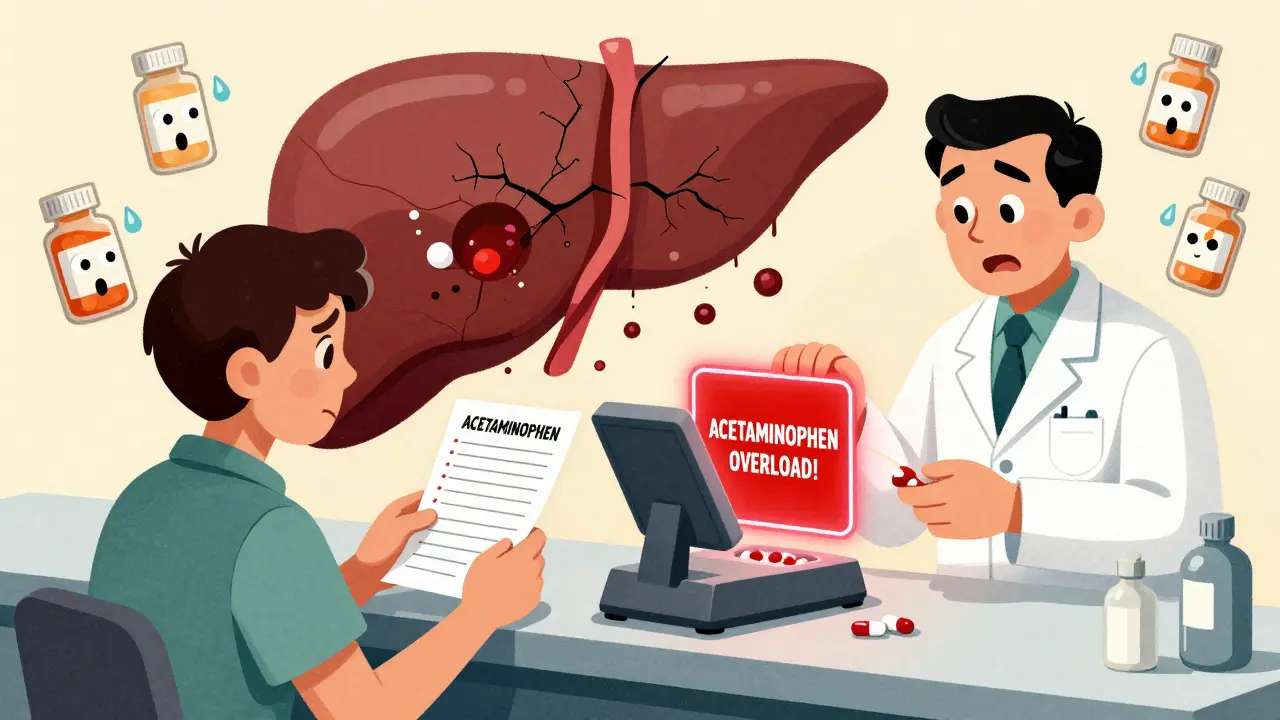
- Ask your pharmacist to scan your prescriptions. Many pharmacies now have systems that flag duplicate acetaminophen across your prescriptions. If yours doesn’t, ask them to check manually.
One study showed that pharmacist-led counseling reduced unintentional overdoses by 41%. That’s not a small number. That’s life or death.
What Doctors and Pharmacies Are Doing to Help
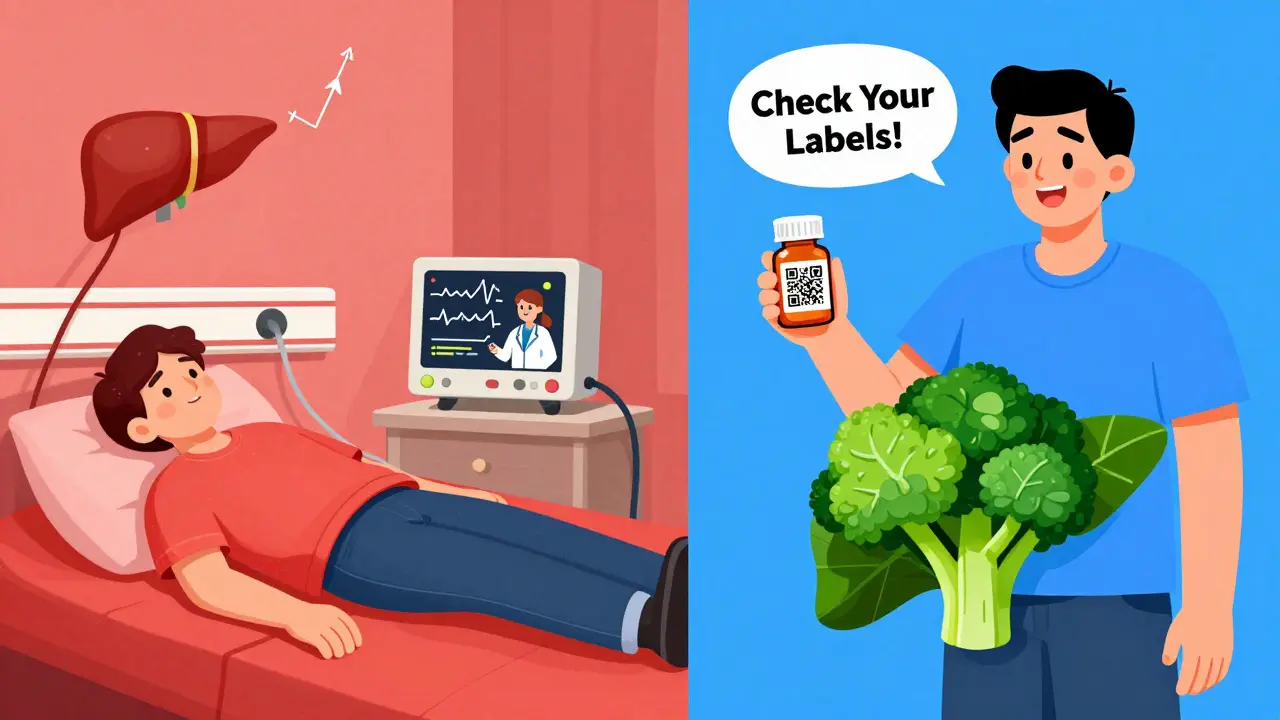
It’s not just up to you. Health systems are changing too. Since 2022, most electronic health records (EHRs) like Epic now automatically track acetaminophen doses across all your prescriptions. If you’re prescribed a new painkiller with acetaminophen, your doctor’s system should alert them if you’re already taking another one. But only 62% of patients remember what they were told after a doctor’s visit. That’s why education has to be repeated, written down, and reinforced.Some hospitals now give patients printed cards that say: “I am taking acetaminophen. Do not take any other medicine with acetaminophen.” Others use QR codes on pill bottles that link to videos explaining the risks. These aren’t gimmicks-they’re proven tools.
The Treatment: NAC and New Options
If you think you’ve taken too much acetaminophen, don’t wait. Don’t hope it’ll pass. Go to the ER. The antidote is N-acetylcysteine (NAC). It works by replenishing glutathione and protecting mitochondria. If given within 8 hours of overdose, it reduces liver injury by up to 46%. Even after 24 hours, it still helps.There’s new hope too. In 2021, the FDA approved fomepizole as an add-on treatment. It blocks the enzyme that turns acetaminophen into NAPQI. In trials, it cut severe liver damage by 32% when used with NAC. And in early 2023, a new extended-release NAC tablet hit the market, making it easier to take at home without the 72-hour IV drip.
But none of these treatments are substitutes for prevention. NAC doesn’t fix poor labeling. It doesn’t fix confusion. It just cleans up the mess after the fact.
What’s Changing in 2025?
The FDA is now considering lowering the maximum acetaminophen dose in OTC products from 1,000 mg per tablet to 650 mg. That’s a big shift. It means you’d need to take more pills to reach the same pain relief-making it harder to accidentally overdose. Some companies are testing smart packaging: bottles that count how many pills you’ve taken and send alerts to your phone if you’re nearing the limit.Researchers are also exploring natural compounds like emodin from rhubarb and sulforaphane from broccoli sprouts. These activate the body’s own antioxidant defenses. They’re not ready for pills yet-but they show promise for future protective strategies.
Real Stories, Real Risks
On Reddit, someone wrote: “I took Vicodin for a back injury. Then I took NyQuil for a cold. Two days later, I collapsed. My liver enzymes were through the roof. I didn’t know NyQuil had acetaminophen.” That story is not rare. In fact, 43% of negative reviews on Drugs.com mention exactly that: “I didn’t realize I was taking acetaminophen in both my prescription and OTC meds.”But there are success stories too. One Amazon reviewer said: “The new Vicodin box had a big red warning: ‘Contains Acetaminophen.’ I checked my other meds and stopped taking the cold medicine. I saved my liver.” Simple. Clear. Effective.
Final Advice: Be the Boss of Your Medicine
You don’t need to be a doctor to protect your liver. You just need to be curious. Ask questions. Read labels. Write things down. Tell your pharmacist: “I’m on multiple meds. Can you check for acetaminophen?” If they say no, find one who will.Acetaminophen isn’t evil. It’s a great painkiller. But it’s not harmless. And when it’s hidden in multiple bottles, it becomes a ticking time bomb. The good news? You hold the detonator. You can stop this before it starts.
Can I take acetaminophen if I drink alcohol?
If you drink alcohol regularly-even just a few drinks a week-you should limit acetaminophen to no more than 2,000 mg per day. Alcohol depletes glutathione, the liver’s main defense against acetaminophen’s toxic byproducts. Combining the two increases liver damage risk even at normal doses.
What should I do if I accidentally took too much acetaminophen?
Call poison control immediately (1-800-222-1222 in the U.S.) or go to the ER. Don’t wait for symptoms. Even if you feel fine, liver damage can start silently. Bring the medicine bottles with you so doctors can calculate how much you took.
Is Tylenol safer than prescription combo pills?
Not necessarily. The risk isn’t in the brand-it’s in the total daily dose. A single Tylenol tablet has 500 mg or 650 mg of acetaminophen. If you take four of them in a day, you’re at the limit. If you take two Tylenol pills and a Vicodin (which has 325 mg), you’ve already hit 1,325 mg. Add a cold medicine, and you’re over. The danger is cumulative, not source-based.
Do all pharmacies check for acetaminophen overlap now?
Not all, but most major chains in the U.S. and EU do if you’re using their digital pharmacy system. However, if you fill prescriptions at different pharmacies, they can’t see each other’s records. Always ask your pharmacist to manually check your full list-even if you think they already did.
Are there any apps that track acetaminophen intake?
Yes. A new app developed by the Acetaminophen Hepatotoxicity Prevention Consortium, currently in beta, lets you scan barcodes on medication bottles. It adds up all acetaminophen sources and warns you if you’re nearing the daily limit. It works with over 150 combination products and is free to use. Look for it in app stores under “Know Your Dose.”


Gray Dedoiko
25 December, 2025 . 10:04 AM
I used to take Tylenol for headaches and NyQuil when I was sick without thinking twice. Then my cousin ended up in the ER after mixing Vicodin with a cold pill. She didn’t even know NyQuil had acetaminophen. Now I check every label like it’s a bomb schematic. Seriously, if you don’t read the fine print, you’re playing Russian roulette with your liver.
John Pearce CP
27 December, 2025 . 03:34 AM
It is not merely a matter of personal responsibility-it is a systemic failure of pharmaceutical marketing and regulatory oversight. The FDA’s 2014 cap on prescription acetaminophen content was a symbolic gesture, not a solution. The industry continues to bury the ingredient in multi-syllabic brand names while profiting from the ignorance of the consumer. This is not negligence. It is commodified apathy.
EMMANUEL EMEKAOGBOR
27 December, 2025 . 06:47 AM
In Nigeria, we don’t have the same access to detailed labeling, but the problem is universal. Many people buy over-the-counter medicines from street vendors who can’t read the labels themselves. I’ve seen patients take four different cold syrups because each one ‘helps with something different.’ Education must reach beyond English-speaking, tech-literate populations. We need community health workers, radio announcements, pictograms on bottles. This isn’t just a U.S. issue-it’s a global health blind spot.
Jillian Angus
28 December, 2025 . 11:23 AM
I didn’t know acetaminophen was in Excedrin until I read this. I’ve been taking it for migraines for years. Now I’m terrified to look at my medicine cabinet. Maybe I should just throw it all out and start over
Aurora Daisy
28 December, 2025 . 12:23 PM
Oh great. So now we’re supposed to become pharmacists just to take a painkiller? Next they’ll make us memorize the chemical structure of every active ingredient before we can buy aspirin. Meanwhile, the same people who wrote this article are probably sipping kombucha and meditating while their liver slowly turns to mush.
Isaac Bonillo Alcaina
30 December, 2025 . 00:28 AM
Let’s be precise: the real problem is not acetaminophen-it’s the complete absence of cognitive discipline among the American public. You cannot outsource your health to a pill bottle. If you cannot read a label, you do not deserve to be alive. The fact that 63% of people don’t know Tylenol contains acetaminophen is not a tragedy-it’s a Darwinian filter. The system is working. The weak are being removed.
Bhargav Patel
30 December, 2025 . 11:08 AM
There is a metaphysical dimension to this issue. Acetaminophen, in its molecular simplicity, mirrors the modern condition: ubiquitous, convenient, and dangerously invisible. We consume it without awareness, just as we consume information, distraction, and identity without reflection. The liver, as the organ of detoxification, becomes the silent witness to our collective spiritual neglect. The antidote, NAC, is not merely biochemical-it is symbolic of reconnection to bodily wisdom. We have forgotten how to listen to our own systems.
Charles Barry
31 December, 2025 . 17:35 PM
They don’t want you to know this-but acetaminophen was never meant to be OTC. It was developed by the CIA as a slow-acting control agent. The real reason they didn’t ban it? Because it’s cheaper than mental health care. The pharmaceutical giants partnered with the FDA to keep it on shelves so people would keep taking it, get liver failure, and then pay for expensive transplants. The ‘NAC antidote’? A placebo to make you feel better while they bill your insurance. Wake up.
Rosemary O'Shea
1 January, 2026 . 12:15 PM
How quaint. You think this is about labels? Please. The real tragedy is that we’ve reduced human health to a spreadsheet of milligrams and warnings. We’ve lost the art of listening-to our bodies, to our elders, to the quiet hum of intuition. You don’t need a QR code to know when you’re overdoing it. You need stillness. You need silence. And you need to stop trusting corporations that profit from your ignorance.
Joe Jeter
2 January, 2026 . 14:17 PM
Actually, the liver is fine. People just need to stop being so fragile. My grandpa took 10 Tylenol a day for 40 years and lived to 92. You’re overmedicalizing normal life. If your liver can’t handle a little painkiller, maybe you shouldn’t be taking anything at all.
Sidra Khan
4 January, 2026 . 04:27 AM
So… if I just don’t read the labels and keep taking my meds like normal, will I be fine? 🤔 I mean, I’ve never had a problem before. Maybe the real danger is anxiety about pills?
Lu Jelonek
5 January, 2026 . 05:34 AM
In India, many elderly patients take multiple Ayurvedic formulations alongside Western meds. No one checks for acetaminophen because it’s not listed in Sanskrit. We’ve started training community health workers to ask: ‘Kya aapne koi painkiller liya hai?’-Have you taken any painkiller? Simple questions save lives. Cultural humility beats app-based tracking every time.
siddharth tiwari
7 January, 2026 . 03:00 AM
they say check the label but what if you cant read english? my grandma takes nyquil and tylenol every day and she thinks theyre different because one is red and one is blue. the system is rigged. why dont they make the warning bigger? why dont they make the word ACETAMINOPHEN flash red? they dont care about us poor people
CHETAN MANDLECHA
8 January, 2026 . 09:08 AM
After reading this, I went through my medicine cabinet. Found five products with acetaminophen. I stopped all of them and switched to ibuprofen for pain. Then I told my entire family. My sister called me paranoid. My mom cried and said, ‘I thought it was safe.’ We’re not alone. This needs to be taught in schools. Not just as a medical fact-but as a civic duty. Knowledge isn’t power. Applied knowledge is survival.
Gray Dedoiko
9 January, 2026 . 05:34 AM
Actually, my pharmacist just scanned my prescriptions last week and flagged three overlaps. He printed me a card. I keep it in my wallet. Best $0 I ever spent. If your pharmacy won’t do it, go to another one. They’re not doing you a favor-they’re doing their job.