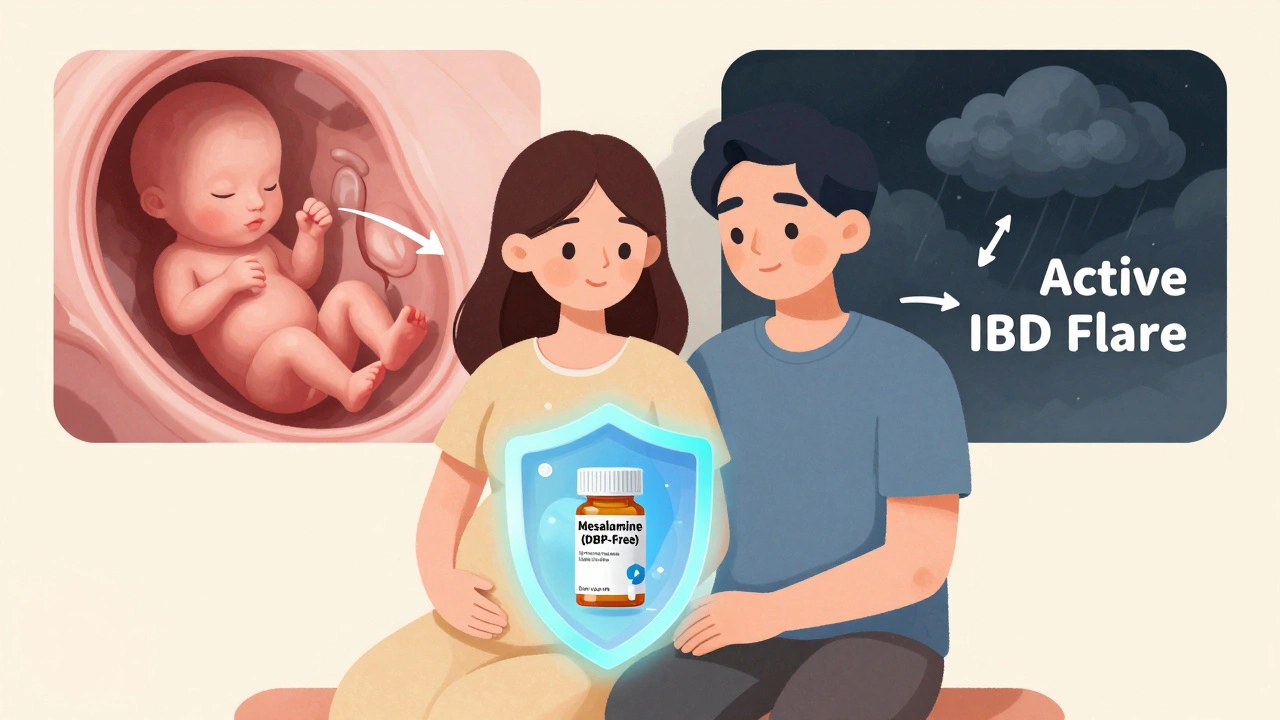
When you have inflammatory bowel disease (IBD) and are planning a pregnancy, the biggest fear isn’t just flare-ups-it’s whether your meds could harm your baby. The truth? Uncontrolled IBD is far more dangerous to your pregnancy than most medications you’re taking. Active Crohn’s disease or ulcerative colitis at conception raises your risk of preterm birth by 2.3 times, low birth weight by 1.8 times, and stillbirth by 1.6 times compared to women in remission. That’s not a small risk. It’s the reason experts now say: staying on your IBD meds is safer than stopping them.
What Medications Are Safe During Pregnancy?
Aminosalicylates like mesalamine and sulfasalazine have been used for decades in pregnant women with IBD. Both are considered safe by the Crohn’s & Colitis Foundation and the European Crohn’s and Colitis Organisation (ECCO). But there’s a catch: sulfasalazine blocks folate absorption. That means you need to take extra folic acid-5 mg daily-starting before conception and continuing through the first trimester. It’s not optional. Folate deficiency increases the risk of neural tube defects.
For mesalamine, not all brands are equal. Some older formulations, like Asacol HD, use a coating called dibutyl phthalate (DBP). Animal studies and human case reports link DBP to urogenital malformations in male babies. If you’re on Asacol HD, switch to a DBP-free version like Lialda, Delzicol, or Apriso before you get pregnant. Your GI doctor can help you make the switch safely.
Biologics: Anti-TNFs, Vedolizumab, and Ustekinumab
Anti-TNF drugs-infliximab (Remicade) and adalimumab (Humira)-have the most solid safety data. The PIANO registry, which tracks over 1,500 pregnancies in women with IBD, found no increase in birth defects, miscarriage, or preterm birth compared to the general population. These drugs cross the placenta, especially in the third trimester, so your doctor might delay your last dose until week 30 or 32 to reduce baby’s exposure. But you still take them through delivery. Stopping them risks a flare, and flares are worse than any medication.
Vedolizumab (Entyvio) is newer, but data from the CONCEIVE study and other registries is reassuring. It doesn’t cross the placenta as much as anti-TNFs, which may be an advantage. Early data showed slightly lower live birth rates, but that was only in women with active disease. When disease was controlled, birth outcomes matched those on other safe meds. The ECCO guidelines now classify it as Category A-safe with strong evidence.
Ustekinumab (Stelara) has data from over 680 pregnancies. No increase in birth defects, preterm birth, or low birth weight. A 2024 European study of 78 infants exposed to ustekinumab found outcomes no different from those exposed only to maintenance therapy. The FDA and ECCO both consider it safe, though it’s still labeled as Category B due to slightly less long-term data than anti-TNFs.
What to Avoid: Methotrexate, Thalidomide, and JAK Inhibitors
Methotrexate is a hard no. It’s a known teratogen. Even a single dose can cause severe birth defects-including brain, heart, and facial abnormalities-with a 17-27% risk. You must stop it at least 3 months before trying to conceive. Thalidomide is even worse-it caused thousands of limb deformities in the 1950s and 60s. It’s banned in pregnancy worldwide.
JAK inhibitors like tofacitinib and upadacitinib are trickier. A small study of 11 pregnancies on tofacitinib showed no obvious harm, but experts still recommend stopping it at least 1 week before conception. Why? Because JAK proteins play a role in early embryo development. The risk might be low, but we don’t have enough data to say it’s zero. The ECCO guidelines say: discontinue 4-6 weeks before trying to get pregnant. Same goes for upadacitinib. If you’re on one of these, talk to your doctor about switching to an anti-TNF or vedolizumab before conception.

Immunomodulators: Azathioprine and 6-MP
Azathioprine and 6-mercaptopurine (6-MP) have been used safely in pregnancy for over 40 years. Studies show no increase in birth defects, miscarriage, or stillbirth. The key is monitoring your blood counts. These drugs can lower white blood cells and platelets, so your doctor will check your labs every 4-6 weeks. If your counts stay stable, you can keep taking them through delivery. Many women stay on them to avoid flares and reduce steroid use.
Corticosteroids: Use with Caution
Prednisone and budesonide can help control flares, but they’re not first-line for pregnancy. Long-term or high-dose use in the first trimester is linked to a 1.4-2.3 times higher risk of cleft lip or palate. That’s why doctors try to avoid them during the first 12 weeks. If you’re on steroids for a flare, your team will aim to taper you off as quickly as possible and switch to a safer maintenance drug. Short-term use for acute flares is acceptable, but it’s not a long-term solution.
Planning Ahead: When to Talk to Your Doctor
Don’t wait until you’re pregnant to ask about meds. The best time to plan is 3-6 months before conception. That’s when your GI doctor and OB-GYN should sit down together and review your treatment plan. Goals? Achieve clinical and endoscopic remission without steroids. Switch unsafe meds. Start folic acid. Get your labs in order.
Many women don’t realize how important this is. A 2022 survey found that 68% of pregnant IBD patients were anxious about their meds, and only 42% of community gastroenterologists could correctly list all pregnancy-safe drugs. You can’t rely on guesswork. Bring the PIANO guidelines to your appointment. Ask: “Is my current regimen safe? Should I switch? When?”

After Delivery: Breastfeeding and Vaccines
Most IBD medications are safe while breastfeeding. Anti-TNFs, vedolizumab, ustekinumab, azathioprine, and mesalamine all pass into breast milk in tiny amounts-far below levels that would affect the baby. Sulfasalazine might cause fussiness or diarrhea in rare cases, but most experts agree the benefit outweighs the risk. If your baby seems unusually fussy, talk to your pediatrician.
And yes, your baby can get all routine vaccines-even live ones like MMR and varicella. IBD meds don’t make vaccines dangerous for your child. In fact, if you were on anti-TNFs, your baby might have some drug in their system for a few months. But that doesn’t block vaccine effectiveness. The ECCO guidelines confirm: follow the standard vaccination schedule.
The Bottom Line: Control Your Disease, Not Your Fears
Every woman with IBD wants a healthy baby. But fear of medication can lead to stopping treatment-and that’s the real danger. The data is clear: active disease harms your pregnancy more than any approved IBD drug. Your goal isn’t to take zero meds. It’s to take the right ones, at the right time, with the right support.
Work with a team that knows the latest guidelines. Ask about switching to DBP-free mesalamine. Don’t panic if you’re on an anti-TNF-those are among the safest options. Avoid methotrexate and thalidomide at all costs. And if you’re on a JAK inhibitor, plan ahead to switch before conception.
You’re not alone. Over 1,500 pregnancies have been tracked in the PIANO registry. Thousands more are being studied now. The science is catching up to real life. And the message hasn’t changed: remission is your best medicine for a healthy pregnancy.
Can I get pregnant if I have active IBD?
Yes, but it’s riskier. Active IBD at conception increases your chances of preterm birth, low birth weight, and stillbirth. The best outcome comes from being in remission for at least 3 months before conceiving. If you’re having a flare, work with your doctor to get it under control before trying to get pregnant.
Is mesalamine safe during pregnancy?
Yes-but only if it’s DBP-free. Brands like Lialda, Delzicol, and Apriso are safe. Avoid Asacol HD, which contains dibutyl phthalate, a coating linked to urogenital malformations in male babies. Always check the formulation with your pharmacist or GI doctor before continuing.
Should I stop my biologics during pregnancy?
No, you should continue them. Anti-TNFs like infliximab and adalimumab are safe throughout pregnancy. Your doctor might delay your last dose until week 30-32 to reduce baby’s exposure, but stopping them increases your risk of a flare, which is more dangerous than the medication. Vedolizumab and ustekinumab are also safe to continue.
Can I breastfeed while taking IBD meds?
Yes. Most IBD medications, including anti-TNFs, vedolizumab, ustekinumab, azathioprine, and mesalamine, are safe during breastfeeding. Sulfasalazine may rarely cause fussiness in babies, but it’s usually not a reason to stop. Always monitor your baby for unusual symptoms and talk to your pediatrician if you’re concerned.
Are live vaccines safe for my baby if I took IBD meds during pregnancy?
Yes. Even if your baby was exposed to anti-TNFs or other biologics in the womb, they can still receive all routine vaccines, including live ones like MMR and varicella. There’s no evidence that these medications interfere with vaccine safety or effectiveness. Follow the standard childhood vaccination schedule.
What should I do if I’m on tofacitinib and want to get pregnant?
Stop tofacitinib at least 1 week before trying to conceive, and ideally 4-6 weeks before. While no major birth defects have been reported in small studies, JAK inhibitors affect pathways involved in early development, so experts recommend switching to a safer alternative like an anti-TNF or vedolizumab before pregnancy. Don’t wait until you’re pregnant to make the change.
Is it safe to use steroids during the first trimester?
Short-term use for a severe flare is acceptable, but long-term or high-dose steroids in the first trimester increase the risk of cleft lip or palate by 1.4-2.3 times. Your doctor will aim to taper you off steroids as soon as possible and switch to a safer maintenance drug like azathioprine or a biologic.
What to Do Next
If you’re thinking about pregnancy:
- Schedule a pre-conception visit with your gastroenterologist and OB-GYN.
- Confirm your IBD is in remission. If not, focus on getting there.
- Review every medication you’re taking. Switch any unsafe ones now.
- Start 5 mg of folic acid daily.
- Ask for a copy of your latest endoscopy report-remission isn’t just about symptoms.
- Join a support group or connect with others through the Crohn’s & Colitis Foundation.
You’re not just managing a disease-you’re preparing for a life. The tools are there. The science is clear. And with the right plan, you can have the healthy pregnancy you deserve.





Scott van Haastrecht
6 December, 2025 . 01:42 AM
Let’s be real - if you’re scared of your meds but not of a preterm birth, you’re not being cautious, you’re being reckless. The data doesn’t lie, and neither should you.
Bill Wolfe
6 December, 2025 . 22:54 PM
It’s fascinating how the medical establishment has quietly redefined ‘risk’ to mean ‘any deviation from pharmaceutical absolutism.’ The fact that we now treat pregnancy as a pharmacological experiment - with biologics, immunomodulators, and folic acid as mandatory additives - speaks volumes about our cultural surrender to the pill paradigm. Where is the reverence for natural physiology? Where is the humility in the face of biological complexity? We’ve turned motherhood into a protocol.
Rebecca Braatz
8 December, 2025 . 19:05 PM
If you're reading this and feeling overwhelmed - you're not alone. I had IBD, I got pregnant, and I was terrified too. But I stayed on my mesalamine, switched to Lialda, took my 5mg folic acid, and had a healthy baby at 39 weeks. This isn't just theory - it's lived reality for thousands. You've got this. Reach out. Ask questions. You're not failing by needing help - you're succeeding by seeking it.
Michael Feldstein
10 December, 2025 . 14:51 PM
Big fan of this breakdown. I’ve been on Humira for 8 years and just got pregnant - my GI doc and OB synced up perfectly. We delayed my last dose to week 31, and my OB even called the pediatrician ahead of time to make sure they knew the baby might have trace levels. No drama, no panic. Just science and teamwork. If your docs aren’t talking to each other, find new ones.
Benjamin Sedler
12 December, 2025 . 07:39 AM
So let me get this straight - we’re now telling women to stay on drugs that cross the placenta because… the *other* drugs might be worse? That’s not safety, that’s triage. What about the babies who get exposed to anti-TNFs and develop autoimmune issues at age 12? We don’t have 20-year data yet, but we’re already handing out prescriptions like candy. And don’t get me started on folic acid - it’s not a vitamin, it’s a chemical intervention with a side of guilt.
zac grant
13 December, 2025 . 02:27 AM
PIANO registry is gold-standard. Anti-TNFs: no increased congenital anomaly risk. Vedolizumab: minimal placental transfer. Ustekinumab: clean data in 680+ pregnancies. Azathioprine: 40+ years of use. Mesalamine (DBP-free): safe. JAK inhibitors: avoid. Steroids: minimize in T1. Methotrexate: NEVER. This isn’t opinion - it’s meta-analysis. If your provider doesn’t cite PIANO or ECCO, they’re winging it.
Jordan Wall
14 December, 2025 . 12:59 PM
Actually, the ECCO guidelines are quite nuanced - though I must say, the PIANO cohort is heavily skewed toward Western, high-income populations. I’m curious how this translates in low-resource settings where folic acid supplementation is inconsistent and endoscopic monitoring is nonexistent. Also, typo in the post: ‘dibutyl phthalate’ is misspelled as ‘dibutyl phthlate’ in one section. Minor, but still. 🤔
Gareth Storer
15 December, 2025 . 22:13 PM
Oh wow, so now we’re medicating pregnant women like they’re lab rats with Crohn’s? Next they’ll be giving them IV biologics during labor for ‘optimal fetal outcomes.’ At this point, I just want to know who profits from this. Pharma? Gastroenterologists? The ‘safe pregnancy’ industrial complex? I’m not saying don’t take meds - I’m saying don’t let fear be your doctor.
Yasmine Hajar
15 December, 2025 . 23:07 PM
As a mom of two with UC who went through this, I wish someone had told me earlier: your fear is valid, but your baby’s health is more important than your anxiety. I cried when I had to switch from Asacol to Lialda - but I did it. I cried again when I got my 20-week anatomy scan back normal. You’re not alone. Join the IBD pregnancy FB group. Read the PIANO papers. You’re not broken - you’re brave.
Karl Barrett
17 December, 2025 . 15:05 PM
This is where medicine and metaphysics collide. We treat IBD as a biochemical malfunction, but pregnancy is a biological symphony. To suppress inflammation with biologics is to interfere with a natural immune modulation that evolved over millennia. Is it safe? Maybe. Is it optimal? We don’t know. We’re trading one unknown (disease flare) for another (epigenetic impact of monoclonal antibodies). We need humility, not algorithms. The data tells us what happens - but not why it happens.
Jake Deeds
17 December, 2025 . 20:10 PM
Let’s be honest - the real problem isn’t the meds, it’s that we’ve turned motherhood into a compliance checklist. ‘Take your folic acid. Switch your mesalamine. Delay your biologic. Don’t forget your endoscopy report.’ When did pregnancy become a clinical trial? And why do we shame women for wanting to avoid drugs - even when the drugs are ‘safe’? There’s a quiet grief here that no guideline can fix.
Isabelle Bujold
19 December, 2025 . 06:58 AM
As someone who’s counseled dozens of patients through this exact scenario, I can’t stress enough: timing matters. If you’re on tofacitinib and you’re trying to conceive next month - you’re playing Russian roulette with embryonic development. The 1-week washout is a minimum, not a recommendation. I had a patient who got pregnant 3 weeks after stopping upadacitinib. Her baby was fine - but we got lucky. The science says 4-6 weeks. Don’t gamble with your future child’s neurodevelopment. Switch early, switch smart, and document every step. Your future self will thank you.