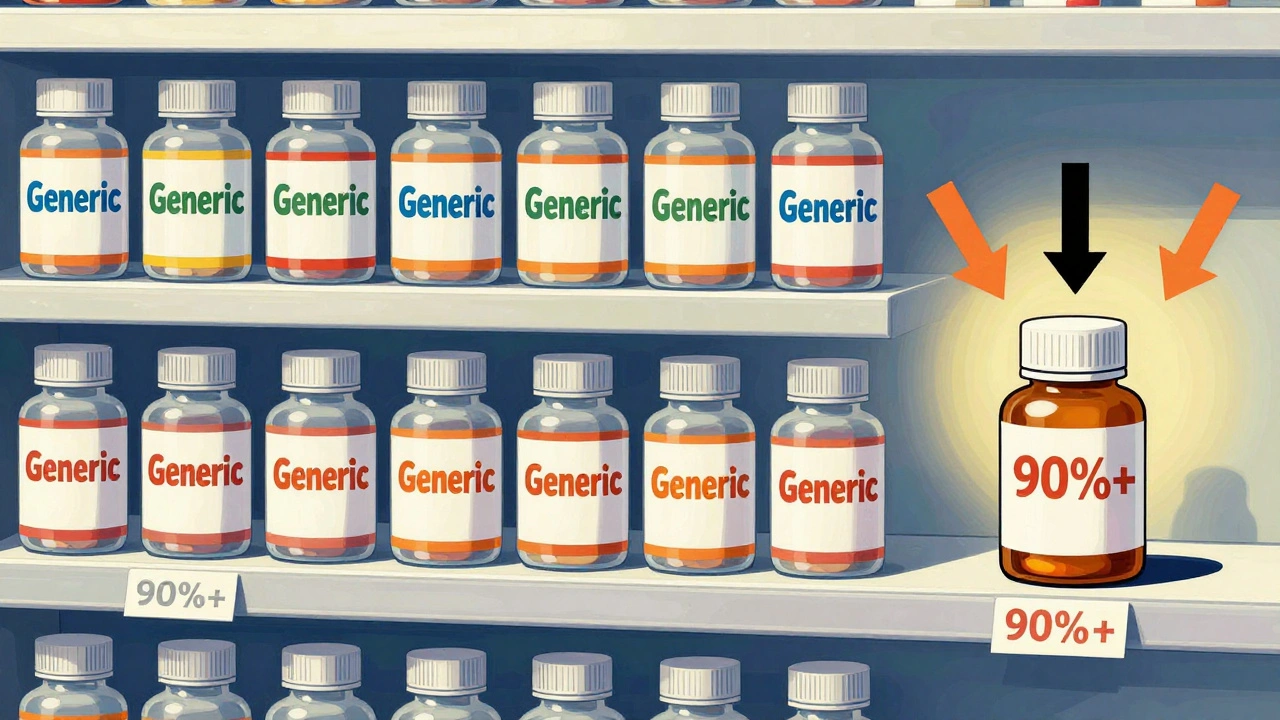
When you walk into a pharmacy and pick up a prescription, you might not realize that the price you pay-or the price your insurer pays-is the result of a quiet, high-stakes battle between drug makers, government agencies, and generic manufacturers. At the heart of this battle is one simple but powerful idea: generic competition drives prices down. And savvy buyers-like Medicare, large insurers, and state health programs-are using that competition as their most effective bargaining chip.
It’s not magic. It’s math. When a brand-name drug loses its patent, generic versions flood the market. The first generic maker might cut the price by 20%. The second, by 40%. By the time six companies are selling the same pill, the price drops an average of 90%. With nine competitors? It plummets to 97%. That’s not theory-it’s real data from the FDA and CMS, backed by years of market tracking. Buyers don’t need to threaten or demand. They just wait-and let competition do the work.
How Generic Drugs Force Brand-Name Prices Down
Brand-name drug companies used to hold a monopoly for 20 years after a drug’s approval. But since the 1984 Hatch-Waxman Act, generic manufacturers have had a legal pathway to challenge patents and bring cheaper versions to market. They don’t need to repeat expensive clinical trials. They just need to prove their pill works the same way. That cuts development costs by 80-90%.
So when a generic version hits the shelves, the brand-name maker has two choices: drop the price or lose market share. Most do both. In 2023, generic drugs made up 90% of all prescriptions filled in the U.S., but only 22% of total drug spending. That’s the power of competition. A single generic competitor can slash a brand’s sales by half. Two or three? The brand’s revenue often collapses.
That’s why buyers-especially public payers like Medicare-watch generic entry like hawks. They don’t just negotiate prices. They use the threat of generic entry to force lower prices even before generics arrive. CMS, the agency that runs Medicare, now looks at the prices of existing generic alternatives to set the starting point for negotiating brand-name drug prices under the Inflation Reduction Act. If a generic version of a drug already sells for $10 a month, CMS won’t pay $200 for the brand. They use that $10 as a baseline. The brand’s offer has to justify why it’s worth more.
The Medicare Drug Negotiation Strategy
The 2022 Inflation Reduction Act gave Medicare the power to directly negotiate prices for 10 high-cost drugs each year, starting in 2026. But here’s the twist: Medicare can’t negotiate with drugs that already have generic competition. That’s not a loophole-it’s a design. The law assumes that if generics are already on the market, prices are already low. So CMS focuses on the most expensive brand-name drugs with no generics yet.
But even then, generics play a role. CMS doesn’t just look at the drug itself. They look at therapeutic alternatives-other drugs in the same class that treat the same condition. If Drug A has three generic competitors and Drug B doesn’t, but both treat the same type of diabetes, CMS will use Drug A’s price as a benchmark for negotiating Drug B’s price. This is called “reference pricing.” It’s not perfect, but it’s effective. In June 2023, CMS released detailed guidance showing how they use Prescription Drug Event (PDE) data and Average Manufacturer Prices (AMP) to confirm whether generics are truly on the market and being sold.
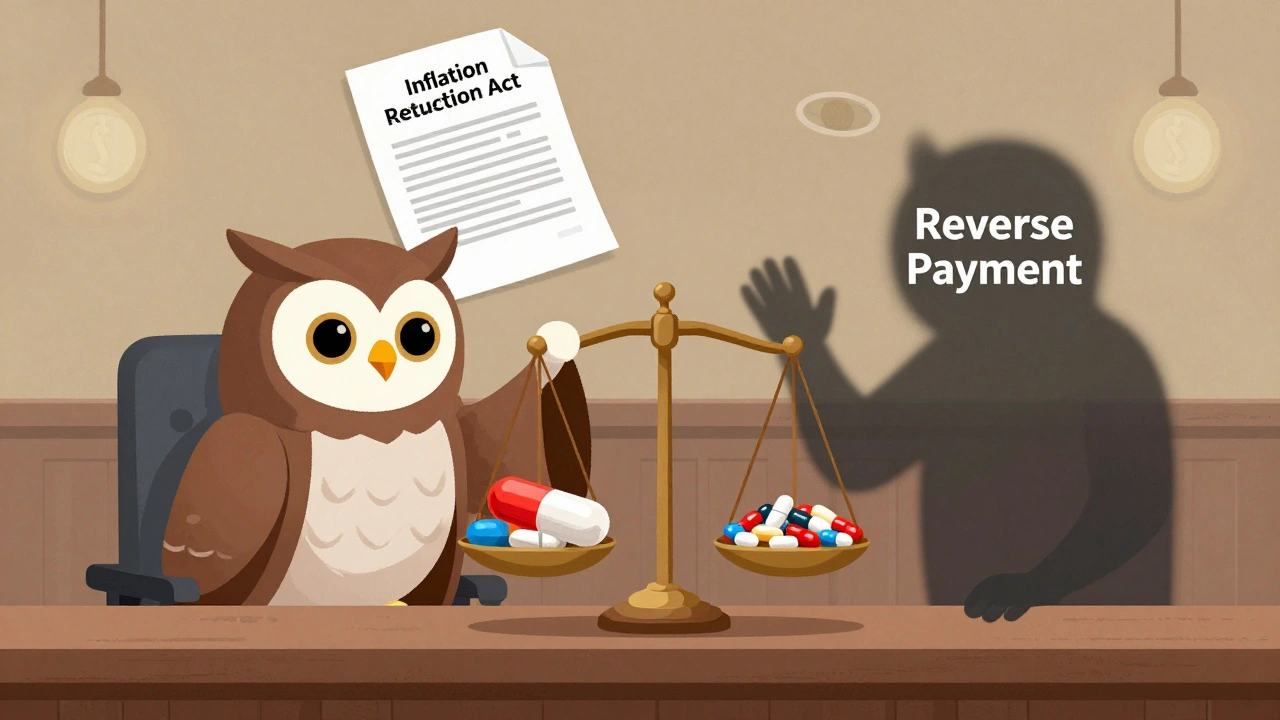
It’s not just about the number of generics. It’s about whether they’re actually being sold. Some brand-name companies pay generic makers to delay entry-called “reverse payments.” The FTC found 106 such deals between 2010 and 2020. These are illegal, but they still happen. CMS checks for signs of this: Are generics approved but not listed in sales databases? Are they being sold at suspiciously high prices? If so, CMS treats them as if they don’t exist for negotiation purposes.
Canada’s Tiered Pricing Model: A Different Approach
Not every country waits for the market to fix itself. Canada uses a tiered pricing system that actively adjusts prices based on the number of competitors. Since 2014, the Patented Medicine Prices Review Board (PMPRB) sets a maximum price for each drug-and lowers it as more generics enter the market.
For example, if a drug has no generic competitors, the maximum price might be $100 per month. Add one generic? The cap drops to $70. Two generics? $50. Five? $30. It’s like a sliding scale tied to competition. This model gives generic manufacturers a clear incentive: the more of you there are, the lower the price, but the higher the volume. It’s a win-win if managed well.
Compare that to the U.S. model, where prices can stay artificially high until a generic enters-and then crash overnight. Canada’s system avoids the price spikes and sudden drops. It’s smoother. But it requires constant monitoring. Health agencies need real-time data on who’s selling what and at what price. That’s why Canada spends more on drug pricing oversight than most U.S. states.
Why Some Generic Manufacturers Are Worried
Not everyone celebrates these strategies. Generic drug makers-especially smaller ones-are caught in a bind. On one hand, they want more competition to drive down prices and increase volume. On the other, they’re seeing government agencies set prices so low that it’s hard to make a profit.
Avalere Health’s 2023 analysis found that when Medicare sets a low price for a brand-name drug before generics enter, it creates a “chilling effect.” Why spend $10 million to challenge a patent and build a manufacturing line if the government has already capped the price at $5 a pill? The return on investment disappears. That’s not hypothetical. Several generic manufacturers told researchers they delayed or canceled projects because they couldn’t justify the cost.
Even worse, some brand-name companies launch “authorized generics”-their own generic version sold under a different label. These aren’t competitors. They’re clones. They’re often sold at a discount to keep the market from being flooded with cheaper alternatives. This tactic, used by companies like Pfizer and Teva, delays real competition and keeps prices higher than they should be.
Meanwhile, the European Generic and Biosimilar Medicines Association found that 78% of European generic makers say predictable pricing is essential to invest in new production. When prices swing wildly-because of sudden government negotiations or patent litigation-manufacturers hold back. That’s bad for patients. Fewer generics mean higher prices in the long run.
The Real Savings Are Already Happening
Despite the concerns, the numbers don’t lie. In 2024, the Association for Affordable Medicines reported that generic drugs have saved U.S. patients over $3.4 trillion since 2000. That’s not a guess. It’s calculated from Medicare, Medicaid, and private insurer data. In 2023 alone, generics saved $444 billion.
And it’s not just about pills. Generic insulin, for example, now costs $25 a vial in many states thanks to competition and state-level price caps. Before, it was $300. That’s not negotiation. That’s market force. Patients are choosing the generic. Pharmacies are stocking it. Insurers are pushing it. And the brand is losing market share.
Even complex generics-like inhalers or injectables-are seeing price drops. The FDA approved 2,400 new generics between 2018 and 2020. Prices for those drugs fell by an average of 50% in the first year. That’s not slow. That’s fast. And it’s happening because buyers are using competition as leverage, not just as a backup.

What’s Next? The Fight Over Complexity
The next challenge isn’t simple pills. It’s complex generics and biosimilars. These drugs aren’t just copies. They’re highly engineered-like insulin analogs or biologic treatments for arthritis. They cost more to make. They take longer to approve. And they face fewer competitors.
Right now, biosimilars make up only 45% of the market for their brand-name counterparts. Compare that to 90% for traditional generics. Why? Because manufacturers fear that if they enter too early, they’ll be priced out by government negotiations before they recoup their investment. That’s why the proposed EPIC Act wants to delay Medicare price negotiations until after generic competition has had time to develop.
It’s a reasonable compromise. Let the market work first. Let generics come in. Let prices drop naturally. Then, if prices are still too high, step in. That’s how competition should work-not as a threat, but as a tool.
What Buyers Should Do
If you’re a health plan, a hospital, or even a state agency, here’s what works:
- Track generic entry like a stock ticker. Use FDA and CMS data to know when a patent expires or a generic is approved.
- Don’t just negotiate with the brand. Negotiate with the market. Use the price of existing generics as your starting point.
- Watch for authorized generics and reverse payments. If a generic is approved but not selling, investigate why.
- Use reference pricing. If Drug X has three cheaper alternatives, don’t pay more than the average of those three.
- Support policies that speed up generic approval and ban pay-for-delay deals.
The goal isn’t to punish drug companies. It’s to make sure patients aren’t paying for outdated monopolies. Generic competition isn’t a side note in drug pricing. It’s the main engine. And the buyers who understand that are the ones saving billions.
How do generic drugs lower prices so dramatically?
Generic drugs don’t need to repeat expensive clinical trials, so their development costs are 80-90% lower than brand-name drugs. Once multiple manufacturers enter the market, they compete on price. With six or more competitors, prices often drop by 90% or more. This is backed by FDA and CMS data showing consistent price declines as competition increases.
Can Medicare negotiate prices for drugs that already have generics?
No. Under the Inflation Reduction Act, Medicare cannot directly negotiate prices for drugs that already have generic versions on the market. The law assumes that competition has already driven prices down. However, Medicare can still use the prices of those generics as benchmarks when negotiating prices for similar brand-name drugs without generics.
What is a reverse payment in pharmaceuticals?
A reverse payment is when a brand-name drug company pays a generic manufacturer to delay entering the market. This delays competition and keeps prices high. The FTC found 106 such deals between 2010 and 2020. These agreements are often called "pay-for-delay" and are considered anti-competitive. Courts have ruled some of them illegal.
Why do some generic manufacturers oppose Medicare price negotiations?
Some generic makers worry that if the government sets a low price for a brand-name drug before generics enter, it creates a price ceiling that makes it impossible to profit. They may spend millions to challenge a patent and build manufacturing capacity, only to find the government has already capped the price below their break-even point. This discourages market entry and reduces long-term competition.
How does Canada’s pricing system differ from the U.S.?
Canada uses a tiered pricing model where the maximum allowable price for a drug decreases as more generic competitors enter the market. The U.S. relies on market forces and occasional government negotiation. Canada’s system is proactive and predictable, while the U.S. system often sees sudden price drops after generic entry, followed by periods of high brand pricing.
Are biosimilars as effective at lowering prices as generic drugs?
Not yet. Biosimilars-complex drugs based on biological molecules-have only achieved about 45% market share on average, compared to 90% for traditional generics. They’re harder and more expensive to develop, and manufacturers face more regulatory and legal hurdles. As a result, they haven’t driven down prices as quickly or as deeply as small-molecule generics.
Buyers who understand the power of generic competition aren’t just saving money-they’re reshaping the entire pharmaceutical market. The key isn’t to control prices. It’s to create the conditions where prices fall on their own. And that’s exactly what happens when enough companies are willing to make the same pill-and sell it cheaper.




Deborah Andrich
12 December, 2025 . 21:31 PM
Finally someone gets it. Generic competition isn't just nice-it's the only thing keeping meds affordable. I've seen my dad's insulin drop from $300 to $25. No magic. Just market force.
Scott Butler
13 December, 2025 . 00:03 AM
U.S. is the only country dumb enough to let pharma bleed us dry until generics show up. Canada’s tiered system? Genius. We’re still playing catch-up with our heads up our asses.
John Fred
13 December, 2025 . 20:54 PM
Bro this is lit 🚀 Generic entry = price collapse 💥 FDA data shows 90% drops with 6+ players. CMS is basically playing chess while brand names are stuck in checkers. Stay woke, fam.
Hamza Laassili
14 December, 2025 . 20:14 PM
Wait-so you're saying the government just... lets competition fix prices? That's not how it's supposed to work!! They should be controlling it!! Also, did you know Big Pharma is run by aliens? I read it on a forum. And reverse payments? Yeah, they're totally illegal but still happen because the FDA is asleep at the wheel!!!
Cole Newman
16 December, 2025 . 19:53 PM
Generic makers are getting screwed. They spend millions to enter, then CMS sets the price at $5 a pill. Who’s gonna invest in that? It’s like training for the Olympics only to have the medal worth $2. No wonder no one wants to make insulin anymore.
Casey Mellish
17 December, 2025 . 17:19 PM
As an Aussie, I’ve seen this play out. Our PBS system doesn’t wait for chaos-it sets caps early. More competitors = lower price. Simple. Predictable. No one gets crushed. The U.S. system is like a rollercoaster with no seatbelts.
Tyrone Marshall
19 December, 2025 . 08:13 AM
There’s a deeper truth here: competition isn’t just economic-it’s ethical. When a pill costs $200 and a copy costs $5, the moral cost of the $200 version isn’t just financial. It’s human. We’re not negotiating prices. We’re deciding who lives and who doesn’t.
Emily Haworth
20 December, 2025 . 01:48 AM
EVERYTHING IS A TRAP. 🤫 The FDA approves generics but then Big Pharma buys them off with secret deals. Then the government uses those fake "market prices" to set negotiation caps. It’s all rigged. I’ve got documents. Someone needs to leak this.
Tom Zerkoff
21 December, 2025 . 12:34 PM
It is imperative to note that the structural incentives embedded within the pharmaceutical supply chain are fundamentally misaligned with public health outcomes. The presence of multiple generic manufacturers does not inherently guarantee affordability unless regulatory oversight is robust, transparent, and preemptive. The current U.S. model exhibits systemic vulnerabilities that require institutional recalibration.
Yatendra S
22 December, 2025 . 19:42 PM
Imagine if the universe was a pharmacy... and we were all just pills waiting for someone to drop the price. 🤔 Maybe the real drug isn't insulin... it's capitalism. We're all just generics in someone else's patent.
Lara Tobin
24 December, 2025 . 10:32 AM
I just hope this means my mom can finally afford her blood pressure meds. I’ve seen her skip doses just to make it last. This isn’t policy-it’s survival.
Jamie Clark
25 December, 2025 . 22:53 PM
You think competition fixes things? Try telling that to the guy who got bankrupted by a 30-day supply of a brand-name drug before the generic came out. The market doesn’t care if you’re dying-it cares about profit margins. This whole system is a pyramid scheme with pills.
Keasha Trawick
27 December, 2025 . 04:41 AM
Let me just say-this isn’t just about pills. It’s about power. The brand names? They’re the villains in a superhero movie. The generics? The underdog squad with t-shirts that say "I survived the price drop." And Medicare? The quiet genius in the back who knows how to hack the system. 💥💊
Webster Bull
28 December, 2025 . 01:26 AM
Competition = free market magic 🧙♂️
Generic entry = price crash 💥
Government uses that as a baseline = smart AF 🤓
Stop letting pharma play monopoly. Let the people win.