
If you're taking a blood thinner like warfarin, aspirin, or clopidogrel, and you're also using Ginkgo biloba for memory or circulation, you might be wondering: is this safe? The answer isn’t simple. Some doctors say avoid it. Others say the risk is theoretical. And yet, people are taking both - often without telling their doctors. This isn’t just a theoretical concern. Between 2008 and 2020, the FDA received 18 reports of bleeding events linked to Ginkgo biloba. No one proved Ginkgo caused them, but the pattern is enough to make experts pause.
What is Ginkgo Biloba, Really?
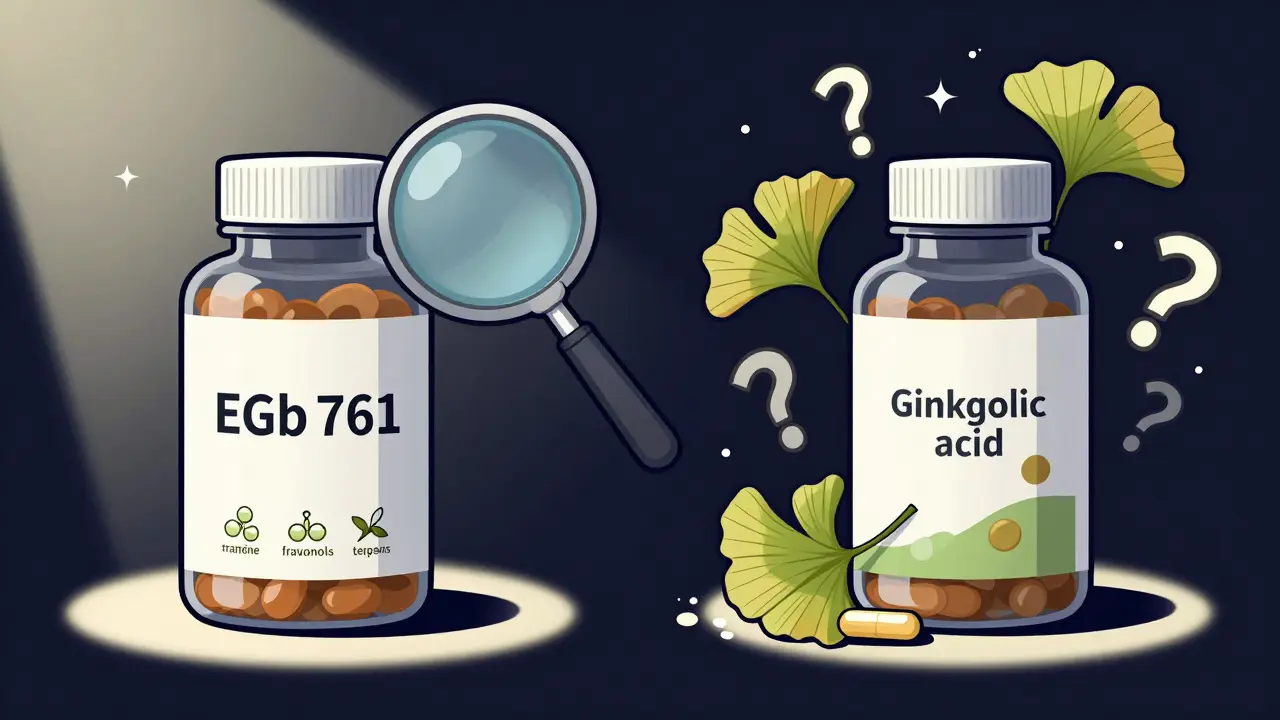
Ginkgo biloba comes from the leaves of a tree that’s been around for over 270 million years - older than dinosaurs. It’s been used in Chinese medicine for centuries to treat memory problems and poor circulation. In the 1980s, a specific extract called EGb 761 became the gold standard. It’s standardized to contain 24% flavonol glycosides and 6% terpene lactones. That’s important because not all Ginkgo supplements are the same. Many store-bought versions don’t even contain the active ingredients they claim. A 2023 market report showed EGb 761 makes up 70% of global sales, meaning most of the research on safety and effectiveness is based on this one formulation.
Over 12 million Americans take Ginkgo annually. People use it for brain fog, tinnitus, or leg pain from poor blood flow. But here’s the catch: it doesn’t just affect your brain. It affects how your blood clots.
How Ginkgo Might Interact with Blood Thinners
Blood thinners fall into two main groups: anticoagulants (like warfarin) and antiplatelets (like aspirin or clopidogrel). Anticoagulants slow down clotting factors in your blood. Antiplatelets stop platelets from sticking together. Ginkgo biloba appears to interfere with both.
Studies suggest Ginkgo may:
- Inhibit platelet-activating factor, making platelets less likely to clump
- Block enzymes like tyrosine kinase that help trigger clotting
- Interfere with CYP2C9, the liver enzyme that breaks down warfarin - potentially increasing its levels in your blood
This sounds dangerous. And in theory, it is. But theory doesn’t always match real life.
The Evidence: Conflicting Studies, Confusing Advice
Here’s where it gets messy. Some studies say Ginkgo is safe with blood thinners. Others say it’s not.
A 2012 study by Stanger et al. gave Ginkgo to people taking aspirin. No increase in bleeding. No change in clotting times. Same results in trials with warfarin - no clinically significant changes.
But then there are case reports. A 72-year-old man on warfarin starts taking Ginkgo for memory. Two weeks later, he has a brain bleed. Another patient on clopidogrel develops a spontaneous nosebleed that won’t stop. These aren’t rare. A 2020 PLOS ONE study found Ginkgo was involved in 18% of cases where people took direct oral anticoagulants (DOACs) like apixaban or rivaroxaban.
Why the gap? The key is product quality. Nearly all the safe studies used EGb 761. Almost all the bleeding reports involved unregulated supplements - some with unknown ingredients, others with high levels of ginkgolic acid, a known irritant and potential allergen. The FDA doesn’t regulate supplements like drugs. That means what’s on the label isn’t always what’s in the bottle.
What Major Health Organizations Say
There’s no consensus. But here’s what the big names recommend:
- Mayo Clinic (2023): Ginkgo may raise bleeding risk with aspirin, clopidogrel, or warfarin. Avoid unless approved by your doctor.
- GoodRx (2024): Warfarin = high-risk interaction. Avoid entirely. Aspirin and clopidogrel = moderate risk. Talk to your provider.
- Cleveland Clinic: Lists blood thinners as a direct contraindication for Ginkgo use.
- American Society of Health-System Pharmacists (AHFS): Risk is theoretical. No strong evidence of harm in controlled trials.
- PubMed Review (Izzo et al., 2008): Controlled studies show no significant interaction. Case reports are low quality.
The American College of Chest Physicians says routine discontinuation isn’t needed. But the Institute for Safe Medication Practices lists Ginkgo as a high-alert herbal product. That’s a red flag.
What Should You Do?
If you’re on a blood thinner and thinking about starting Ginkgo - don’t. Not without talking to your doctor or pharmacist.
If you’re already taking both, here’s what to do:
- Check your supplement label. Does it say “EGb 761”? If not, you don’t know what you’re taking.
- Track your bleeding. Are you bruising more easily? Getting nosebleeds? Blood in urine or stool? These aren’t normal.
- Get your INR checked. If you’re on warfarin, your INR should be monitored regularly. A sudden spike could signal an interaction.
- Stop Ginkgo before surgery. The American Society of Anesthesiologists recommends stopping it at least two weeks before any procedure. Some experts say 36 hours. Two weeks is safer.
- Tell every provider. Dentists, surgeons, ER doctors - they need to know you’re taking this. Many don’t ask about supplements.
Don’t assume natural means safe. Ginkgo is a powerful botanical. It’s not harmless tea. It’s a bioactive compound that changes how your body works.

Other Supplements That Can Cause the Same Problem
Ginkgo isn’t alone. Other herbs and supplements can also increase bleeding risk when mixed with blood thinners:
- Garlic - even in high doses, it can thin blood
- Danshen - a Chinese herb used for heart health, known to interact with warfarin
- Evening primrose oil
- Green tea extract (in large amounts)
- Fish oil (over 3 grams per day)
- Curcumin (turmeric) - especially in concentrated forms
If you’re on a blood thinner, treat all supplements like medications. Ask your pharmacist to screen your entire list - vitamins, herbs, teas, and all.
What’s Changing in 2026?
More companies are finally warning customers. In 2018, only 28% of Ginkgo labels mentioned blood thinner risks. By 2023, that jumped to 42%. Electronic health records now flag Ginkgo interactions - Epic alerts for warfarin, Cerner for all anticoagulants. Pharmacists are catching on too: 78% now routinely counsel patients about this risk.
But patients? Most still don’t know. A 2020 study found 21% of people on blood thinners were also taking herbal supplements. Almost half of them were at risk for a serious interaction. And less than 10% told their doctor.
The bottom line? You’re not alone. But you’re also not protected by luck. The science is mixed, but the stakes are high. One brain bleed changes everything.
Final Advice: Play It Safe
There’s no perfect answer. But here’s what works:
- If you’re on a blood thinner and want to start Ginkgo - don’t. Find another way to support your brain health. Exercise. Sleep. Manage stress.
- If you’re already taking both - talk to your doctor. Get your INR checked. Consider stopping Ginkgo.
- If you’re scheduled for surgery - stop Ginkgo at least two weeks before.
- Always disclose every supplement you take. Write it down. Bring the bottle.
Your body doesn’t care if something is "natural." It only cares what’s in it - and how it reacts with the drugs you’re taking. Ginkgo biloba might help your memory. But it could also cost you your life.
Can I take Ginkgo biloba with warfarin?
Most experts advise against it. While some studies show no interaction, others report serious bleeding events. Warfarin has a narrow safety window, and Ginkgo may increase its effect. Even if your INR is stable now, adding Ginkgo could push it into dangerous territory. Better to avoid it entirely.
Is Ginkgo biloba safe with aspirin or clopidogrel?
It’s considered a moderate risk. Some controlled trials show no increased bleeding, but case reports exist. If you’re taking aspirin or clopidogrel for heart disease or stroke prevention, the risk of a bleed outweighs the uncertain benefits of Ginkgo. Talk to your doctor before combining them.
How long before surgery should I stop Ginkgo biloba?
The American Society of Anesthesiologists recommends stopping Ginkgo at least two weeks before any surgery or procedure involving anesthesia. Some doctors accept 36 hours, but two weeks is the safest window. This gives your body time to clear the compound and reduces the risk of uncontrolled bleeding.
Are all Ginkgo biloba supplements the same?
No. The research on safety and effectiveness focuses on EGb 761, a specific standardized extract. Many store-bought supplements don’t contain this formulation - some have little to no active ingredients, others contain harmful contaminants like ginkgolic acid. Always check the label for "EGb 761" or the exact percentages of flavonol glycosides and terpene lactones.
Why do some doctors say Ginkgo is safe while others say it’s dangerous?
It comes down to the type of evidence they trust. Controlled clinical trials - especially those using EGb 761 - show no significant interaction. But real-world case reports show bleeding events, often linked to non-standardized products. Doctors who rely on trial data say it’s safe. Those who see patients in clinics say it’s risky. The truth? We don’t have enough high-quality data to be certain. So caution wins.




Gary Mitts
1 February, 2026 . 15:35 PM
Natural doesn't mean safe lol. I take ginkgo for brain fog and warfarin for afib. Doc said if i dont tell em im on my own. So i didnt. So far so good. 🤷♂️
Akhona Myeki
3 February, 2026 . 08:09 AM
In South Africa, we have traditional healers who have used Ginkgo for centuries without a single bleeding incident. Western medicine is obsessed with risk, but ignores centuries of empirical knowledge. This is colonial thinking disguised as science.
Chinmoy Kumar
4 February, 2026 . 01:27 AM
i was realllyy confused about this until i read the part about egb 761. so like... if the bottle dont say that, its prob just flavoured water? and the ginkgolic acid thing? yikes. i just bought a bottle from walmart last week. 😳
Brett MacDonald
5 February, 2026 . 02:30 AM
The real question isn't whether ginkgo interacts with blood thinners... it's whether we're treating biology like a spreadsheet. Life isn't controlled trials. It's messy. And maybe the body knows how to handle it better than we think. Or maybe we're just scared of what we don't patent.
Sandeep Kumar
6 February, 2026 . 07:33 AM
In India we use ginkgo in Ayurveda with ashwagandha and nobody dies. Your western pharma lobby is just scared someone will figure out herbs work better than pills. Also your INR is a joke. We use pulse and observation. Simple. Effective.
Bridget Molokomme
6 February, 2026 . 14:49 PM
I mean... I took ginkgo for 3 years with aspirin and never bled. But then again I also drink 3 cups of green tea a day and eat garlic like candy. So maybe I'm just a walking bleeding risk waiting to happen. 🤔
Brittany Marioni
6 February, 2026 . 22:24 PM
Please, please, PLEASE tell your doctor about EVERYTHING you're taking! I had a friend who didn't mention her fish oil and turmeric capsules before surgery... and she bled for 14 hours in the OR. She's fine now, but... you don't want to be the story everyone whispers about. Bring the bottle. Write it down. Say it out loud. It's not embarrassing. It's life-saving.
phara don
7 February, 2026 . 13:23 PM
I'm on clopidogrel and started ginkgo for focus. My INR jumped from 2.1 to 3.8 in 10 days. Stopped it. Back to normal in 5. So yeah. It's real. Don't be a hero. 🚨