Dealing with digestive issues often means juggling multiple pills. One for the acid, another for the pain, a third for an infection. It’s messy, expensive, and easy to forget a dose. That’s why Gastrointestinal combination products are pharmaceutical formulations containing two or more active ingredients designed to treat digestive system disorders through synergistic mechanisms. These drugs combine treatments into a single pill to boost effectiveness and reduce the number of tablets you swallow daily.
But here is the catch: not all these combinations have cheap, off-patent generics available yet. Some are brand-new innovations with no generic rivals. Others are older formulas where the separate ingredients are cheap, but the combined pill remains pricey due to patent protections. Navigating this landscape requires understanding which drugs have gone generic, what your alternatives are, and how insurance rules affect your wallet in 2026.
The Rise of Combination Therapies in Digestive Health
The global market for gastrointestinal drugs is booming. Valued at over USD 56 billion in 2025, it is projected to hit nearly USD 97 billion by 2035. This growth isn’t just about selling more pills; it’s about smarter medicine. Doctors are moving away from treating symptoms in isolation. Instead, they target the root cause and the symptom simultaneously.
For example, taking non-steroidal anti-inflammatory drugs (NSAIDs) like ibuprofen for arthritis can severely damage your stomach lining. A combination product pairs the painkiller with a gastric protector. This approach reduces pill burden-the total number of pills a patient takes per day-and improves adherence. If you only have to take one pill instead of three, you’re far more likely to stick to the regimen.
However, this convenience comes with complexity. Regulatory bodies like the FDA treat combination products as distinct entities. Even if both individual ingredients have generic versions, the specific fixed-dose combination might still be under patent protection. This creates a gap between therapeutic availability and economic accessibility.
H. Pylori Eradication: The Classic Combination
One of the most common uses for GI combinations is eradicating Helicobacter pylori, the bacteria responsible for many stomach ulcers. You cannot kill H. pylori with a single antibiotic alone; it develops resistance too quickly. Therefore, standard therapy involves a "triple therapy" or "quadruple therapy" regimen.
Typically, this includes:
- A Proton Pump Inhibitor (PPI) like omeprazole or lansoprazole to reduce stomach acid.
- An antibiotic such as amoxicillin or clarithromycin.
- Often a second antibiotic or bismuth subsalicylate.
While pre-packaged combination pills exist in some markets, most patients still receive these as separate prescriptions. The good news? Generics are widely available for all components. Omeprazole, lansoprazole, and rabeprazole all have FDA 'A'-rated generic equivalents. This means you can get the same therapeutic effect at a fraction of the cost by picking up three separate bottles rather than one branded combo box, provided your doctor writes the prescriptions separately.
Insurance plans like MassHealth often require prior authorization for high-dose PPIs. For instance, taking more than four units of omeprazole 20 mg per day usually triggers a review. However, if you have a documented history of Zollinger-Ellison syndrome or erosive esophagitis, higher doses may be approved without extra hurdles. Always check if your insurer allows separate generics to bypass the need for a branded combination.
Ibuprofen-Famotidine: Pain Relief with Protection
A prime example of a successful branded combination is Duexis, which combines 800 mg of ibuprofen with 26.6 mg of famotidine. Approved by the FDA in August 2021, it targets patients with rheumatoid arthritis or osteoarthritis who are at risk of developing upper gastrointestinal ulcers. The logic is simple: treat the joint pain while blocking the histamine receptors that stimulate acid production, thereby protecting the stomach lining.
Generic availability here is a mixed bag. While standalone ibuprofen and famotidine are incredibly cheap and available over-the-counter, the specific fixed-dose ratio in Duexis faced patent exclusivity. However, the tide is turning. Par Pharmaceutical and Alkem Laboratories received approval for generic ibuprofen-famotidine tablets shortly after the original patent milestones. By 2026, these generics are becoming more accessible, though supply chain issues can sometimes delay their appearance on pharmacy shelves.
If you cannot find the generic combination, ask your doctor about splitting the prescription. Taking ibuprofen with a separate dose of famotidine achieves similar protective effects. Just ensure the timing aligns-famotidine works best when taken before meals, while ibuprofen is often taken after food to minimize irritation.
| Product Type | Active Ingredients | Primary Use | Generic Status (2026) |
|---|---|---|---|
| Duexis | Ibuprofen + Famotidine | Arthritis pain with ulcer prevention | Generics available |
| Voquezna | Vonoprazan | Nonerosive GERD heartburn | Brand only (Patent protected) |
| H. Pylori Regimens | PPI + Antibiotics | Ulcer eradication | Components generic; combos vary |
| Linzess | Linaclotide | IBS-C and constipation | Generic available since 2021 |
New Mechanisms: Vonoprazan and Beyond
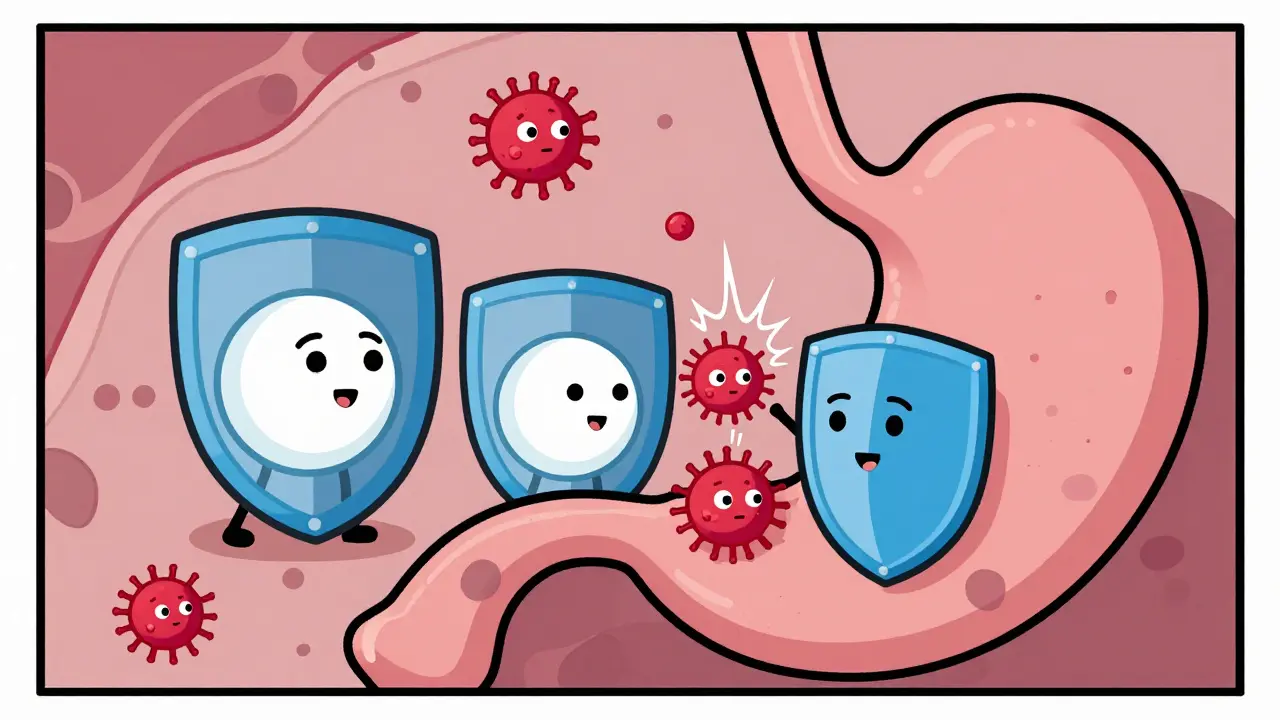
Not all new GI drugs are just rehashes of old ones. Vonoprazan (brand name Voquezna), approved in July 2024, represents a significant shift. Unlike traditional PPIs that block the proton pump enzyme, vonoprazan is a potassium-competitive acid blocker (P-CAB). It binds reversibly to the proton pump, providing faster and more consistent acid suppression, even in patients with certain genetic variations that make PPIs less effective.
Because vonoprazan is a newer mechanism, it does not yet have a generic equivalent. Patients needing this specific action must pay the brand price or seek alternative therapies. However, its efficacy in treating nonerosive GERD makes it a valuable option for those who fail standard omeprazole or pantoprazole trials. Insurance coverage often requires documentation of failed PPI trials before approving vonoprazan.
Another notable development is maralixibat (Livmarli), an ileal bile acid transporter inhibitor. Originally for pediatric liver conditions, its label expanded in mid-2024 to treat cholestatic pruritus (itching caused by liver disease) in patients aged 12 months and older. This highlights how GI drugs increasingly overlap with hepatology (liver health), creating complex treatment pathways that few single-pill combinations can address.
Navigating Insurance and Prior Authorization
Access to these drugs is rarely just about medical necessity; it’s about bureaucratic navigation. Medicare’s drug negotiation program treats combination products as distinct drugs. This means Janumet (sitagliptin and metformin) is negotiated separately from Januvia (sitagliptin alone). While Janumet is technically a diabetes drug, it affects GI health significantly, showing how metabolic and digestive care intersect.
For pure GI combinations, insurers look for "step therapy." They want proof that cheaper options failed. If you request a branded combination like a specific PPI-antibiotic mix, your insurer will likely demand medical records showing an adverse reaction or inadequate response to a generic equivalent. Without this documentation, your claim gets denied.
Pro tip: Ask your gastroenterologist to document "failure of generic step therapy" explicitly in your chart. Mention specific side effects, such as diarrhea from antibiotics or persistent heartburn despite high-dose PPIs. This language unlocks prior authorizations faster.
Biosimilars and Biologics in GI Care
The GI space isn’t just small molecules. Biologics now account for 33% of the market revenue. Drugs like ustekinumab (Stelara) treat Crohn’s disease and ulcerative colitis by targeting immune proteins. With patents expiring, biosimilars are entering the market. Ustekinumab-ttwe (Pyzchiva), approved in July 2024, offers a lower-cost alternative to Stelara for inflammatory bowel diseases.
Risankizumab-rzaa is another key player, being the first IL-23 specific inhibitor approved for both ulcerative colitis and Crohn’s disease. These biologics are injectable, not oral combinations, but they represent the future of targeted GI therapy. As biosimilars gain traction, prices for these high-end treatments should drop, making them accessible to more patients outside of specialized clinical trials.
Practical Steps for Patients and Providers
To maximize value and minimize out-of-pocket costs, consider these steps:
- Check the Formulary: Before accepting a prescription, verify if the specific combination is on your insurance’s preferred list. Often, the separate generics are Tier 1 (lowest copay), while the combination is Tier 3 (highest copay).
- Ask About Splitting: If a combination pill is $200 and the generics are $10 each, split them. Discuss timing with your pharmacist to ensure efficacy.
- Document Failures: Keep a log of side effects or lack of improvement with previous medications. This evidence is crucial for prior authorizations.
- Monitor Supply Chains: Generic approvals don’t always mean immediate shelf availability. Contact the ANDA applicant (the generic manufacturer) directly if your pharmacy reports shortages.
- Consider New Classes: If PPIs fail, ask about P-CABs like vonoprazan. They work differently and might solve stubborn heartburn.
The landscape of gastrointestinal combination products is shifting rapidly. Patents are expiring, generics are arriving, and new mechanisms are emerging. By understanding these dynamics, you can advocate for better, more affordable care.
Are there generic versions of H. pylori combination pills?
Pre-packaged combination pills for H. pylori vary by region and manufacturer. However, the individual components-proton pump inhibitors (like omeprazole) and antibiotics (like amoxicillin)-are widely available as low-cost generics. Most doctors prescribe these separately to ensure flexibility and cost savings.
What is the difference between vonoprazan and traditional PPIs?
Vonoprazan is a potassium-competitive acid blocker (P-CAB), whereas traditional drugs like omeprazole are proton pump inhibitors (PPIs). Vonoprazan provides faster and more consistent acid suppression because it binds reversibly to the proton pump. It is particularly effective for patients who do not respond well to standard PPIs due to genetic factors.
Why is my insurance requiring prior authorization for my GI medication?
Insurers use prior authorization to enforce "step therapy," ensuring you try cheaper, generic alternatives first. For combination products, they often require proof that separate generic ingredients failed or caused adverse reactions. Providing detailed medical records of these failures usually speeds up approval.
Is Duexis available as a generic?
Yes, generic versions of the ibuprofen-famotidine combination found in Duexis have been approved by the FDA. Manufacturers like Par Pharmaceutical and Alkem Laboratories produce these generics. However, availability can vary by pharmacy, so it is worth checking with local providers or requesting the separate generic ingredients if the combo is unavailable.
How do biosimilars impact the cost of GI biologics?
Biosimilars are highly similar copies of biologic drugs like ustekinumab (Stelara). Their introduction increases competition, driving down prices for treatments of Crohn’s disease and ulcerative colitis. As more biosimilars enter the market in 2026 and beyond, patients can expect lower out-of-pocket costs for these advanced therapies.