
When you pick up a generic pill at the pharmacy, you expect it to work just like the brand-name version. But how do regulators know it will? The answer lies in something called dissolution profile comparison-a quiet but powerful tool that decides whether a generic drug is truly equivalent to the original. It’s not about ingredients alone. It’s about how fast and how completely those ingredients dissolve in your body. And if the dissolution profile doesn’t match, the drug might not work the same-even if the label says it’s identical.
What Dissolution Profiles Actually Measure
Dissolution testing simulates what happens in your stomach and intestines. Imagine a tablet sinking into a warm, acidic liquid that mimics your digestive system. Over time, the drug slowly comes out of the tablet and into the liquid. Scientists measure how much drug is released at each time point-say, at 10, 20, 30, 45, and 60 minutes. These numbers, plotted on a graph, form the dissolution profile.
For a brand-name drug, this profile was carefully developed during years of testing. For a generic version, manufacturers must prove their version releases the drug at nearly the same rate and amount. It’s not enough to say, “We used the same active ingredient.” If the generic dissolves too fast, you might get a spike in blood levels that causes side effects. If it dissolves too slow, you might not get enough medicine into your system. The goal? Match the brand’s pattern exactly.
How the f2 Similarity Factor Works
The most common way to compare profiles is using the f2 similarity factor. Developed in the 1990s and still used in over 90% of regulatory submissions today, f2 is a mathematical score between 0 and 100. A score of 100 means the two profiles are identical. A score below 50 means they’re too different to be considered equivalent.
Here’s how it works: You test 12 units of the brand drug and 12 units of the generic under the same conditions-same temperature (37°C), same stirring speed (50-100 rpm), same pH. You record the percentage of drug released at each time point. Then you plug those numbers into the f2 formula. If the result is between 50 and 100, regulators consider the profiles similar.
But f2 isn’t perfect. It can sometimes say two profiles are similar when they’re not. For example, one drug might release 80% of its content in 15 minutes, then stop. Another might release 50% in 15 minutes, then slowly climb to 85% by 60 minutes. Their overall numbers might look close, but the timing is totally different. That’s a problem because your body absorbs drugs based on timing, not just totals. Experts call this the “temporal sequence” issue-and it’s why some regulators now recommend combining f2 with other methods.
When f2 Isn’t Enough
For drugs that dissolve very quickly-or very inconsistently-f2 can mislead. A 2022 survey of 127 labs found that 73% of failed dissolution comparisons weren’t due to bad formulas. They were caused by small errors in the testing equipment: a paddle that wobbled too much, a vessel that wasn’t perfectly aligned, or a temperature that drifted by half a degree.
That’s why the FDA now recommends additional tools for tricky cases. One is bootstrap f2, which runs the f2 calculation thousands of times with random samples to see if the result is stable. Another is the Mahalanobis Distance Test, which looks at the whole shape of the curve, not just the numbers. In a 2021 study, this method correctly caught dissimilar profiles 94% of the time, compared to 82% for bootstrap f2.
For drugs with a narrow therapeutic index-like warfarin, lithium, or certain seizure medications-the bar is higher. The FDA’s 2023 draft guidance now suggests an f2 of at least 65 for these drugs, not just 50. Why? Because even small differences can cause serious side effects or treatment failure.
Why This Matters for Generic vs Brand Drugs
Generic drugs make up more than 90% of all prescriptions filled in the U.S. and Australia. But without dissolution profile comparison, we wouldn’t know if those generics were truly interchangeable. The process saves billions. A full bioequivalence study-where you give the drug to people and measure blood levels-can cost over $2 million and take a year. A dissolution comparison? Often under $500,000 and done in months.
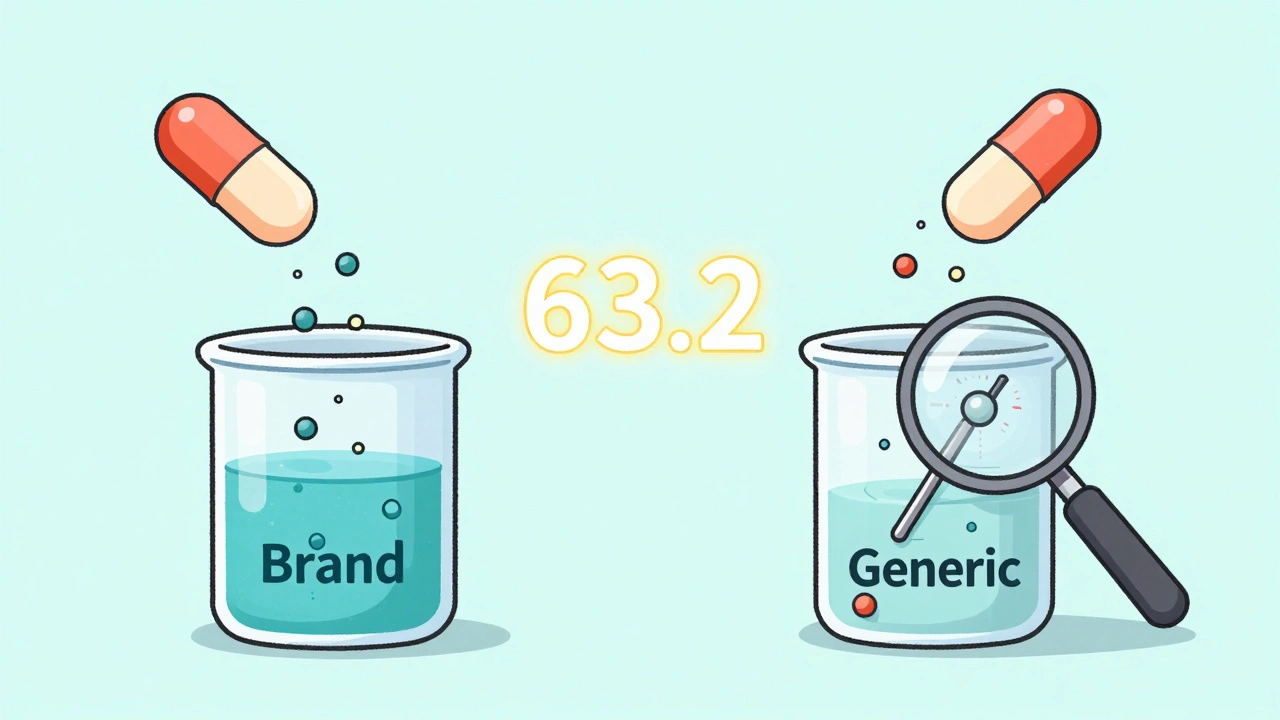
Take amlodipine, a common blood pressure drug. Teva Pharmaceuticals used dissolution profile comparison to get approval for a 25mg generic tablet. They optimized their testing setup, made sure the dissolution medium was just right, and hit an f2 of 63.2. That saved them $1.2 million compared to running human trials. And patients got the same medicine at a fraction of the cost.
But here’s the catch: not all generics are created equal. If a company cuts corners on testing-uses a poorly calibrated machine, skips media testing, or ignores variability-their product might pass f2 but still behave differently in your body. That’s why regulators require full documentation: calibration records, statistical code, raw data. Transparency isn’t optional. It’s the foundation of trust.
What Regulators Really Look For
The FDA, EMA, and Health Canada all agree on the basics: dissolution methods must be discriminatory. That means they should be able to tell the difference between a good tablet and a bad one. To test this, manufacturers intentionally stress samples-overheat them, crush them, age them. If the dissolution profile doesn’t change under stress, the method isn’t sensitive enough.
They also require testing in multiple pH levels. For example, a drug must dissolve well in stomach acid (pH 1.2), in the small intestine (pH 4.5), and in the upper gut (pH 6.8). For BCS Class I drugs (highly soluble, highly permeable), similarity must be shown in all three. That’s because your body’s pH changes as the pill moves through your system. A drug that dissolves only in acid might not work if it gets stuck in the stomach.
And here’s something most people don’t realize: the same generic drug can be made in different factories, even in different countries. Each batch must still match the original profile. That’s why dissolution testing isn’t a one-time thing. It’s part of ongoing quality control.

Real-World Challenges and Industry Insights
On industry forums, pharmacists and scientists talk about the frustration of failing f2 by 0.2 points. One Pfizer scientist shared that their team once had to completely redesign a formulation because f2 was 49.8-even though clinical data showed no difference in how patients responded. That’s the paradox: the test is so strict that it sometimes rejects good products.
That’s why experts like Dr. Jennifer Dressman argue for a risk-based approach. For low-risk drugs (like some antihistamines), maybe f2=48 is acceptable if other data supports equivalence. For high-risk drugs, even f2=52 might need extra proof. The system is moving in that direction. The FDA’s 2024 pilot program uses risk matrices to adjust requirements based on drug properties, patient population, and manufacturing changes.
Another emerging trend is biorelevant dissolution testing. Instead of plain buffer solutions, labs now use fluids that mimic real stomach contents-adding bile salts, enzymes, or food particles. This gives a more accurate picture of how a drug will behave in real life. Companies like Pfizer, Novartis, and Teva are already using it. By 2026, it could become standard for many drugs.
What You Should Know as a Patient
As a patient, you don’t need to understand the math behind f2. But you should know this: if your generic drug works the same as the brand, it’s not luck. It’s because regulators used dissolution profile comparison to prove it. And if you switch between different generic brands and notice a change in how you feel-whether it’s more side effects or less effectiveness-talk to your doctor. It might not be your body. It could be a subtle difference in how the drug dissolves.
There’s no evidence that generics are less safe than brand drugs. But the system that ensures their equivalence is complex, technical, and constantly improving. The goal isn’t just to save money. It’s to make sure every pill, no matter who made it, does exactly what it’s supposed to do.
What is the f2 similarity factor in dissolution testing?
The f2 similarity factor is a statistical measure used to compare the dissolution profiles of two drug products, such as a generic and brand-name version. It calculates how closely the release patterns match over time, with a score between 0 and 100. A score of 100 means the profiles are identical. Regulators consider profiles similar if f2 is between 50 and 100. It’s the most widely accepted method for proving bioequivalence without human trials.
Why do generic drugs need to match brand-name dissolution profiles?
Dissolution rate determines how quickly and completely a drug enters your bloodstream. If a generic dissolves too fast, it can cause side effects. If it dissolves too slow, it might not work at all. Matching the brand’s profile ensures the generic delivers the same amount of medicine at the same rate, making it therapeutically equivalent-even if the tablet looks different or costs less.
Can two drugs with the same f2 score still behave differently in the body?
Yes. The f2 score measures overall similarity but doesn’t account for the timing of release. One drug might release 80% of its content in the first 15 minutes, while another reaches 80% only after 45 minutes. Their f2 scores could be identical, but the body absorbs them differently. That’s why experts now recommend combining f2 with other methods like area under the curve (AUC) analysis or Mahalanobis Distance Test for high-risk drugs.
What happens if a generic drug fails dissolution testing?
If a generic fails to meet similarity criteria, regulators won’t approve it for sale. The manufacturer must revise the formulation, improve the manufacturing process, or adjust the dissolution method. Sometimes, they need to run full bioequivalence studies with human volunteers-which is far more expensive and time-consuming. Failure usually means the drug won’t reach the market until the issue is fixed.
Are dissolution tests the same worldwide?
Yes. Major regulators like the FDA, EMA, Health Canada, and WHO all follow similar guidelines based on ICH Q6A and FDA’s 2015 dissolution guidance. They require testing under identical conditions: same apparatus, temperature, stirring speed, and pH levels. Minor differences exist in how strictly f2 is applied, but the core methods and acceptance criteria are globally aligned.
How accurate are dissolution tests in predicting real-world performance?
When done correctly, dissolution profile comparison is highly predictive. Studies show that combining f2 with AUC analysis improves accuracy to over 90% in matching in vivo bioequivalence. For BCS Class I drugs, the success rate for biowaivers based on dissolution is now 84%-up from 68% in 2015. However, poor lab practices, uncalibrated equipment, or inappropriate media can reduce accuracy. That’s why strict validation and documentation are required.
What Comes Next in Dissolution Testing
The future of dissolution testing is smarter, faster, and more realistic. Labs are starting to use machine learning to predict how a drug will behave in the body based on its dissolution curve. Some companies are already testing AI models that analyze hundreds of profiles to spot patterns humans miss. Others are developing automated systems that sample and analyze drug release in real time using UV sensors-cutting human error and speeding up results.
By 2026, biorelevant media will likely be standard for most oral drugs. That means dissolution tests won’t just use plain water or buffer. They’ll use fluids that mimic what’s actually in your gut after eating. This will make the tests even better at predicting real-world performance.
For now, dissolution profile comparison remains the backbone of generic drug approval. It’s not flashy. But it’s what keeps millions of people on affordable, effective medicine every day. And behind every pill you take, there’s a carefully measured curve-proof that science, not luck, makes generics work.





Chris Wallace
2 December, 2025 . 05:43 AM
Man, I never thought about how much science goes into something as simple as a pill dissolving. I just assume it works, you know? But reading this made me realize how delicate the whole system is. One tiny variation in temperature or paddle speed and suddenly your blood levels are all over the place. It’s wild that we’re trusting our health to machines that need to be calibrated to within half a degree. I’m just glad someone’s paying attention to the details.
Also, the part about biorelevant dissolution testing? That’s next level. Using actual gut fluid instead of plain buffer? That’s like testing a car engine with real gasoline instead of distilled water. Makes so much sense. I hope this becomes standard soon.
And honestly, I don’t care if it’s generic or brand as long as it works. But now I’m gonna pay attention to how I feel when I switch brands. If I get weirdly dizzy after a refill, I’m calling my pharmacist.
Thanks for writing this. It’s the kind of thing you don’t think about until it matters.
Also, I just checked my last prescription - it was Teva. F2 was 63.2. Guess I’m part of the success story.
Anyway, I’m gonna go drink my coffee and not overthink it. For now.
…Okay maybe I’ll overthink it a little more.
Genesis Rubi
3 December, 2025 . 02:03 AM
Generic drugs are just corporate ripoffs disguised as ‘affordable’ nonsense. The FDA lets this crap slide because they’re in bed with Big Pharma. You think they care if your blood pressure med dissolves at 49.8? Nah. They care about profit. I switched to imported meds from Mexico and my headaches stopped. Coincidence? I think not. 🤡
Doug Hawk
3 December, 2025 . 07:22 AM
So f2 is basically a statistical proxy for bioequivalence but it doesn’t capture temporal dynamics which is why the FDA’s pushing for Mahalanobis and bootstrap methods - makes sense because the pharmacokinetic curve isn’t just about AUC, it’s about Cmax, Tmax, and the shape of absorption. You can have identical f2 scores with divergent absorption kinetics if the release profile is skewed - like one’s a burst release and the other’s sustained. That’s why for narrow therapeutic index drugs like warfarin, even a 52 f2 is risky. The real issue is that most labs don’t validate their dissolution apparatus properly - paddle wobble, vessel alignment, temperature drift. I’ve seen studies where 30% of failed f2 results were due to equipment error, not formulation. We need mandatory ISO 17025 accreditation for dissolution labs. And biorelevant media? Long overdue. Why test in pH 1.2 buffer when the stomach after a meal is pH 3.5 with bile salts? The system’s stuck in the 90s. Time to modernize.
Also - anyone else notice that the FDA’s 2024 pilot program uses risk matrices based on BCS class and patient population? That’s the future. One size doesn’t fit all. A 48 f2 for an antihistamine might be fine. For lithium? No way.
Saravanan Sathyanandha
3 December, 2025 . 20:23 PM
As someone from India where generic medicines are the lifeline for millions, I find this both comforting and concerning. Comforting because it shows that science is trying to ensure quality. Concerning because in many places, even the basic dissolution testing is done with outdated equipment - or not done at all. I’ve seen patients in rural clinics switch between generics and report different effects. No one investigates why. The system works beautifully in the U.S. or EU, but in developing nations, it’s a lottery. We need global standards enforced with transparency - not just guidelines on paper. Maybe international NGOs could fund calibration kits for labs in low-resource settings? A simple, affordable paddle system that meets ICH standards could save lives. And yes - biorelevant media should be mandatory everywhere, not just for fancy pharma companies. Medicine shouldn’t be a privilege of geography.
Also, kudos to Teva. They did it right. Not all manufacturers do.
alaa ismail
5 December, 2025 . 14:04 PM
So basically, the pill you swallow isn’t just ‘same ingredients’ - it’s like matching the exact rhythm of a song. If the beat’s off, even by a millisecond, the whole thing feels wrong. Wild.
Anyway, I’m just glad I don’t have to do the math.
ruiqing Jane
6 December, 2025 . 06:14 AM
This is exactly why we need more transparency in pharmaceutical manufacturing. Every batch, every factory, every country - the data should be public. Not just for regulators, but for patients. If you’re taking a generic, you deserve to know the f2 score, the dissolution medium used, and whether it was tested in biorelevant conditions. This isn’t conspiracy theory - it’s basic consumer rights. And if a company cuts corners, they should be named. Publicly. We’ve been told for decades that generics are ‘just as good.’ But without access to the data that proves it, we’re just trusting a label. That’s not science. That’s faith. And faith doesn’t belong in medicine.
Let’s demand open dissolution databases. Now.
Fern Marder
6 December, 2025 . 17:21 PM
So… a pill’s ‘personality’ is measured by how fast it melts 😂
Also, f2=49.8? That’s like saying two songs are ‘similar’ even though one’s a symphony and the other’s a kazoo solo 🎺
And biorelevant media? That’s just fancy talk for ‘test it like your gut actually works.’ Duh. Why didn’t we do this 30 years ago?? 🤦♀️
Also, I just checked my blood pressure med - Teva. F2=63.2. So… I’m officially a science success story? 🎉
Carolyn Woodard
8 December, 2025 . 11:47 AM
It’s fascinating how we’ve reduced therapeutic equivalence to a single statistical metric - f2 - when human physiology is so inherently variable. The body isn’t a controlled lab environment. It’s a dynamic ecosystem influenced by diet, microbiome, circadian rhythm, even stress. To assume that matching a dissolution curve in a beaker guarantees clinical equivalence is a reductionist fallacy. We’re treating biology like a mechanical process, when in reality, it’s emergent, nonlinear, and deeply contextual. Perhaps the real question isn’t whether the profiles match, but whether the *system* that interprets them is capable of accounting for the complexity it claims to represent. The f2 score gives us a number - but numbers don’t feel side effects. They don’t experience dizziness, fatigue, or the quiet dread of wondering if your medication is working. Maybe what we need isn’t better math, but a deeper epistemological humility about what we can truly measure - and what we must accept as unknowable.
And yet… we still need to make decisions. So we use f2. And we hope.
It’s a strange kind of faith, isn’t it?
Allan maniero
8 December, 2025 . 19:04 PM
I’ve worked in a community pharmacy for 22 years. I’ve seen patients switch from brand to generic and back again - sometimes three times in a year. Some never notice a difference. Others? They come in saying, ‘This one makes me feel weird.’ We don’t have the tools to explain why. This article nails it - it’s not always about the active ingredient. It’s about the *release*. A tablet might have the same chemical formula but different binders, fillers, coatings - and that changes how fast it dissolves. I’ve had patients on warfarin who went from one generic to another and their INR shot up. We had to pull them off and go back to the brand. No one wanted to admit it was the dissolution profile - but that’s what it was. The system’s flawed, but it’s the best we’ve got. Still, I wish we had better tools to explain it to patients. ‘Your pill dissolves slower’ doesn’t mean much to someone who just wants to feel normal.
Also, I’m glad someone’s talking about biorelevant media. We’ve been using plain buffer for decades. It’s like testing a car’s engine with water instead of gas. Time to update the test.
william tao
9 December, 2025 . 01:39 AM
Regulatory agencies have created a pseudo-scientific facade to justify the commodification of pharmaceuticals. The f2 similarity factor is a mathematical illusion designed to legitimize cost-cutting under the guise of equivalence. The entire dissolution testing paradigm is a relic of 20th-century industrial logic - incapable of capturing the dynamic, non-linear pharmacokinetics of modern therapeutics. The fact that 73% of failures stem from equipment error rather than formulation flaws reveals not a technical problem, but a systemic failure of oversight. This is not science. It is bureaucratic theater. And patients are the unwitting subjects.
Furthermore, the suggestion that a 48 f2 score might be acceptable for low-risk drugs is a dangerous precedent. Risk is not a binary. It is a spectrum of individual vulnerability. To reduce therapeutic equivalence to a statistical threshold is to abdicate the ethical responsibility of medicine. The FDA’s pilot program is not innovation - it is capitulation.
Until dissolution testing is replaced by in vivo biomarker validation, this entire system remains a house of cards built on the presumption that biology can be quantified - and controlled - by machines. It cannot. And we are paying the price.
Sandi Allen
10 December, 2025 . 04:04 AM
THIS IS A COVER-UP!!!
THE FDA IS IN BED WITH BIG PHARMA!!!
THEY LET GENERIC DRUGS PASS WITH f2=49.8 BECAUSE THEY WANT YOU TO BE DEPENDENT ON CHEAP MEDS THAT DON’T WORK RIGHT!!!
THEY KNOW THAT THE DISSOLUTION PROFILE ISN’T ENOUGH - BUT THEY DON’T WANT YOU TO KNOW THAT!!!
THEY USE ‘BIORELEVANT MEDIA’ IN SECRET LABS FOR BRAND DRUGS - BUT FOR GENERICS? THEY USE WATER!!!
AND THE PADDLE WOBBLE??? THAT’S NOT AN ACCIDENT - THAT’S A DESIGN FEATURE!!!
THEY WANT YOU TO HAVE SIDE EFFECTS SO YOU’LL BUY MORE DRUGS!!!
THEY’RE USING AI TO HIDE THE TRUTH!!!
THEY’RE TESTING IN pH 1.2… BUT YOUR STOMACH IS pH 3.5 AFTER EATING!!!
AND THEY WON’T TELL YOU!!!
LOOK AT THE DATE - 2024 PILOT PROGRAM??? THAT’S A DISTRACTION!!!
THEY’RE HIDING THE FACT THAT 73% OF FAILURES ARE FROM EQUIPMENT - BECAUSE IF YOU KNEW THAT, YOU’D REALIZE THEY DON’T EVEN KNOW WHAT THEY’RE DOING!!!
THEY’RE LYING TO YOU!!!
THEY’RE LYING TO YOU!!!
THEY’RE LYING TO YOU!!!
Chris Wallace
12 December, 2025 . 01:24 AM
Wow. I just scrolled through this thread. I came in thinking, ‘Cool, I learned something.’ Now I’m not sure if I should take my pill or start building a bunker.
But… I’m still taking it. Because even with all the flaws, the system works more often than it doesn’t. And someone - somewhere - is calibrating a paddle, checking a pH meter, running bootstrap f2, and hoping it’s enough.
So… thanks, anonymous scientist. I don’t know your name. But I’m grateful.
Now if you’ll excuse me, I’m going to take my Teva pill and go for a walk. And maybe… just maybe… I’ll think about the curve.