Drug-Acid Reducer Interaction Checker
This tool helps you understand potential interactions between acid-reducing medications and other drugs. Note: This is for informational purposes only and does not replace professional medical advice.
Potential Impact
Critical Warning
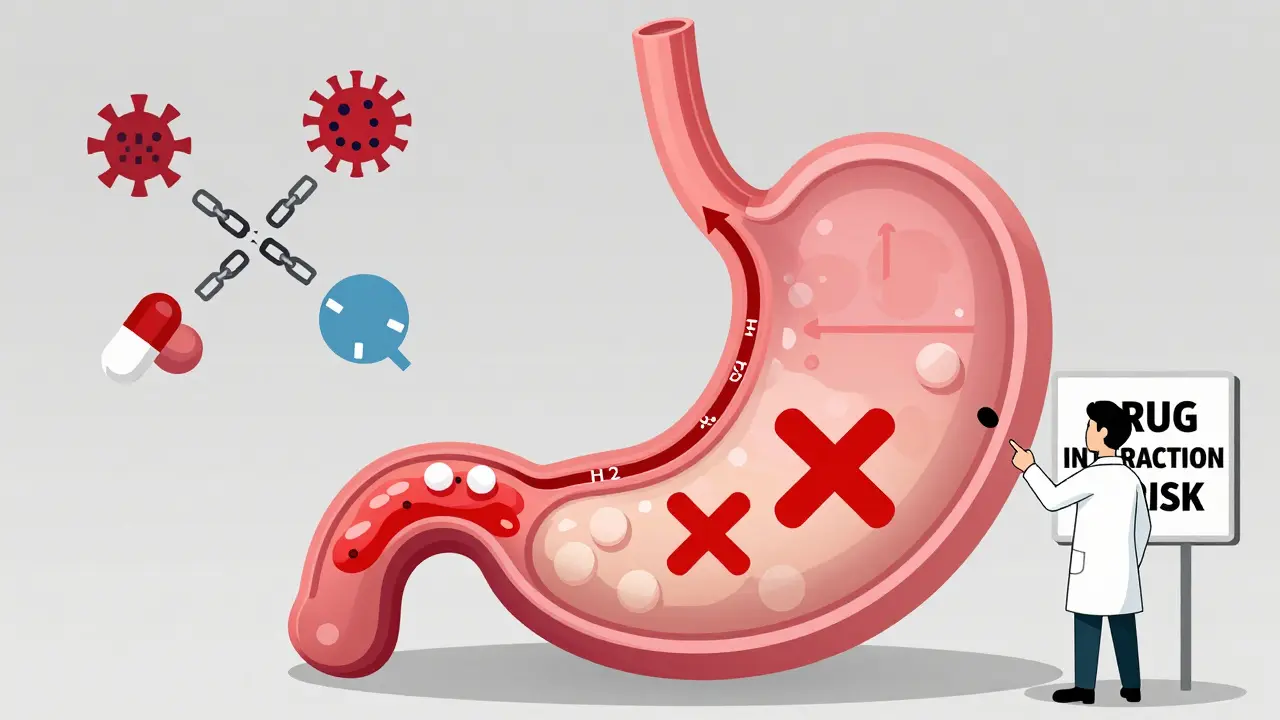
Most people think of acid-reducing medications like omeprazole or famotidine as harmless heartburn fixes. But what if taking them could make your blood pressure pill, cancer drug, or HIV treatment stop working? It’s not a myth. Around one in four of the most commonly prescribed drugs in the U.S. are affected by these medications - and many doctors don’t tell patients.
How Acid Reducers Change Your Body’s Chemistry
Proton pump inhibitors (PPIs) and H2 blockers work by turning down stomach acid. PPIs like omeprazole, esomeprazole, and lansoprazole shut down the acid-producing pumps in your stomach lining. H2 blockers like ranitidine or famotidine block the signal that tells those pumps to activate. Either way, your stomach pH rises from its normal 1.0-3.5 to 4.0-6.0. That sounds harmless - until you realize your body doesn’t just digest food there. It also absorbs most of your medications.
Drugs aren’t all the same. Some dissolve best in acid. Others need a less acidic environment. Weakly basic drugs - meaning they have a chemical structure that prefers to stay neutral in low acid - are the most vulnerable. About 70% of oral medications fall into this category. When your stomach becomes less acidic, these drugs don’t dissolve properly. They sit there, unchanged, and get passed into the intestines without being absorbed. The result? Less drug in your bloodstream. Less effect. Sometimes, no effect at all.
The Drugs Most at Risk
Not all interactions are created equal. Some are mild. Others are dangerous.
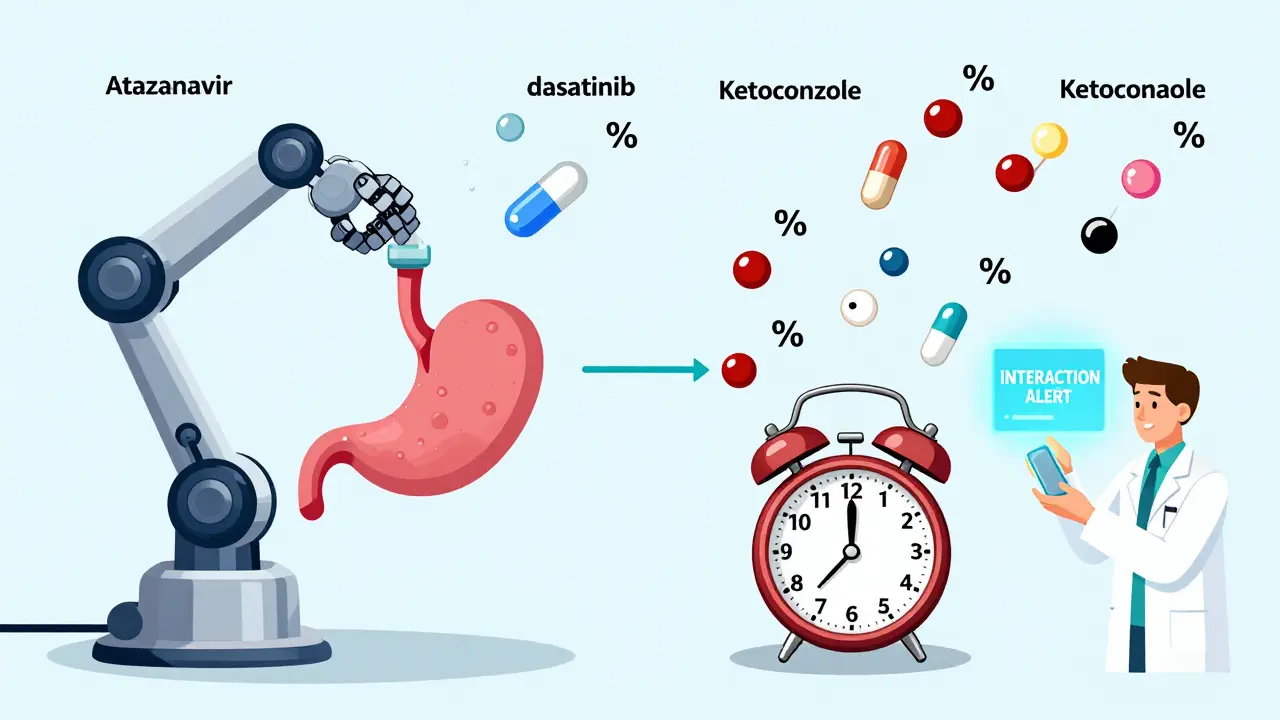
Atazanavir, an HIV medication, is the textbook case. When taken with a PPI, its absorption drops by up to 95%. Patients have gone from undetectable viral loads to over 12,000 copies per milliliter - all because they started omeprazole for heartburn. One Reddit user wrote: “My infectious disease specialist said this is a classic interaction we test for in pharmacology.”
Dasatinib, used for chronic myeloid leukemia, sees a 60% drop in absorption with PPIs. A 2023 study of over 12,000 patients found those taking both had 37% higher rates of treatment failure. The FDA requires doctors to warn patients - but many don’t.
Ketoconazole, an antifungal, becomes almost useless with PPIs. A 75% drop in absorption means the drug can’t reach the levels needed to kill fungi. It’s not just less effective - it’s broken.
Even drugs you wouldn’t expect are affected. Dasiglucagon, used for severe low blood sugar, absorbs better in higher pH - but the increase is small enough that dose changes aren’t usually needed. Meanwhile, weak acids like aspirin barely budge. The real danger lies in drugs with narrow therapeutic windows - where a small drop in absorption means treatment fails, not just slows down.
PPIs vs. H2 Blockers: Not All Acid Reducers Are Equal
Many assume all acid reducers are the same. They’re not.
PPIs are stronger and longer-lasting. They keep your stomach pH above 4 for 14 to 18 hours a day. H2 blockers like famotidine only do it for 8 to 12 hours. That difference matters. A 2024 study in JAMA Network Open found PPIs reduce absorption of affected drugs by 40-80%. H2 blockers? Only 20-40%.
That’s why guidelines now say: if you must use an acid reducer with a sensitive drug, try an H2 blocker first. And even then, space them out.
Why the Small Intestine Doesn’t Save the Day
You might think: “If the stomach isn’t absorbing the drug, won’t the intestine pick it up?”
It sounds logical. After all, the small intestine has 200-300 square meters of surface area - way more than the stomach’s 1-2 square meters. But absorption doesn’t just happen because there’s more space. It needs the drug to dissolve first.
Most weakly basic drugs start dissolving in the stomach. If they don’t dissolve there, they don’t get a chance to be absorbed later. Even if they reach the intestine, they remain as undissolved chunks. The intestine can’t magically turn a solid lump into a usable medicine. That’s why timing and pH at the start matter more than where the drug ends up.
Enteric Coatings and Other Hidden Traps
Some drugs come with enteric coatings - a shell designed to keep them from dissolving in the stomach. That’s meant to protect the drug from acid or protect your stomach from the drug. But when you raise gastric pH, those coatings can dissolve too early. The drug releases in the stomach, gets degraded, and never reaches the intestine.
Take omeprazole itself. It’s enteric-coated. If you crush it or take it with something that changes pH, it can break down too soon. Same goes for other coated pills. The problem isn’t just absorption - it’s destruction.
Real-World Consequences
These aren’t theoretical risks. They’re happening every day.
The FDA’s adverse event database recorded 1,247 reports of therapeutic failure linked to acid reducers between 2020 and 2023. Atazanavir led the list with 312 reports. Dasatinib came second with 287. Ketoconazole had 198.
One Drugs.com user wrote: “My doctor didn’t tell me Nexium would interfere with my blood pressure meds - my readings were consistently 20 points higher until we figured out the interaction.”
It’s not just patients. Doctors miss it too. A 2023 study showed pharmacist-led reviews cut inappropriate co-prescribing by 62% in Medicare patients. That means without pharmacists stepping in, most of these dangerous combinations go unnoticed.
What You Can Do
Don’t stop your acid reducer without talking to your doctor. But do ask these questions:
- Is this medication affected by acid-reducing drugs?
- Is there a safer alternative for my heartburn?
- Can we space the doses - like taking my blood pressure pill 2 hours before my PPI?
Staggering doses helps - but only a little. A 2024 study found it reduces interaction by 30-40%, not enough for high-risk drugs like atazanavir. For those, the only safe option is to avoid PPIs entirely.
Antacids like Tums or Rolaids can be used with a 2-4 hour gap, but they only last a few hours. Not practical for chronic use.
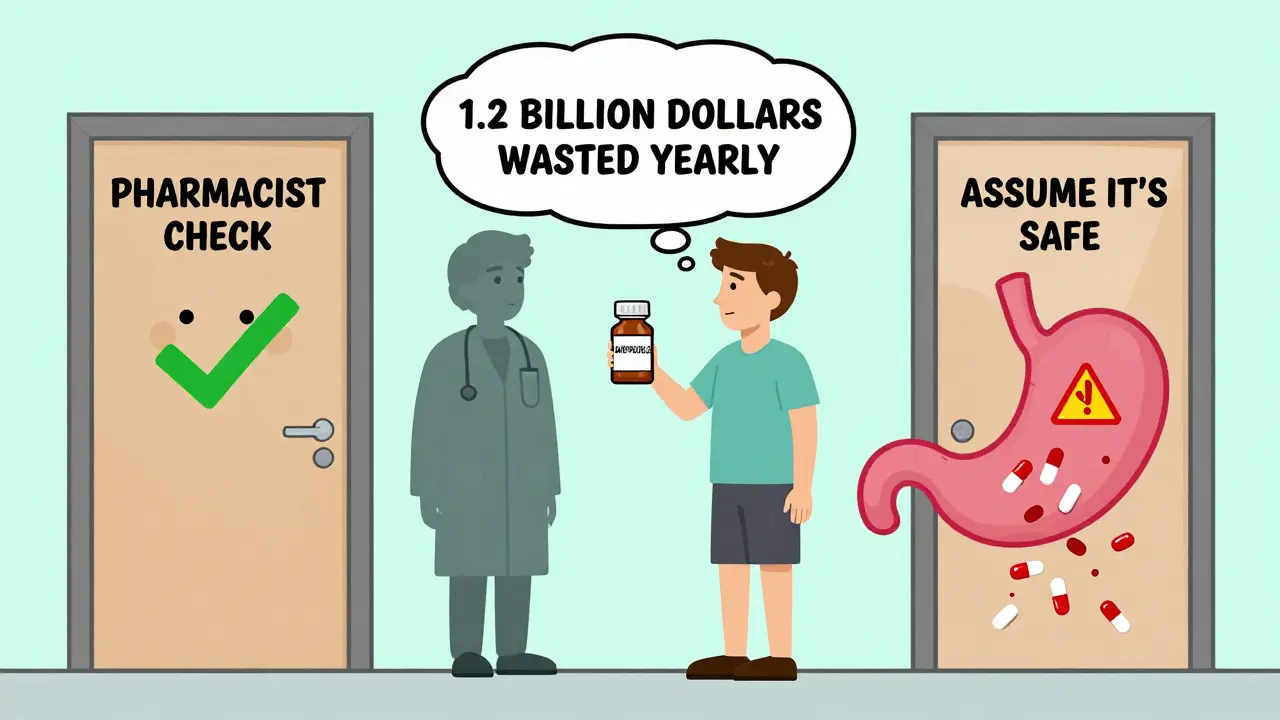
Ask your pharmacist to run a drug interaction check. Most pharmacies have software that flags these issues. If your doctor doesn’t mention it, your pharmacist might.
The Bigger Picture
Over 15 million Americans take PPIs long-term - and about half of them don’t need them. The American College of Gastroenterology recommends deprescribing PPIs in 30-50% of long-term users. Why? Because the risks - from nutrient deficiencies to infections to drug interactions - often outweigh the benefits.
The FDA now requires 28 drug labels to warn about acid reducer interactions - up from just 12 five years ago. The European Medicines Agency has done the same. The cost? Around $1.2 billion a year in wasted treatments, hospital visits, and failed therapies.
Pharmaceutical companies are starting to respond. Nearly 40% of new drugs in development now include pH-independent delivery systems. AI tools are being built to predict interactions with 89% accuracy. But until those arrive, you’re still on your own.
What to Do Next
If you’re on any of these drugs - atazanavir, dasatinib, ketoconazole, nilotinib, erlotinib, mycophenolate, or any HIV or cancer treatment - check your acid reducer. Don’t assume it’s safe.
Keep a list of all your medications. Bring it to every appointment. Ask: “Could any of these interfere with each other?”
And if your doctor says, “It’s probably fine” - get a second opinion. This isn’t guesswork. It’s science. And the science says: these interactions are real, common, and preventable.
Can I still take omeprazole if I’m on a blood pressure medication?
It depends on the blood pressure drug. Most common ones like lisinopril, amlodipine, or metoprolol aren’t affected. But if you’re on a drug like nilotinib or dasiglucagon, there could be an interaction. Always check with your pharmacist or use a reliable drug interaction checker. Never assume it’s safe just because it’s a common medication.
Is famotidine safer than omeprazole for drug interactions?
Yes, generally. Famotidine (an H2 blocker) raises stomach pH less and for a shorter time than omeprazole (a PPI). Studies show H2 blockers reduce absorption of affected drugs by about half as much as PPIs. If you need an acid reducer and are on a sensitive medication, famotidine is often the better choice - but spacing doses by 2 hours is still recommended.
What should I do if my medication stops working after starting an acid reducer?
Don’t increase your dose. Don’t ignore it. Contact your doctor immediately. If you’re on an HIV, cancer, or immunosuppressant drug, a drop in effectiveness can be life-threatening. Your doctor may need to switch your acid reducer, adjust your dose, or change your medication entirely. Keep a log of symptoms and timing - it helps pinpoint the cause.
Are over-the-counter acid reducers safer than prescription ones?
No. Omeprazole, esomeprazole, and famotidine are the same whether bought over the counter or prescribed. The dose might be lower, but the chemical effect on stomach pH is identical. Many people take OTC PPIs daily for months without realizing they’re risking interactions with other medications. Just because it’s available without a prescription doesn’t mean it’s harmless.
Can I just take my acid reducer at night and my other meds in the morning?
It might help - but not always. PPIs work for up to 18 hours. Even if you take your heartburn pill at night, it’s still raising your stomach pH in the morning. For high-risk drugs like atazanavir, this isn’t enough. The only safe option is to avoid PPIs entirely. For less critical cases, spacing by 2-4 hours can reduce risk, but it’s not foolproof. Always confirm with your pharmacist.


Donna Macaranas
31 January, 2026 . 13:16 PM
Wow, I had no idea my omeprazole could mess with my blood pressure meds. I’ve been taking it for years just because it ‘helps with the burn.’ Guess I’m scheduling a pharmacist chat this week.
Rachel Liew
31 January, 2026 . 15:42 PM
my doc never told me this about famotidine and my chemo drug 😣 i just thought i was getting worse… thanks for posting this, i’m calling my pharmacy first thing tomorrow
Lisa Rodriguez
31 January, 2026 . 18:46 PM
This is such an important post. I work in a clinic and we see this all the time - patients on PPIs for years thinking it’s ‘just heartburn medicine’ while their antivirals or cancer drugs are basically useless. The fact that doctors don’t always flag it is terrifying. Pharmacists are the real heroes here. If you’re on any chronic med, ask your pharmacist to run a full interaction check. It’s free, it’s fast, and it might save your life. Also, if you’re on atazanavir - please, just avoid PPIs. Full stop.
Lilliana Lowe
1 February, 2026 . 03:31 AM
The notion that ‘H2 blockers are safer’ is a gross oversimplification. While they have shorter duration, their pharmacokinetic profiles still induce clinically significant pH shifts in susceptible patients. Moreover, the JAMA study cited fails to account for CYP3A4 inhibition synergies with certain PPIs - particularly omeprazole - which compound the absorption issue beyond mere gastric pH. This is not a ‘switch to famotidine’ problem. It’s a systemic failure of prescriber education.
vivian papadatu
1 February, 2026 . 11:49 AM
Just had to share this with my mom who’s on HIV meds and takes Prilosec daily. She didn’t even know it could interfere. 🥺 I’m printing this out and taking it to her next appointment. Knowledge is power, but access to clear info? That’s life-saving. Thank you for writing this.
Melissa Melville
1 February, 2026 . 15:42 PM
So let me get this straight - we’ve got millions of people popping OTC acid reducers like candy, and the FDA only just started requiring 28 labels to warn about it? And we wonder why healthcare costs are insane. 😅
Deep Rank
2 February, 2026 . 02:53 AM
you people are so naive, you think this is just about drugs? this is about corporate greed, pharma companies know this and they dont care because they make more money selling you the next drug when the first one fails, they dont want you to know because then youd stop taking the ppi and theyd lose billions, and your doctors are paid by them too so theyll never tell you the truth, you think your doc cares? no, they care about their bonus, and you just keep popping pills like a good little zombie, wake up, this is all designed to keep you sick and dependent
Naomi Walsh
3 February, 2026 . 04:03 AM
It’s appalling that this isn’t common knowledge in medical school. The fact that a 2023 study showed 62% reduction in co-prescribing only after pharmacist intervention speaks volumes about the incompetence of primary care providers. This isn’t a ‘patient education’ issue - it’s a systemic failure of clinical training. Anyone prescribing PPIs without checking for drug interactions should be barred from practice.
Bob Cohen
3 February, 2026 . 18:28 PM
My grandma’s on metoprolol and took omeprazole for 3 years. Her BP was all over the place until her pharmacist caught it. She didn’t even know the meds could talk to each other. Now she takes Tums when she needs it and only uses famotidine if she’s having a bad night. Simple fix, big difference.
Aditya Gupta
4 February, 2026 . 18:16 PM
bro i was on nexium for acid and my cancer med stopped working. doctor said 'maybe its stress' lol. i checked online and found this. switched to famotidine and spaced doses. my numbers are back to normal. if you're on anything serious - dont trust your doc to know. check it yourself.