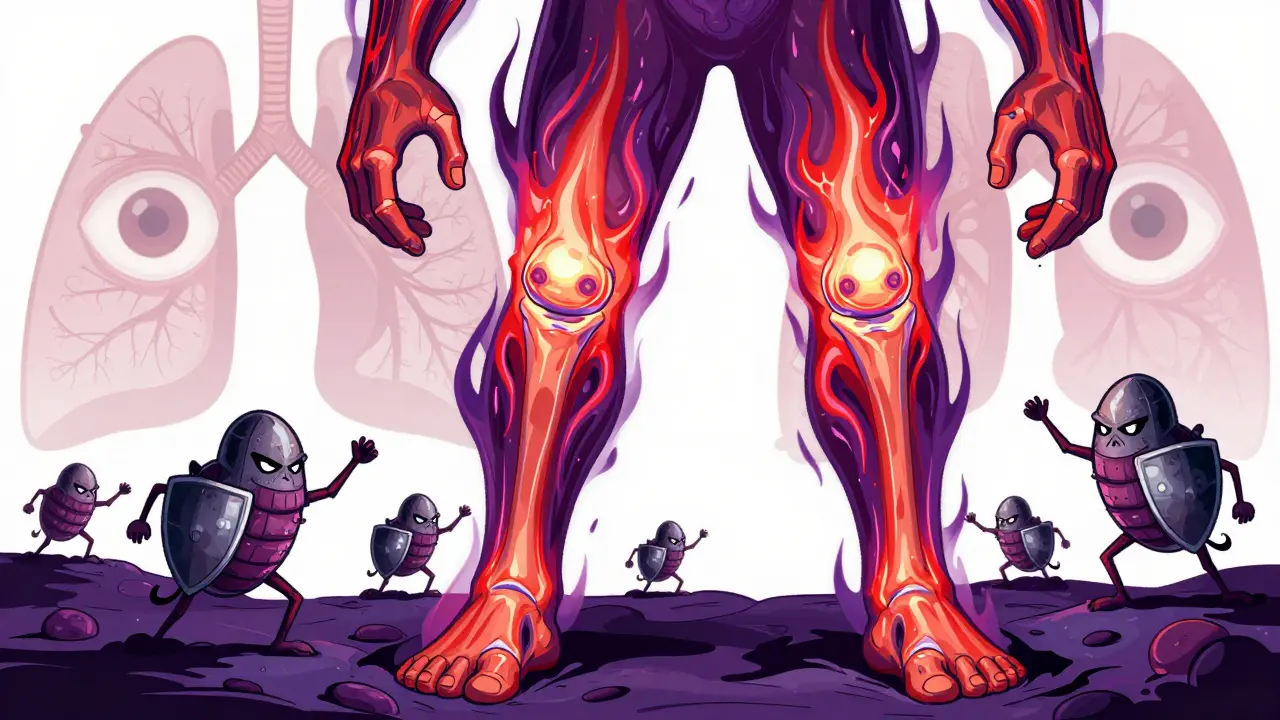
When your immune system turns on your own joints, life changes fast. Rheumatoid arthritis (RA) isn’t just stiff knees or aching fingers-it’s a full-body autoimmune storm. Unlike osteoarthritis, which comes from wear and tear, RA is when your body’s defenses go rogue, attacking the lining of your joints. This triggers swelling, pain, and eventually, permanent damage. And it doesn’t stop at the joints. RA can affect your lungs, heart, eyes, and even your blood. It hits women harder-two to three times more often than men-and usually shows up between ages 30 and 60. But it can strike anyone, anytime.
How Rheumatoid Arthritis Starts and Progresses
RA doesn’t hit you overnight. It creeps in. You might notice your knuckles feel tender in the morning, or your feet ache after walking. That stiffness? It lasts longer than 30 minutes-often over an hour. And it’s symmetric: if your left wrist hurts, your right one will too. This symmetry is one of the clearest signs doctors look for.
Blood tests help confirm it. High levels of rheumatoid factor (RF) or anti-CCP antibodies point to RA, though not everyone with RA tests positive. X-rays and ultrasounds show early signs: soft tissue swelling, then thinning bone around the joint, and eventually, tiny holes in the bone where cartilage has been destroyed. By the time erosions appear, damage is already done. That’s why early diagnosis matters so much.
Up to 15% of people with RA also develop Sjögren’s syndrome-dry eyes, dry mouth, a constant feeling of grit in your eyes. Others get rheumatoid nodules-firm lumps under the skin near elbows or heels. Some face lung inflammation, anemia, or a higher risk of heart attack. The disease isn’t just painful; it’s systemic. And it’s unpredictable. Flares come and go. Some months, you feel okay. Others, even holding a coffee cup feels impossible.
Why Biologics Are a Game Changer
For decades, methotrexate was the go-to drug for RA. It’s cheap, effective for many, and has been used since the 1980s. But for about half of patients, it’s not enough. That’s where biologics come in.
Biologic therapies are made from living cells, not chemicals. They’re designed to block specific parts of the immune system that fuel inflammation. Think of them as precision missiles instead of scatter shots. The first one, etanercept, got FDA approval in 1998. Since then, we’ve seen a revolution.
There are four main types:
- TNF inhibitors (like adalimumab, etanercept, infliximab): These block tumor necrosis factor, a key inflammation signal. They’re the most commonly used biologics.
- IL-6 inhibitors (like tocilizumab): These target interleukin-6, a protein that drives joint damage and fatigue.
- B-cell inhibitors (like rituximab): These remove B-cells, the immune cells that make harmful antibodies.
- T-cell blockers (like abatacept): These stop T-cells from activating other immune cells.
When paired with methotrexate, biologics can reduce disease activity by 50% or more in about 60% of patients. That’s a big jump from methotrexate alone, which helps about 40%. For many, it means regaining function-tying shoes, opening jars, playing the piano again. Sarah K., a 42-year-old from Ohio, started tocilizumab in 2022. After five years of hand deformities, she was able to return to playing piano. That’s not just symptom relief. That’s life restored.
The Real Cost of Biologics
But there’s a catch. Biologics cost between $15,000 and $60,000 a year. Even with insurance, co-pays can hit $500 a month. A 2023 Arthritis Foundation survey found 41% of patients skipped doses or stopped treatment because of cost. That’s not just financial stress-it’s health risk. Stopping biologics can trigger flares that are harder to control later.
There’s some hope. The first biosimilar to adalimumab (adalimumab-adaz) was approved in September 2023. Biosimilars are nearly identical to the original drugs but cost 15-20% less. More are coming. By 2026, we could see biosimilars covering over 30% of the RA market, making treatment more accessible.
Still, access isn’t equal. Rural patients are 30% less likely to get biologics than those in cities. Specialist shortages, long travel distances, and lack of insurance coverage all play a role. This isn’t just a medical issue-it’s a systemic one.

Risks and Side Effects You Need to Know
Biologics aren’t risk-free. Because they suppress parts of your immune system, you’re more vulnerable to infections. Studies show a 1.5 to 2 times higher risk of serious infections like pneumonia or tuberculosis compared to traditional DMARDs. Before starting, you’ll need a TB test and possibly a hepatitis screen.
Injection site reactions are common-redness, itching, swelling where you inject the drug. For some, it’s mild. For others, it’s enough to make them switch. About 32% of users on Humira (adalimumab) report these reactions, according to Drugs.com reviews.
There’s also a small but real link to lymphoma. The risk is low-less than 1 in 1,000 per year-but it’s higher than in the general population. That’s why the FDA requires all biologics to have a Risk Evaluation and Mitigation Strategy (REMS). That means your doctor must explain the risks, and you must sign off before starting.
And yes, some people just don’t respond. About 30% of patients don’t improve after six months on a biologic. That’s why doctors use a “treat-to-target” approach: check disease activity every 3-6 months, adjust meds if needed, and aim for remission or low disease activity. No guessing. No waiting. Just data-driven decisions.
What Works Beyond the Pill
Medication alone isn’t enough. RA management is a team sport. Exercise matters. The CDC recommends 150 minutes of moderate activity a week-walking, swimming, cycling. Studies show regular movement reduces pain, improves joint function, and even lowers inflammation.
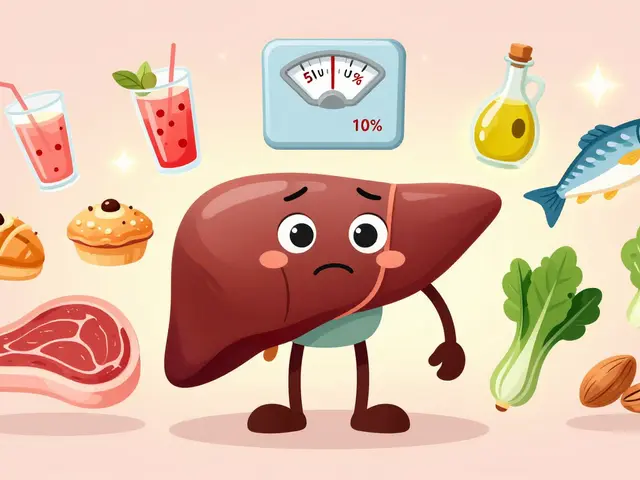
Weight loss helps too. Losing just 5-10% of your body weight can cut disease activity by 20-30%. For someone weighing 200 pounds, that’s 10-20 pounds. Not a miracle cure, but enough to make a real difference.
Support networks matter. The Arthritis Foundation’s Live Yes! Arthritis Network has over 100,000 members. Online communities like Reddit’s r/rheumatoidarthritis (with 28,500 active users) offer real talk: how to manage flares, what to say to your employer, how to explain RA to your kids. One survey found 78% of users experience morning stiffness lasting over 60 minutes. You’re not alone.
Apps like MyRA help track symptoms, meds, and appointments. Downloaded over 250,000 times, it’s rated 4.2 out of 5. Simple tools like these can help you stay on top of a complex disease.

What’s Next for RA Treatment?
The future is getting more targeted. In January 2024, the FDA expanded approval for upadacitinib (Rinvoq), a JAK inhibitor, for early RA. JAK inhibitors work inside cells, blocking signals that cause inflammation. They’re pills, not injections-convenient for people who hate needles.
Researchers are also hunting for biomarkers. A 2023 study in Nature Medicine used genetic markers to predict methotrexate response with 85% accuracy. Imagine knowing before you start a drug whether it’ll work for you. That’s the goal.
New drugs are in phase 3 trials: TYK2 inhibitors like deucravacitinib, and next-gen B-cell blockers. These could offer better results with fewer side effects. Market entry is expected between 2025 and 2027.
By 2030, experts believe early diagnosis and treat-to-target strategies could reduce RA-related disability by 40%. That’s not just hope-it’s a roadmap. But it only works if we fix access gaps. If rural patients can’t see a rheumatologist, if cost blocks treatment, progress stalls.
Final Thoughts: It’s Manageable, But You Need to Act
Rheumatoid arthritis isn’t a death sentence. But it won’t fix itself. The window to prevent joint damage is narrow-3 to 6 months after symptoms start. Delay diagnosis, and you risk irreversible harm.
If you’ve had joint pain for more than six weeks, especially with morning stiffness, see a doctor. Get blood tests. Get imaging. Don’t wait for it to get worse. Biologics aren’t perfect, but they’ve changed the game. For many, they mean working again, playing with grandkids, living without constant pain.
Cost is a hurdle. Side effects are real. But the alternative-untreated RA-is worse. Talk to your doctor about your options. Use support tools. Join a community. Track your symptoms. You’re not just a patient. You’re someone who can take control.
What’s the difference between rheumatoid arthritis and osteoarthritis?
Osteoarthritis is caused by wear and tear on joints over time. It’s mechanical. Rheumatoid arthritis is autoimmune-your immune system attacks your joints. RA causes symmetrical joint pain, morning stiffness lasting over 30 minutes, and can affect organs like the lungs and heart. Osteoarthritis usually affects one joint at a time and doesn’t cause systemic symptoms.
Can biologics cure rheumatoid arthritis?
No, biologics can’t cure RA. But they can put it into remission-meaning little to no symptoms, no joint damage progression, and normal function. Many people live for years in remission with the right treatment plan. Stopping biologics often leads to flare-ups, so most people stay on them long-term.
How long does it take for biologics to work?
Most people start noticing improvement in 4 to 8 weeks. Full effect can take 3 to 6 months. That’s why doctors don’t switch treatments too quickly. Patience is key. If you don’t see improvement after 6 months, your doctor may switch to another biologic or try a JAK inhibitor.
Are there natural alternatives to biologics for RA?
Diet, fish oil, turmeric, and acupuncture may help ease symptoms slightly, but none replace biologics or DMARDs. RA is a serious autoimmune disease. Relying only on natural remedies risks irreversible joint damage. Always use complementary therapies alongside, not instead of, medical treatment.
Can I still work with rheumatoid arthritis?
Yes, many people with RA continue working full-time. The key is early treatment and workplace adjustments-ergonomic chairs, flexible hours, remote options. A 2023 CDC study found that people who started biologics within 6 months of diagnosis were 50% more likely to stay employed than those who waited.
What should I do if I miss a dose of my biologic?
If you miss a dose, take it as soon as you remember-if it’s within a day or two. Don’t double up. If it’s been longer, skip the missed dose and resume your regular schedule. Contact your doctor if you miss multiple doses. Skipping doses increases flare risk and can make the drug less effective over time.
RA is complex, but it’s not a life sentence. With the right care, you can live well. Start early. Stay informed. Speak up about costs and side effects. You’re not just managing a disease-you’re reclaiming your life.





Angie Thompson
25 January, 2026 . 12:35 PM
I started biologics last year and honestly? My hands don't feel like they're wrapped in concrete anymore. 🙌 I can hold my coffee without wincing. Also, my cat finally stopped judging me when I cry in the shower. She knows now it's not just 'being dramatic'.
James Nicoll
26 January, 2026 . 22:03 PM
So we're paying $60k a year to make your immune system forget how to do its job? Cool. Next they'll sell us a subscription to not sneeze. At least back in the day, we just suffered quietly and called it 'character'.
John Wippler
28 January, 2026 . 00:16 AM
I’ve been living with RA for 14 years. Methotrexate gave me nausea and a half-life of a guppy. Then came adalimumab. I didn’t just get better-I got my life back. I started hiking again. I taught my niece how to ride a bike. That’s not medicine. That’s magic. And yeah, it’s expensive. But what’s the cost of never seeing your grandkids run again?
Faisal Mohamed
28 January, 2026 . 06:42 AM
The immunomodulatory cascade induced by TNF-alpha inhibition represents a paradigm shift in the cytokine-targeted therapeutic landscape. However, the pharmacoeconomic burden remains suboptimal given the current reimbursement structures in the U.S. healthcare ecosystem. Biosimilars are merely transitional artifacts until we achieve true precision immunophenotyping. 🤖💊
SWAPNIL SIDAM
29 January, 2026 . 12:28 PM
My mother had RA. She cried every morning because she couldn’t hold my baby brother. Now I see my sister on biologics and she’s laughing again. God bless science. And God bless the people who made this possible. I’m not religious, but today I pray for more access.
Geoff Miskinis
31 January, 2026 . 04:37 AM
Let’s be real-this article reads like a pharma whitepaper dressed up as a public service. You mention biosimilars but don’t address how the original manufacturers lobby to block them. And you gloss over the fact that 30% of patients still don’t respond. This isn’t progress. It’s rebranding. 🤡
Sally Dalton
31 January, 2026 . 16:52 PM
i just wanna say thank you for writing this. i’ve been too scared to tell my boss i have ra but now i feel less alone. also i think i forgot to take my shot yesterday but i’m gonna do it today promise 🙏 i’m not perfect but i’m trying
eric fert
31 January, 2026 . 17:41 PM
Look, I get it. You want to feel like a hero for taking your expensive injections. But let’s not pretend this is some noble battle against a villainous disease. It’s a chronic condition with a high price tag and a bunch of side effects that no one talks about until you’re lying on the floor with a fever and a red injection site. And don’t get me started on the ‘you’re not trying hard enough’ comments from people who think yoga cures everything. You think I haven’t tried turmeric? I’ve eaten it like cereal. It didn’t stop the erosion in my wrists. So stop with the toxic positivity. This isn’t a motivational poster. It’s my life.
Shawn Raja
1 February, 2026 . 03:46 AM
I used to think RA was just old people stuff. Then I met a 28-year-old who couldn’t open a jar. Now I get it. Biologics aren’t perfect, but they’re the closest thing we’ve got to a time machine for your joints. And yeah, the cost sucks-but so does watching your best friend cry because she can’t hug her dog anymore. We need better access, not better guilt.
Ryan W
2 February, 2026 . 05:05 AM
This whole thing is a scam. Why do we pay for drugs that are made in the U.S. and sold for 10x what they cost to produce? Canada gets it for $5k. Europe for $8k. We’re being robbed. And don’t give me that ‘it’s R&D’ nonsense. The science was public. The patents were bought. This is capitalism, not healthcare.
Dan Nichols
3 February, 2026 . 06:02 AM
I’ve been on three biologics and none worked. The docs just keep swapping them like trading cards. Meanwhile my joints are turning to dust. And now they want me to take a JAK inhibitor? I’m supposed to risk lymphoma because my insurance won’t cover the next one? This isn’t medicine. It’s Russian roulette with a prescription pad.