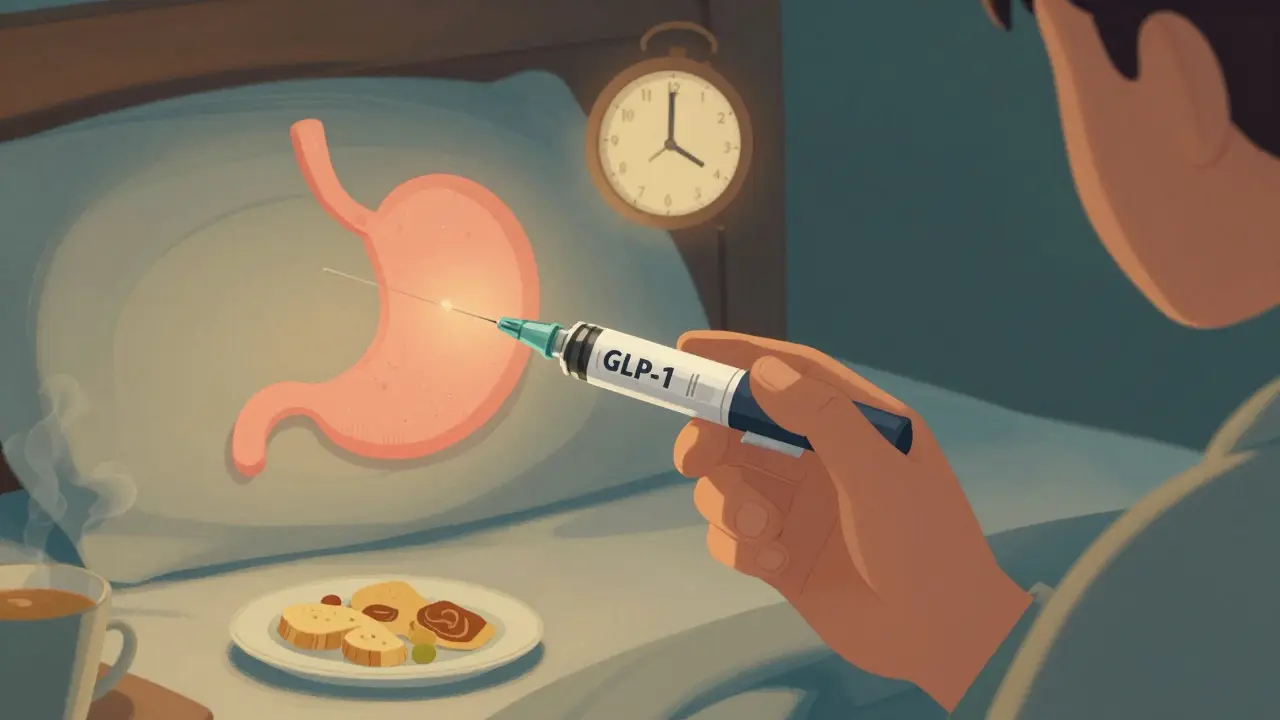
When you start a GLP-1 medication like Wegovy, Ozempic, or Mounjaro for weight loss, the goal is clear: lose weight, feel better, and improve your health. But for many, the first real challenge isn’t the scale-it’s the nausea. It hits hard, often right after the first dose. You might feel queasy, lose your appetite, or even vomit. It’s not rare. In fact, up to 45% of people on higher doses report nausea, according to FDA data. The good news? It usually gets better. And with the right approach, most people don’t have to quit.
Why GLP-1 Medications Cause Nausea
GLP-1 drugs work by slowing down how fast your stomach empties. That’s not a bug-it’s the feature. Slower digestion means you feel full longer, eat less, and your blood sugar stays steadier. But that same effect can make your stomach feel like it’s holding onto food too long. That’s what triggers nausea. It’s not your imagination. It’s biology.Think of it like this: your body isn’t used to being told to hold off on digesting food. When you start a GLP-1, your stomach doesn’t know how to react. That’s why nausea is worst in the first few weeks. By the time you hit your maintenance dose-whether that’s 2.4 mg of semaglutide or 15 mg of tirzepatide-your system has usually adjusted. Studies show 72% of users say nausea improves after 2-4 weeks at each new dose level.
Dosing Schedules: Why Slow and Steady Wins
You won’t jump straight to the highest dose. That’s by design. Each GLP-1 has a carefully planned titration schedule to give your body time to adapt.Here’s how it breaks down:
- Wegovy (semaglutide for weight loss): Starts at 0.25 mg weekly. Increases every 4 weeks: 0.5 mg → 1 mg → 1.7 mg → finally 2.4 mg. That’s 17 weeks to reach the full dose.
- Ozempic (semaglutide for diabetes): Starts at 0.25 mg, then 0.5 mg, then 1 mg. Max dose is 2 mg-lower than Wegovy because diabetes doesn’t require the same weight loss push.
- Mounjaro (tirzepatide): Begins at 2.5 mg weekly. Increases every 4 weeks: 5 mg → 7.5 mg → 10 mg → 12.5 mg → 15 mg. Takes about 20 weeks to max out.
- Victoza (liraglutide): Daily injection. Starts at 0.6 mg, then bumps to 1.2 mg or 1.8 mg after a week or two.
The slower the ramp-up, the better your chances of keeping nausea under control. Rushing the dose? That’s a recipe for quitting. Most people who drop out do so because they pushed too fast. Stick to the schedule-even if you feel fine. Your stomach needs the time.
How to Reduce Nausea: 5 Proven Tactics
If nausea hits, don’t panic. You don’t have to suffer through it. Here’s what actually works, based on patient reports and doctor recommendations:- Take it at bedtime. About 63% of users who switched from morning to night injections say nausea dropped noticeably. Sleeping through the worst of it helps your body adjust without the stress of daily activity.
- Eat smaller, more frequent meals. Instead of three big meals, try five small ones. Large meals overwhelm your slowed stomach. A handful of nuts, a boiled egg, or yogurt between meals keeps things moving without triggering nausea.
- Avoid high-fat and fried foods. Fat slows digestion even more. When your stomach is already sluggish, greasy food becomes a disaster. Stick to lean proteins, vegetables, and whole grains.
- Stay hydrated-but sip slowly. Chugging water can make nausea worse. Sip room-temperature water or herbal tea throughout the day. Ginger tea or ginger candies are recommended by 78% of obesity specialists for their natural anti-nausea effect.
- Don’t skip meals just because you’re not hungry. Fasting on GLP-1s can backfire. Your body needs fuel to adjust. Even if you feel full, eat something light. Your metabolism isn’t broken-it’s just recalibrating.
One user on Reddit put it simply: “I didn’t lose weight until I stopped trying to eat like I was still on a normal diet. Once I switched to small, bland meals, the nausea vanished.”

When to Pause or Lower Your Dose
Not all nausea is normal. Mild nausea that fades after a few days? That’s expected. Constant vomiting, dizziness, or pain? That’s a red flag.Here’s when to call your doctor:
- You can’t keep down fluids for more than 24 hours.
- You’re losing weight too fast-more than 1-2 kg per week after the first month.
- Nausea gets worse instead of better after two weeks at the same dose.
- You feel faint, have rapid heartbeat, or severe abdominal pain.
Some doctors recommend holding your dose for a week if nausea is severe, then restarting at the previous level. Others say push through mild symptoms. There’s no one-size-fits-all rule. But if you’re miserable, you’re not helping yourself. Adjusting isn’t failure-it’s smart management.
What Happens If You Stop?
Many people quit because of nausea. And that’s understandable. But here’s the hard truth: if you stop, you’ll likely regain the weight. Studies show patients who stick with GLP-1 therapy for at least 6 months lose an average of 10-15% of their body weight. Those who quit before 3 months? Most regain 80% of it within a year.But here’s the hopeful part: 89% of people who pushed through the first 8 weeks of nausea went on to lose at least 5% of their body weight. That’s the threshold where health benefits-like lower blood pressure, improved insulin sensitivity, and reduced joint pain-start kicking in.

What’s New in 2025
The GLP-1 landscape is changing fast. In late 2023, the FDA approved Zepbound (tirzepatide) specifically for weight loss, making it the second drug after Wegovy to get that label. That’s good news-more options mean more chances to find one that fits.And by 2025, Novo Nordisk plans to launch an oral version of semaglutide. Early data suggests it may cause fewer gastrointestinal side effects than injections. That could be a game-changer for people who can’t tolerate the needle or the nausea.
Supply issues are still a problem. Wegovy and Ozempic were on the FDA’s drug shortage list for over a year through October 2023. If you’re having trouble getting your prescription, talk to your doctor about alternatives like liraglutide or compounded versions-but be cautious. The FDA warns that unregulated compounding can be unsafe.
Who’s Using GLP-1s-and Why
As of 2023, about 68% of GLP-1 prescriptions go to women, mostly between 35 and 64. Employers are catching on too: 32% of Fortune 500 companies now cover these drugs for weight management, up from just 9% in 2021. Why? Because the health savings are real. The 2023 SELECT trial showed semaglutide reduced heart attacks, strokes, and heart-related deaths by 20% in non-diabetic people with obesity.That’s why doctors aren’t just prescribing these for weight loss anymore. They’re prescribing them for longevity.
Final Thoughts: It’s a Marathon, Not a Sprint
GLP-1 medications aren’t magic pills. They’re tools. And like any tool, they work best when you use them right. Nausea is a temporary hurdle, not a dealbreaker. The dose schedule exists to protect you. The dietary tips exist to help you feel better. The patience? That’s the secret ingredient.If you’re on one of these drugs and struggling, you’re not alone. But you’re also closer to results than you think. Most people don’t see major weight loss until after week 12. The nausea fades. The appetite changes. The clothes fit differently. And suddenly, the discomfort feels worth it.
Don’t quit because it’s hard. Quit only when your doctor says it’s time. And if you’re unsure? Talk to someone. Whether it’s your provider, a support group, or a fellow user on Reddit-there are people who’ve been where you are. And they made it through.
How long does nausea last on GLP-1 medications?
For most people, nausea peaks in the first 2-4 weeks at each new dose and gradually improves. By the time you reach your maintenance dose-usually after 16-20 weeks-about 70-80% of users report nausea has significantly decreased or disappeared. It’s not gone for everyone, but it’s manageable for most with the right adjustments.
Can I take GLP-1 medications without food?
Yes, GLP-1s can be taken with or without food. But if you’re prone to nausea, taking them with a small, bland meal-like plain toast or yogurt-can help. Avoid skipping meals entirely, even if you’re not hungry. Your body needs consistent fuel during the adjustment phase.
Is it safe to increase my dose faster than recommended?
No. The dosing schedule is designed to minimize side effects and protect your health. Speeding up increases your risk of severe nausea, vomiting, dehydration, and even hospitalization. Always follow your doctor’s titration plan-even if you feel fine. Your stomach needs time to adapt.
Do all GLP-1 medications cause the same level of nausea?
No. Tirzepatide (Mounjaro/Zepbound) tends to cause slightly higher rates of nausea than semaglutide (Wegovy/Ozempic), especially at higher doses. Liraglutide (Victoza) generally causes the least nausea but requires daily injections and offers less weight loss. The trade-off is often between side effects and results-your doctor can help you weigh the options.
What should I do if nausea doesn’t improve after 6 weeks?
If nausea is still severe after 6 weeks at your current dose, contact your doctor. You may need to pause the dose increase, temporarily reduce your dose, or switch medications. Persistent nausea could signal an intolerance or an underlying issue like gastroparesis. Don’t ignore it-there are alternatives, and your comfort matters.



Michelle M
16 December, 2025 . 12:15 PM
It’s funny how the body resists change even when it’s for the better. I was terrified of nausea when I started, but I stuck to the bedtime injection and small meals-no fancy tricks, just consistency. By week 6, I could eat a whole meal without feeling like I’d swallowed a brick. The weight didn’t drop overnight, but the nausea did. And honestly? That was the real win.
Lisa Davies
18 December, 2025 . 02:11 AM
OMG YES. Ginger candy. 🍬 I kept a pack in my purse and chewed one every time I felt that wave. It’s not magic, but it’s the closest thing. Also, sleep through it. I switched to night dosing and my life changed. No more panic attacks before lunch. 🙌
Cassie Henriques
18 December, 2025 . 15:49 PM
From a clinical perspective, the GI motility modulation is well-documented, but the real-world adherence data is what’s compelling. The 72% improvement metric at each titration step aligns with pharmacokinetic half-life adaptation curves. Still, the behavioral component-meal frequency, fat avoidance-is underemphasized in guidelines. Patient-reported outcomes trump RCTs here.
Jake Sinatra
19 December, 2025 . 18:39 PM
This is exactly why we need better patient education. People think these drugs are like caffeine-take it and go. No. This is a physiological recalibration. You wouldn’t sprint a marathon on day one. Why treat your metabolism like a machine you can overclock?
John Brown
20 December, 2025 . 19:36 PM
Just wanted to say I’m 14 weeks in and still nauseous. But I’m not giving up. I’ve lost 18 lbs. My knees don’t crack when I stand up. I sleep better. The nausea? It’s a low hum now, not a scream. You’re not broken-you’re adapting. Keep going.
Nupur Vimal
21 December, 2025 . 21:57 PM
why do people make this so hard just take the shot and eat less its not that complicated
Benjamin Glover
23 December, 2025 . 03:06 AM
It’s amusing how Americans treat a pharmacological intervention as if it were a lifestyle trend. In Europe, we’ve had these drugs for over a decade. The side effects are known. The discipline required is not optional. If you can’t manage nausea, perhaps you’re not ready for the responsibility of weight loss.
RONALD Randolph
23 December, 2025 . 15:22 PM
Let’s be clear: if you can’t handle a simple injection and a few bland meals, you’re not sick-you’re weak. This isn’t a wellness app. This is medicine. Stop whining. Take the dose. Eat the chicken. Drink the water. No excuses.
Mike Nordby
23 December, 2025 . 18:06 PM
Interesting that the article mentions the 89% success rate after 8 weeks, but doesn’t address dropout rates among those who discontinue before week 4. The real statistic isn’t how many succeed-it’s how many quit because they were never properly counseled on the timeline. This isn’t a drug problem-it’s a communication problem.
John Samuel
24 December, 2025 . 03:43 AM
The symphony of the human gut-once a chaotic orchestra of hunger and haste-is now conducting a slow, deliberate waltz under the baton of semaglutide. The nausea? A dissonant note in the first movement. By the third, harmony emerges. And oh, the crescendo of confidence when your jeans finally zip without a struggle… that’s the finale no pill can compose.
Christina Bischof
25 December, 2025 . 02:07 AM
Just wanted to say thank you for writing this. I’ve been silent for weeks because I was embarrassed to admit I was struggling. But reading this made me feel less alone. I’m on week 9. Still eating tiny meals. Still sipping ginger tea. Still here. That’s progress.
Raj Kumar
26 December, 2025 . 23:31 PM
bro i was scared too but i did the bedtime thing and ate like 3 eggs and rice every day no fried food and now i feel like a new person. also i lost 22 lbs. no cap. you got this.
Melissa Taylor
27 December, 2025 . 03:55 AM
I’m 11 weeks in and still nauseous, but I’m not quitting. I’ve lost 15 lbs. My blood pressure dropped. I sleep better. The nausea is just… background noise now. I didn’t expect to feel this good. I just kept going.
Jocelyn Lachapelle
28 December, 2025 . 05:43 AM
My mom started this last year. She’s 62. She went from 210 to 168. She says the nausea lasted 6 weeks. She still takes it every Sunday. She says it’s the best thing she’s ever done for herself. You’re not alone.
Sai Nguyen
30 December, 2025 . 00:54 AM
India has been using these for years. Americans act like it’s a new miracle. We had access to liraglutide before your FDA approved it. Your healthcare system is broken. Stop making excuses. Just take the shot.