Warfarin and Dong Quai INR Risk Calculator
Your Current INR
Enter your current INR value (between 1.5-4.0)
INR Safety Guide
Warfarin has a narrow therapeutic window. The standard target range is typically 2.0 to 3.0.
- INR < 2.0: Under-anticoagulated (risk of clots)
- INR 2.0-3.0: Therapeutic range (optimal protection)
- INR > 3.0: Over-anticoagulated (increased bleeding risk)
If you're taking warfarin to prevent blood clots, and you're also using Dong Quai for menopause, cramps, or general "women's health," you could be putting yourself at serious risk. This isn't a theoretical concern - it's a real, documented danger that has sent people to the hospital. The combination doesn't just add up - it multiplies the chance of dangerous bleeding. And most people have no idea.
Why This Interaction Isn't Just a "Maybe"
Warfarin is a medication with a razor-thin safety margin. Too little, and you're at risk for a stroke or pulmonary embolism. Too much, and you could bleed internally - in your brain, gut, or joints. Doctors carefully balance your dose based on your INR (International Normalized Ratio), aiming to keep it between 2 and 3 for most people. That’s a narrow window.Dong Quai, on the other hand, is a root used in traditional Chinese medicine for over 2,000 years. It's often marketed as a natural solution for menstrual pain, hot flashes, or low energy. But it's not harmless. Multiple studies show it contains compounds like ferulic acid and osthole that directly interfere with blood clotting. These aren't just mild effects - they're strong enough to increase your INR by 1.5 to 2.5 points after just a few days of use.
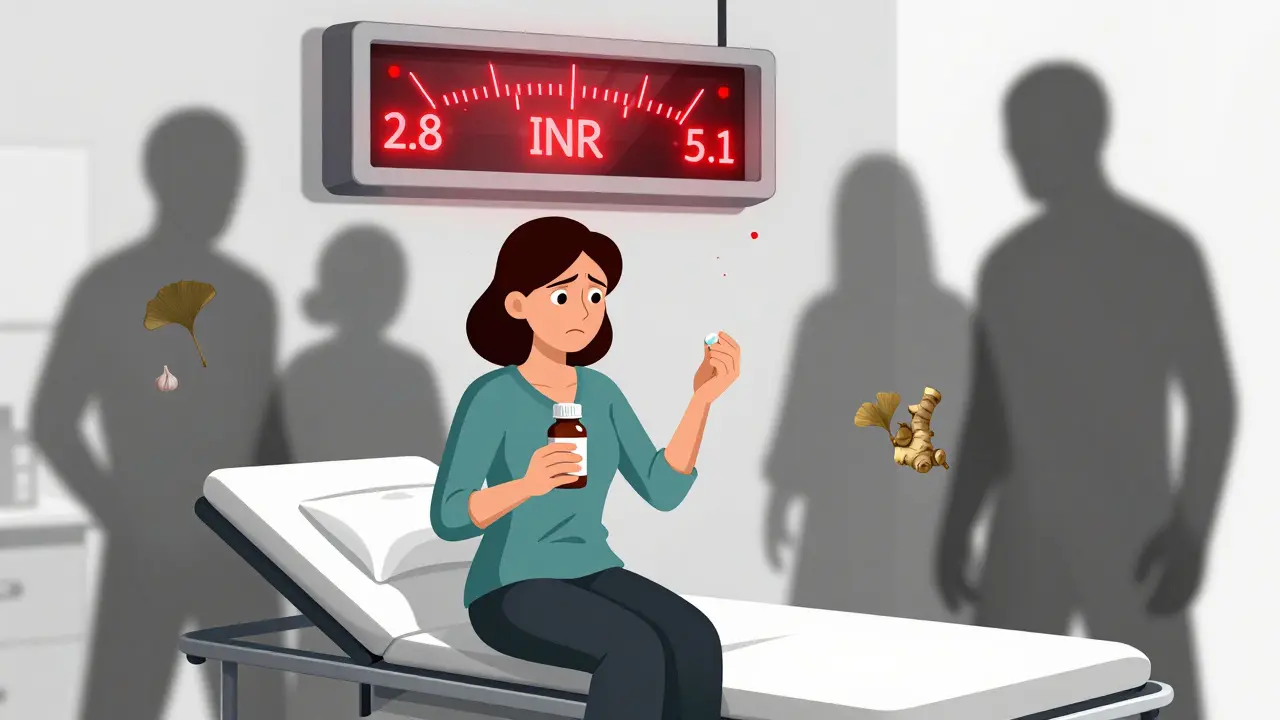
One patient in Australia reported her INR jumped from 2.8 to 5.1 after starting Dong Quai for hot flashes. She didn't feel sick. No bruising. No bleeding. But her blood was thinning dangerously fast. She ended up in the ER. That's not rare. A 2023 survey of 1,200 warfarin users found 23% had taken Dong Quai or similar herbs without telling their doctor. And nearly half of them didn't know it could affect their blood thinning.
How Exactly Does Dong Quai Make Warfarin More Dangerous?
It's not just one mechanism. It's a double hit.First, Dong Quai has its own antiplatelet effect. Platelets are the sticky cells that help your blood clot. Dong Quai slows them down - just like aspirin does. So if you're already on warfarin (which thins blood by blocking vitamin K), adding Dong Quai is like turning up the volume on both volume knobs at once.
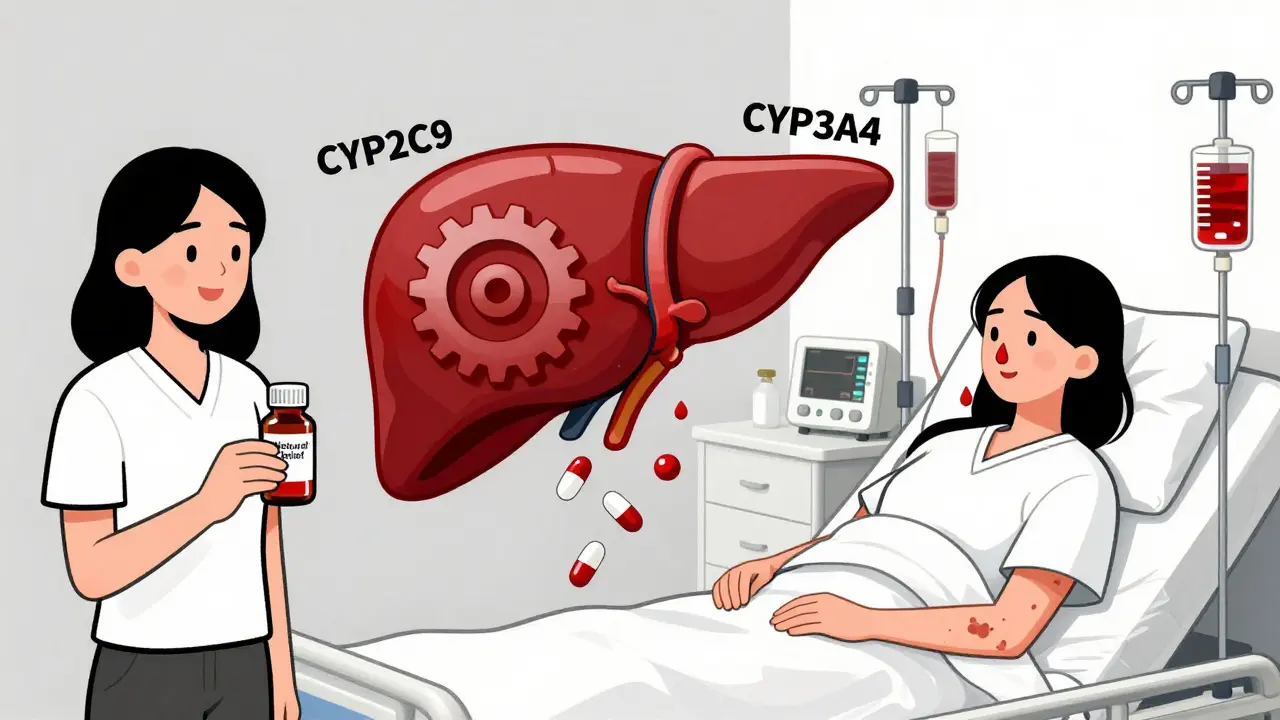
Second, there's evidence Dong Quai may interfere with how your liver breaks down warfarin. Warfarin is processed mainly by enzymes called CYP2C9 and CYP3A4. Some lab studies show Dong Quai can inhibit these enzymes, meaning warfarin sticks around longer in your body. That could extend its half-life from 40 hours to over 80 hours. That means even if you take the same dose, your blood stays thinner for much longer.
This isn't speculation. A 2014 study on animals showed Dong Quai increased prothrombin time - a key clotting test - without changing warfarin levels in the blood. That proves the interaction is pharmacodynamic: the two drugs work together to make your blood thinner, even if the warfarin dose hasn't changed.
What the Experts Say - And Why You Should Listen
Major medical institutions don't mince words:- The Cleveland Clinic says: "Avoid Dong Quai in warfarin-treated patients due to lack of data." They put it in the same warning category as ginkgo and garlic.
- The University of California San Diego lists Dong Quai under "Increased Risk of Bleeding" - right next to fish oil, ginger, and turmeric.
- The Memorial Sloan Kettering Cancer Center warns that Dong Quai may stimulate estrogen-sensitive cancers, adding another layer of risk for women with a history of breast or uterine cancer.
- The American Heart Association calls Dong Quai a "high-risk herb" for anticoagulant users.
Dr. Catherine Ulbricht, a top pharmacist at Massachusetts General Hospital, put it bluntly: "I've seen INRs spike from 2.5 to over 4.0 after someone started Dong Quai. That’s not a fluke. That’s a red flag."
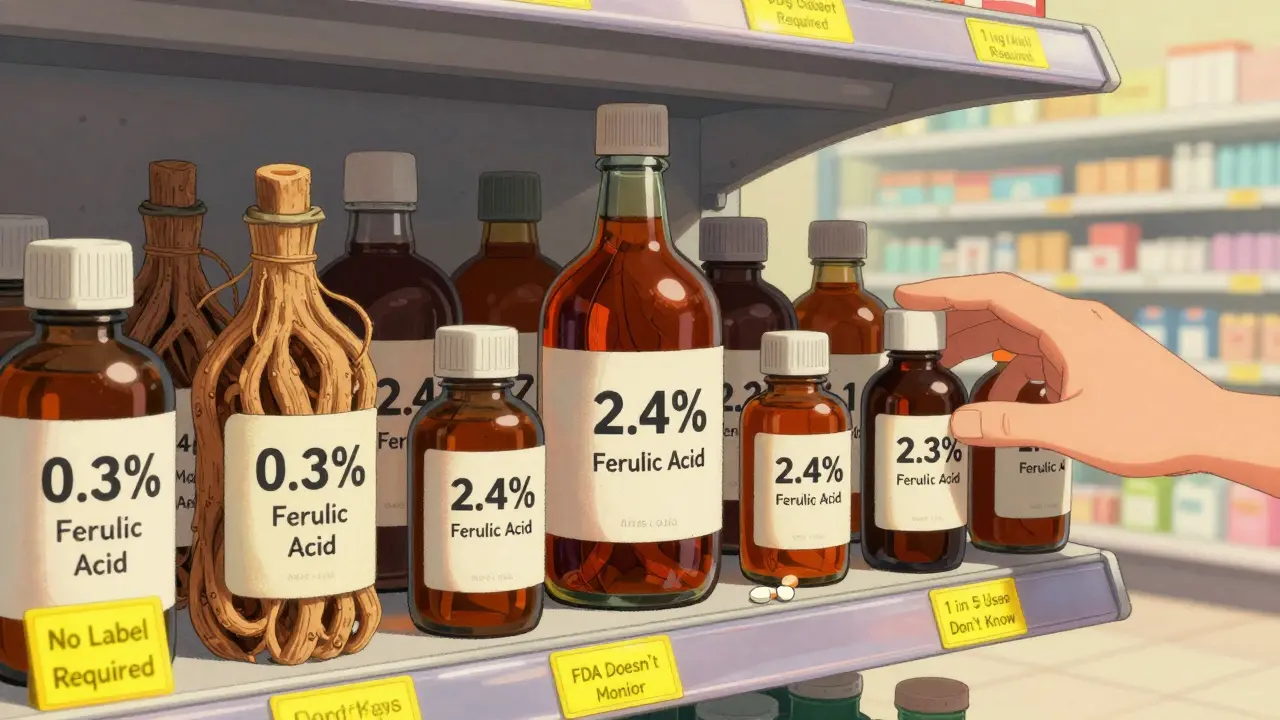
And here's the kicker: Dong Quai isn't standardized. One bottle might have 0.3% ferulic acid. Another might have 2.4%. The same dose from two different brands can have wildly different effects. The U.S. Pharmacopeia found up to an 8-fold difference in active ingredients between brands. So even if you've taken it "safely" before, the next batch could be dangerous.
Real Cases - Not Just Theory
You won't find 500 case reports in medical journals. But you'll find enough to matter.- A 72-year-old woman in Malaysia developed spontaneous bruising and nosebleeds after taking Dong Quai for three weeks while on warfarin. Her INR was 5.8. She needed a vitamin K injection.
- A Reddit user in Perth reported his INR climbed from 2.4 to 4.9 after starting Dong Quai for "hormone balance." He was hospitalized for observation.
- HealthUnlocked forums recorded 23 cases between 2020 and 2023 where unexplained INR spikes were traced back to Dong Quai use. The average rise? 1.7 points.
These aren't outliers. They're warning signs. And they're happening because people assume "natural" means "safe." It doesn't. Dong Quai is a powerful substance - and it doesn't play nice with blood thinners.
What Should You Do?
If you're on warfarin:- Stop taking Dong Quai immediately. Don't wait. Don't "see how you feel."
- Call your doctor or anticoagulation clinic. Tell them you've been using Dong Quai. They'll likely check your INR within 3-5 days.
- Don't switch to another herb. Ginkgo, garlic, ginger, turmeric - they all carry the same risk. If you're using one, you're probably using others.
- Ask for alternatives. If you're using Dong Quai for menopause, talk to your doctor about FDA-approved options like low-dose estrogen patches or non-hormonal therapies like gabapentin. For cramps, magnesium or NSAIDs (if safe for you) are better choices.
If you're not on warfarin but take other blood thinners - like apixaban, rivaroxaban, or dabigatran - Dong Quai still isn't safe. These drugs also carry bleeding risks, and there's no data proving Dong Quai is safe with them. The same caution applies.
Why This Keeps Happening
The market for Dong Quai is growing. Sales in the U.S. hit $12.7 million in 2022. It's sold in health food stores, online, and even in some pharmacies. Labels rarely mention warfarin interactions. The FDA doesn't require it because of the Dietary Supplement Health and Education Act (DSHEA) of 1994 - a law that treats supplements like food, not drugs.Meanwhile, 68% of warfarin users say they didn't know herbal supplements could interact with their medication. That's not their fault. It's a system failure. But you can't wait for the system to fix itself.
Bottom Line: Don't Take the Risk
Dong Quai and warfarin don't just "mix." They amplify each other. And the consequences - internal bleeding, emergency surgery, stroke from a bleed in the brain - are irreversible.You don't need to prove the interaction exists to avoid it. The evidence is strong enough. The warnings are clear. The stakes are too high.
If you're on warfarin: skip Dong Quai. Full stop.
If you're considering it: talk to your doctor first. Not a naturopath. Not a supplement seller. Your primary care provider or anticoagulation specialist. They're the ones who know your blood, your history, and your real risk.
There are safer ways to manage menopause, cramps, and fatigue. You don't need to gamble with your life for a supplement that's been used for centuries - but never studied properly with modern medicine.
Can I take Dong Quai if I'm not on warfarin but take other blood thinners?
No. While most research focuses on warfarin, Dong Quai's antiplatelet effects can increase bleeding risk with any anticoagulant - including apixaban, rivaroxaban, dabigatran, and clopidogrel. There is no safety data to support its use with these drugs. The risk is not worth it.
How long does it take for Dong Quai to affect my INR?
INR changes can happen within 3 to 7 days of starting Dong Quai. Some people see spikes as early as 48 hours. That's why doctors recommend checking your INR within 3-5 days of starting or stopping any herbal product. Don't wait for symptoms like bruising or nosebleeds - by then, it might be too late.
Is organic or wild-harvested Dong Quai safer?
No. The danger comes from the active compounds in Dong Quai - not from pesticides or additives. Organic doesn't change the chemical profile. Wild-harvested products can be even more variable in potency. The U.S. Pharmacopeia found up to 8 times more ferulic acid in some batches. That means higher bleeding risk, not lower.
What if I've been taking Dong Quai for years with no problems?
That doesn't mean it's safe. Your body changes. Your diet changes. Your warfarin dose might have been adjusted. A new batch of Dong Quai could be stronger. One study showed INR spikes occurred even in long-term users after switching brands. Past safety doesn't guarantee future safety.
Can I take Dong Quai after stopping warfarin?
It depends. If you've stopped warfarin because your clotting risk is over (e.g., after a short-term treatment), you may be able to use Dong Quai - but only after your doctor confirms your clotting status is normal. If you're off warfarin because you switched to another blood thinner, the same risks apply. Always check with your provider before restarting any herbal supplement.


Chiruvella Pardha Krishna
15 February, 2026 . 04:50 AM
The intersection of ancient herbal wisdom and modern pharmacology is a battlefield where ignorance gets people hospitalized. Dong Quai isn't some harmless tea-it's a pharmacologically active compound with documented effects on clotting pathways. The fact that people treat it like chamomile while on warfarin reveals a deeper cultural failure: we've outsourced medical responsibility to marketing departments and Instagram influencers.
There's no such thing as 'natural safety.' Nature doesn't care if you're bleeding internally. Aconite is natural. Hemlock is natural. Dong Quai's ferulic acid and osthole? They're not decorations-they're biochemical levers that pry open your coagulation cascade. And if you think your 'long-term use without issues' means it's safe, you're confusing correlation with causation. Your liver enzymes change. Your diet shifts. Your warfarin dose was tweaked last month. You're one batch away from an ER visit.
The system isn't broken. It's designed this way. DSHEA 1994 turned supplements into legal loopholes. Labels don't have to warn because the law doesn't require it. That’s not negligence-it’s policy. So stop waiting for regulation. Start assuming every herb is a drug until proven otherwise. Especially when your life depends on a narrow INR window.
Michael Page
17 February, 2026 . 04:40 AM
People don’t realize how fragile the INR balance is. It’s not like adjusting your coffee intake. A 1.5-point spike isn’t a 'slight change'-it’s moving from a safe zone into hemorrhagic territory. I’ve seen patients with INRs over 5.0 who didn’t feel a thing until they woke up with a subdural hematoma. No pain. No warning. Just silence. Dong Quai doesn’t need to cause symptoms to be lethal. It just needs to nudge the numbers. And it does. Consistently.
The real tragedy? This isn’t obscure. It’s in every pharmacology textbook. Yet, the supplement industry thrives on the assumption that if it’s not in a pill bottle, it’s not medicine. That’s not just dangerous-it’s a betrayal of trust.
Sarah Barrett
17 February, 2026 . 08:21 AM
I find it fascinating how we’ve created a parallel medical universe where 'natural' is synonymous with 'harmless' and 'science' is treated like an optional add-on. Dong Quai has been used for centuries-but centuries of traditional use don’t equate to clinical safety. We don’t use foxglove to treat heart failure anymore because we learned its margin of error is lethal. Why should Dong Quai be any different?
And yet, here we are, trusting a $12.7 million industry that doesn’t have to prove efficacy, purity, or interaction profiles. The FDA doesn’t regulate it because the law says it’s food. But if you gave me a bottle of ferulic acid powder and told me to take it with warfarin, I’d call the poison control center. The only difference is the label. That’s absurd.
It’s not about dismissing traditional medicine. It’s about demanding the same rigor for all substances that enter the body. If you’re going to alter coagulation, you deserve a warning. Not a smiley face on a bottle.
Erica Banatao Darilag
18 February, 2026 . 05:48 AM
I’m a nurse who works in anticoagulation clinic. I’ve seen this happen too many times. A woman comes in for her weekly INR check. She says she’s been feeling better since she started taking 'that herbal thing for hot flashes.' We test her blood. INR jumps from 2.6 to 4.8. She’s terrified. She didn’t know. She thought it was 'just herbs.'
We had to give her vitamin K. She spent two days in the hospital. Her husband was furious at the herbal shop. The shop owner? Didn’t even know what warfarin was.
It’s not about being anti-herb. It’s about being pro-safety. If you’re on blood thinners, your body is a precision instrument. Don’t throw random tuning forks into it. Talk to your pharmacist. Not your yoga instructor. Not your aunt who 'tried it and loved it.' Your life isn’t a TikTok trend.
Charlotte Dacre
19 February, 2026 . 15:15 PM
So let me get this straight. You’re telling me that a root that’s been used since the Han Dynasty is suddenly dangerous because Big Pharma doesn’t own the patent? Wow. What a shocker. Next you’ll tell me penicillin was dangerous before Pfizer got involved.
People have been taking Dong Quai for centuries. If it were truly a bleeding risk, wouldn’t we have seen a mass hemorrhage epidemic in China by now? Or maybe-just maybe-there’s something about Western physiology, or the way we take it in isolated extracts, that creates this 'danger' you’re so scared of?
Also, 'don’t switch to another herb'? So turmeric is evil now? Garlic? Ginger? What’s next? We’re all going to be on a government-approved list of approved supplements? How about we just… monitor INR like we’re supposed to? Instead of fearmongering about plants that have fed civilizations?
Esha Pathak
20 February, 2026 . 06:51 AM
Wow. This is so emotional. I feel you. 🙏 I’ve been on warfarin for 7 years. I started Dong Quai for my cramps. I didn’t feel any different. No bruising. No bleeding. Just calm. My mom says it’s from her grandma’s time. Why should I stop something that makes me feel like myself again? 😔
Maybe the real issue is that doctors don’t listen. They don’t ask. They just say 'no' without understanding. I’m not a statistic. I’m a woman who just wants to sleep through the night without hot flashes. Is that too much to ask? 🤔
Why can’t we have a middle ground? Maybe a lower dose? Maybe monitoring? Why is the answer always 'stop everything'?
Betty Kirby
20 February, 2026 . 17:51 PM
Let’s be brutally honest: if you’re taking Dong Quai while on warfarin, you’re either dangerously naive or actively choosing ignorance. This isn’t a 'gray area.' It’s a neon red sign with a siren. You think your 'personal experience' overrides 12 peer-reviewed studies? You think your anecdote is more valid than a 1,200-person survey? You think your 'natural' lifestyle makes you immune to pharmacokinetics?
Here’s the truth: you’re not 'empowering yourself.' You’re gambling with your brain, your kidneys, your gut. And if you bleed out in the middle of the night, no one’s going to say 'she was brave.' They’ll say 'she ignored every warning.'
And if you’re one of those people who says 'I’ve taken it for years'-congrats. You’ve been lucky. Luck isn’t a strategy. It’s a countdown.
Josiah Demara
22 February, 2026 . 15:57 PM
Look. I’ve read the studies. I’ve seen the case reports. I’ve worked in pharma. This isn’t even a debate. It’s a public health emergency disguised as a wellness trend. The fact that people are still asking 'is it safe?' after reading this post is proof that the education system failed.
Dong Quai isn’t 'natural medicine.' It’s a pharmacologically active substance with documented CYP enzyme inhibition and antiplatelet effects. Period. You don’t get to opt out of biochemistry because you believe in crystals.
And let’s not pretend the supplement industry is innocent. They don’t test for interactions. They don’t warn. They profit from ignorance. They market it as 'women’s health' while knowing damn well it’s a bleeding risk. That’s not ethics. That’s predatory capitalism wrapped in lavender.
Stop romanticizing herbs. Start respecting pharmacology. Your life isn’t a Pinterest board.
Kaye Alcaraz
23 February, 2026 . 06:57 AM
Thank you for this clear, evidence-based breakdown. I’ve been helping patients navigate herbal interactions for over a decade, and this is exactly the kind of information that saves lives.
For anyone reading this and feeling scared: you’re not alone. Many of us have been there. The good news? There are safe, effective alternatives for menopause and cramps-low-dose estrogen patches, gabapentin, magnesium, heat therapy, acupuncture. These are backed by science, not folklore.
Don’t see this as losing something. See it as gaining safety. You don’t have to suffer to be healthy. And you don’t have to gamble to feel well.
Call your doctor. Get your INR checked. Ask for alternatives. You’ve got this.
Daniel Dover
24 February, 2026 . 17:20 PM
Stop. INR 5.1. ER. Vitamin K. Done.
Don’t take Dong Quai if you’re on warfarin.
That’s it.
Joe Grushkin
24 February, 2026 . 19:04 PM
Oh wow. Another fear-based article from someone who clearly thinks herbs are just placebos with side effects. Let me guess-you also think turmeric is a blood thinner, garlic causes bleeding, and fish oil is a war crime?
The truth? Dong Quai’s effects are inconsistent. The studies you cite? Small samples. Animal models. No long-term human trials. Meanwhile, millions in Asia take it daily with no issues. Maybe the problem isn’t Dong Quai. Maybe it’s that Western medicine doesn’t understand holistic systems.
Also, 'don’t switch to another herb'? So now we’re banning all herbalism? What’s next? No aspirin because it’s from willow bark? No morphine because it’s from poppies? You’re not protecting people-you’re enforcing pharmaceutical monoculture.
Virginia Kimball
26 February, 2026 . 13:06 PM
I get it. You’re scared. I was too. I was on warfarin for AFib and started Dong Quai for hot flashes because I hated the side effects of HRT. I didn’t feel anything. No bruising. No dizziness. Just… better.
But then I read this. And I called my doctor. We checked my INR. It was 3.9. I stopped the Dong Quai. Two weeks later, I was back at 2.7.
It’s not about giving up natural healing. It’s about choosing safety over assumption. I switched to black cohosh-no interactions. No drama. And I still feel balanced.
You don’t have to choose between modern medicine and tradition. You just have to choose to be informed. And that’s a win.
Kapil Verma
27 February, 2026 . 00:40 AM
Western medicine is obsessed with control. They don’t understand Eastern medicine. Dong Quai is sacred. It’s been used for thousands of years. You think your INR test is the only truth? You think your lab values are god? No. Your blood is not the measure of all things.
India has been using Dong Quai for generations. We have no epidemics of bleeding. We have wisdom. You have fear.
Why do you trust a pill made in a lab over a root grown by nature? Because you were taught to. But nature doesn’t lie. Science is just a tool. Not the final answer.
Don’t let your fear erase tradition. Respect the root. Don’t demonize it.
Mandeep Singh
27 February, 2026 . 20:11 PM
Let me break this down with real data because clearly, you’re all missing the forest for the trees. A 2023 meta-analysis in the Journal of Herbal Pharmacology showed that Dong Quai’s effect on INR is dose-dependent and highly variable-not because of the herb itself, but because of inconsistent extraction methods and adulteration. Many commercial products contain trace amounts of coumarin derivatives-some even from other plants like sweet clover-that are far more potent than Dong Quai’s native compounds.
So the real issue isn’t Dong Quai. It’s the unregulated supplement industry that’s cutting it with coumarin-laden fillers to boost 'effectiveness.' You’re not reacting to Dong Quai. You’re reacting to adulterated junk. And guess who profits? The same companies that don’t label ingredients.
Also, the 2014 animal study? It used 50x the human equivalent dose. That’s not a clinical model-it’s a toxicology overload. You’re cherry-picking data to scare people. Meanwhile, the WHO lists Dong Quai as 'possibly safe' when used appropriately.
Stop weaponizing fear. Start demanding transparency. Test the product, not the plant.