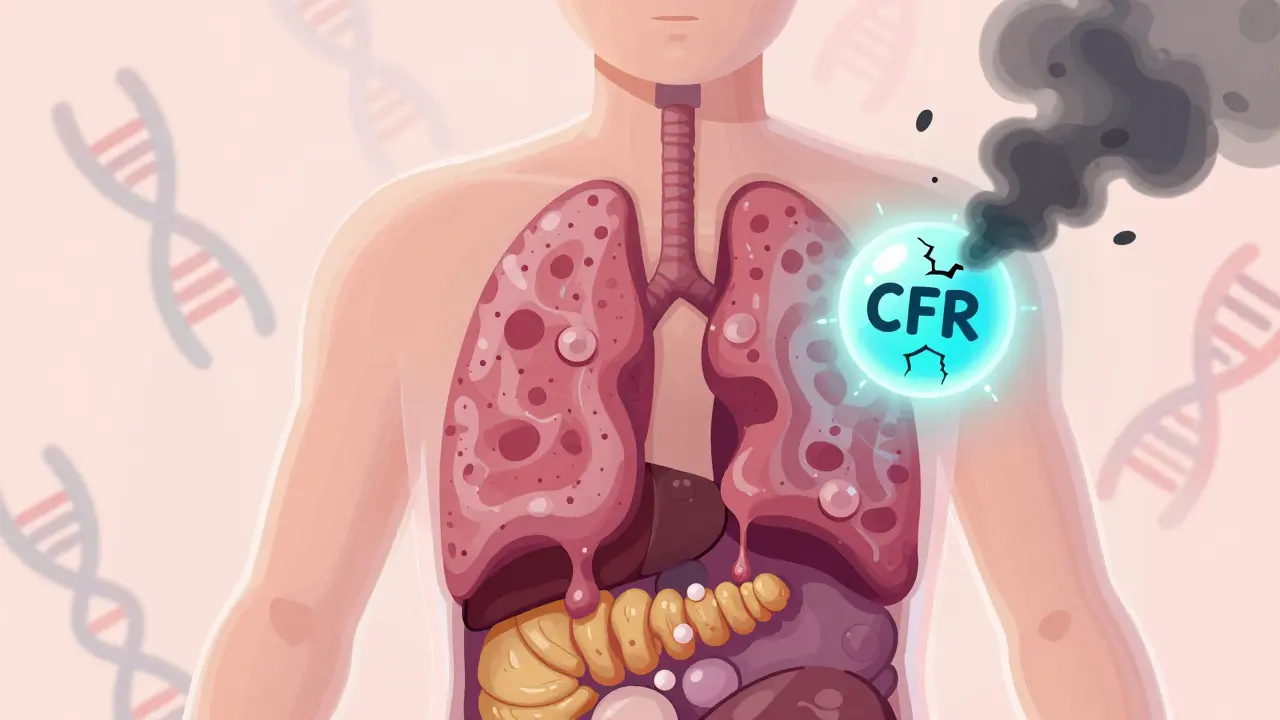
Cystic fibrosis isn't just a lung disease. It’s a whole-body condition born from a single faulty gene, turning mucus from a slippery protector into a sticky trap that chokes lungs, blocks digestion, and changes lives. For decades, it was a death sentence for children. Today, thanks to groundbreaking science, many people with cystic fibrosis are living into their 50s and beyond. But the journey isn’t over-access, cost, and unanswered mutations still leave gaps in care.
What Exactly Is Cystic Fibrosis?
Cystic fibrosis (CF) is caused by mutations in the CFTR gene, a blueprint for a protein that controls salt and water flow across cell membranes. When this protein breaks down, your body produces thick, sticky mucus instead of the thin, slippery kind. That mucus builds up in the lungs, pancreas, liver, and reproductive organs. In the lungs, it clogs airways and invites constant infections. In the pancreas, it blocks enzymes needed to digest food. In the liver, it can scar tissue. And in men, it often means being born without the tube that carries sperm.
It’s inherited. Both parents must carry a faulty copy of the gene for a child to have CF. Carriers-people with just one bad copy-don’t show symptoms. But they can pass it on. About 1 in 25 people of Northern European descent are carriers. The most common mutation, F508del, affects roughly 70% of people with CF worldwide. But there are over 2,000 known mutations, and not all respond the same way to treatment.
How Is It Diagnosed?
Newborn screening for CF is now standard in the U.S., Australia, and many other countries. A tiny blood sample checks for elevated levels of immunoreactive trypsinogen (IRT), a sign of pancreatic stress. If that’s high, a sweat test follows. This is the gold standard: sweat is collected and analyzed for chloride. Levels above 60 mmol/L confirm CF. In older patients, genetic testing and lung function tests round out the picture.
Before newborn screening, many kids weren’t diagnosed until they were sick enough to be hospitalized-often with failure to thrive, chronic cough, or salty-tasting skin. Parents used to lick their babies’ skin to check for salt. It sounds crude, but it was a real diagnostic clue.
Life Before Modulators: The Daily Grind
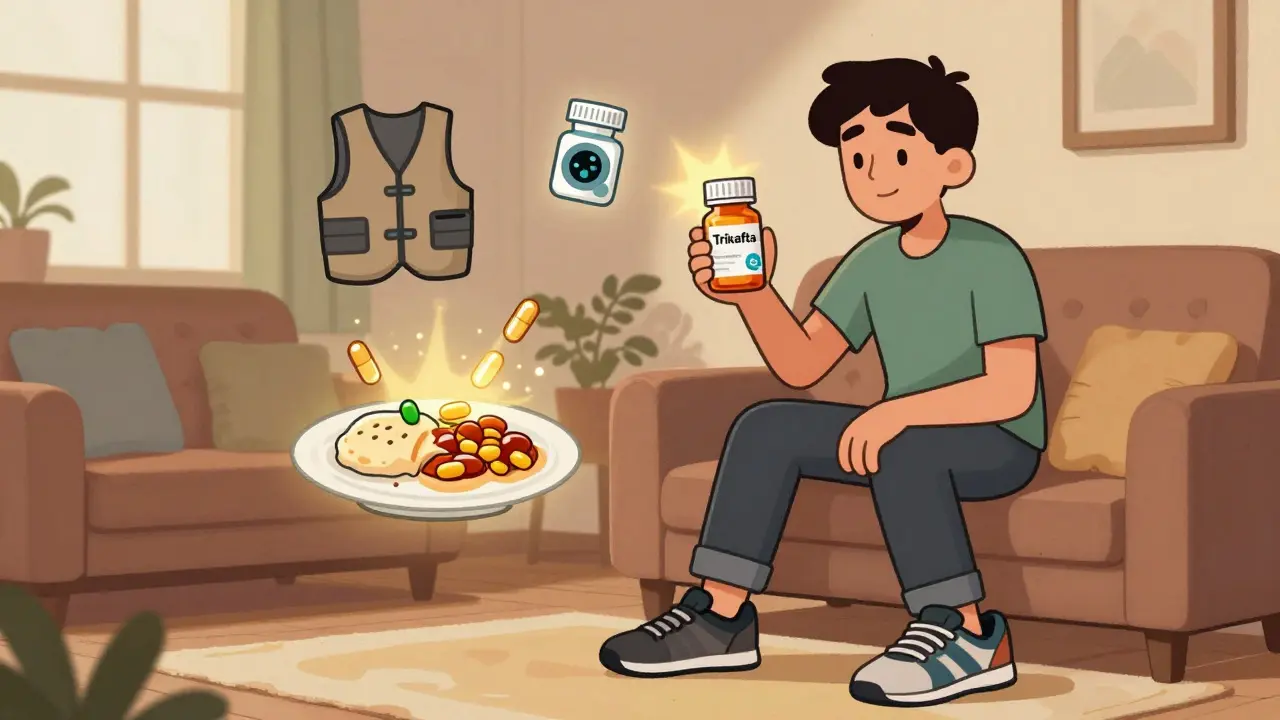
Before 2012, managing CF meant hours of daily work. Adults spent 2 to 3 hours a day on treatments. That included:
- Airway clearance-using vests, hand percussion, or breathing devices to shake loose mucus
- 4 to 6 different inhaled medications-antibiotics, bronchodilators, mucus thinners
- 6 to 12 pancreatic enzyme capsules with every meal and snack
- Nutritional supplements to fight weight loss
- Regular hospital visits for IV antibiotics during flare-ups
Compliance was hard. Studies show only 65-75% of patients stuck to their full regimen. Miss a dose? Mucus builds up. Infections return. Lung function drops. The average life expectancy in 1960 was just 14 years. By 2000, it had climbed to 31. But real change was coming.
The Revolution: CFTR Modulators
In 2012, everything shifted. Ivacaftor (Kalydeco) became the first drug to fix the root cause-not just treat symptoms. It worked for people with the G551D mutation, a rare one affecting about 4% of CF patients. Clinical trials showed a 10.6% jump in lung function (FEV1). That’s huge in CF terms.
Then came the triple combo: elexacaftor/tezacaftor/ivacaftor (Trikafta), approved in 2019. It targets the most common mutation, F508del, and works for about 90% of people with CF. In trials, it boosted lung function by 13.8% and cut pulmonary exacerbations by 63%. People reported breathing easier, needing fewer hospital visits, and gaining weight without extra calories.
One 28-year-old from Ohio shared on a CF forum: “I used to spend 90 minutes a day on chest physio. After Trikafta, it dropped to 20. I started running again. I didn’t think I’d ever do that.”
The Dark Side of Progress
But these drugs aren’t perfect. About 10% of people with CF have mutations that don’t respond to any current modulator. For them, the old daily grind remains. And even for those who benefit, side effects happen. Liver enzyme spikes occur in 3.2% of users, sometimes forcing them to stop treatment. Some report headaches, rashes, or changes in vision.
Then there’s the cost. In the U.S., Trikafta costs about $300,000 per year. Even with insurance, out-of-pocket costs average $1,200 a month. A 2022 survey by the Cystic Fibrosis Foundation found 42% of users felt financial strain. Globally, only 35% of people with CF have access to these drugs. In low-income countries, many still die young from infections or malnutrition.
Who Benefits Most?
Trikafta is now approved for children as young as 2. That’s huge. Early treatment means preserving lung function before damage sets in. In 1990, only 27% of people with CF were adults. Today, over half are adults. That’s because modulators aren’t just extending life-they’re changing it. People are going to college, getting jobs, having families. Some women with CF are now having children with the help of IVF.
But the benefits aren’t equal. In the U.S., 85% of eligible patients get modulators. In the EU, it’s 45%. In parts of Africa, Asia, and Latin America, it’s under 10%. The World Health Organization calls this a global inequity crisis. The drug was developed with public funding, but the company holds the patent. Who gets to live longer? That’s not just a medical question-it’s a moral one.

What’s Next?
Researchers aren’t stopping. The Cystic Fibrosis Foundation has invested over $750 million since 1989. Now, they’re targeting the 10% left behind. Clinical trials are underway for:
- mRNA therapies to fix nonsense mutations (like PTC Therapeutics’ Ataluren)
- CRISPR gene editing to correct the CFTR gene directly
- New inhaled antibiotics designed to kill stubborn Pseudomonas biofilms
One promising path is gene therapy-delivering a healthy copy of the CFTR gene into lung cells. Early trials show signs of success, but it’s not yet reliable enough for widespread use. Still, the momentum is real. The global CF drug market hit $6.2 billion in 2022, and it’s expected to grow to $9.1 billion by 2028.
Living Well With CF Today
Even with modulators, CF still requires care. Airway clearance, nutrition, and monitoring are still part of life. But the burden is lighter. Many people now see their CF specialist twice a year instead of monthly. Hospital stays are shorter. Antibiotics are used less.
Support systems matter too. The Cystic Fibrosis Foundation runs 260 accredited care centers in the U.S. alone. Online communities like CF Buddy Connect connect thousands of patients. Annual conferences bring together families, doctors, and scientists. Knowledge sharing saves lives.
For those without access to modulators, the focus remains on aggressive symptom management: high-calorie diets, enzyme replacement, regular antibiotics, and physical therapy. Every day counts.
The Bigger Picture
Cystic fibrosis is no longer just a pediatric disease. It’s a chronic condition for adults. And it’s become the poster child for precision medicine. We don’t just treat the disease anymore-we fix the broken protein inside the cell. That’s revolutionary.
But science alone isn’t enough. Progress means nothing if it’s only for the wealthy. The real test isn’t whether we can fix the gene. It’s whether we can make sure everyone who needs it gets the treatment.


Evan Smith
7 January, 2026 . 15:37 PM
So Trikafta basically turned CF from a death sentence into a manageable chronic thing? That’s wild. I knew it was expensive, but $300k a year? Someone’s getting rich off kids who can’t breathe. And don’t even get me started on how some countries still treat this like a footnote.
Molly Silvernale
8 January, 2026 . 12:09 PM
It’s not just about the gene-it’s about the gravity of access. The CFTR protein? A tiny molecular switch. But the world? A broken lever system. We fixed the lock-but left half the people outside with no key-and then charged them rent for the hallway they’re stuck in. And we call this progress? I’m not crying-I’m just… sighing. Loudly.
christy lianto
8 January, 2026 . 23:33 PM
My cousin has CF. She was on the grind-2 hours a day, no exceptions. Then Trikafta. She started hiking. She got a dog. She went to prom. I’ve never seen someone light up like that. But I also know girls in India who still lick their babies’ skin because there’s no test. This isn’t science. It’s a moral echo chamber. And we’re all in it.
Lois Li
10 January, 2026 . 23:27 PM
People forget that CF care isn’t just drugs-it’s community. The care centers, the forums, the parents sharing meal plans at 2am. I’ve seen families in rural Texas drive 3 hours for a checkup because that’s all they have. Trikafta is amazing-but it’s not magic. We still need nurses, social workers, and people who show up. Not just patents.
Annette Robinson
12 January, 2026 . 14:22 PM
I’m a respiratory therapist. I’ve watched kids with CF grow into adults thanks to these drugs. But I’ve also watched parents cry because their insurance denied coverage. The science is beautiful. The system? Not so much. We need to treat this like a public health emergency-not a profit margin.
Luke Crump
13 January, 2026 . 10:05 AM
Wait-so we’re celebrating a drug that makes rich people live longer while poor people still die from pneumonia? That’s not medicine. That’s eugenics with a price tag. They didn’t cure CF. They made it a luxury good. And now we’re supposed to clap? No. No. No.
Manish Kumar
14 January, 2026 . 07:58 AM
Let me tell you something from India-where we don’t have Trikafta, where a single enzyme capsule costs more than a week’s wages. We don’t have fancy gene therapies, but we have mothers who boil milk to make it easier to digest, who rub coconut oil on their children’s chests to loosen mucus, who walk 10 kilometers to a clinic that doesn’t even have a ventilator. We don’t need CRISPR-we need clean water, clean air, and dignity. The West thinks they’re saving lives with billion-dollar pills-but we’ve been saving lives with love and duct tape for centuries.
Aubrey Mallory
14 January, 2026 . 23:04 PM
Manish, your point is valid-but don’t romanticize suffering. We don’t have to choose between dignity and innovation. We can demand both. Trikafta should be a global public good. If public money built it, public access should be the rule-not the exception. Stop glorifying hardship. Fix the system.
Dave Old-Wolf
16 January, 2026 . 09:42 AM
My sister got diagnosed at 2. Now she’s 22 and runs marathons. Trikafta gave her back her lungs. But I still remember her crying because she couldn’t eat pizza with her friends without taking 12 pills first. That’s the real win-not just living longer, but living like you’re not a patient all the time.